The Night the Parthenon Blew Apart
On the evening of September 26, 1687, a Venetian mortar shell struck an Ottoman gunpowder store inside the Parthenon, shattering the 2,000-year-old temple.
For nearly two thousand years, the Parthenon had survived everything — wars, emperors, earthquakes, and conversion from temple to church to mosque. It took one September evening in 1687 to bring it down.
Athens was under siege. The Venetian Republic, led by the veteran commander Francesco Morosini, was trying to wrest Greece from the Ottoman Empire in what became known as the Morean War. The Ottoman garrison had retreated into the Acropolis, the ancient fortress hill, and made a fateful decision: they stored their gunpowder inside the Parthenon itself, evidently believing the Venetians would never fire on the most famous building in the Greek world.
They were wrong. On the evening of September 26, 1687, a Venetian mortar shell arced over the walls and struck the temple. The powder magazine ignited. The explosion tore the Parthenon apart — the roof collapsed, the great columns toppled, and the blast killed around 300 people sheltering inside. The day before, an Ottoman powder store in the Propylaea, the gateway to the Acropolis, had already blown up; now the crown jewel of classical architecture lay in ruins.
Morosini, who had destroyed the temple, then tried to loot it. He ordered sculptures removed from the pediment as trophies for Venice. The tackle failed; the statues crashed to the ground and shattered.
The temple had already lived many lives. Completed in the 430s BC as Athena's shrine, it became a Christian church in the sixth century AD and a mosque after the Ottoman conquest of Athens in 1458 — more than two centuries before Morosini's guns arrived. The Ottomans had treated it with respect; it was war, not neglect, that finally broke it. Venice held Athens for barely a year before abandoning it, leaving the shattered temple to two more centuries of weathering and looting.
The irony runs deep. The Parthenon had been built in the fifth century BC, under Pericles, as a temple to Athena — the glory of democratic Athens. It had stood intact longer than almost any building on earth. In a single night of early modern warfare, it became the ruin we know today — the beautiful, broken silhouette that defines Athens.
There is a lesson in the rubble, and it is not an old one. Armies still store weapons in historic places. Shells still fall on museums, temples, and old towns. The Parthenon reminds us that cultural heritage is never as safe as it looks — and that some losses, once the smoke clears, can never be rebuilt.
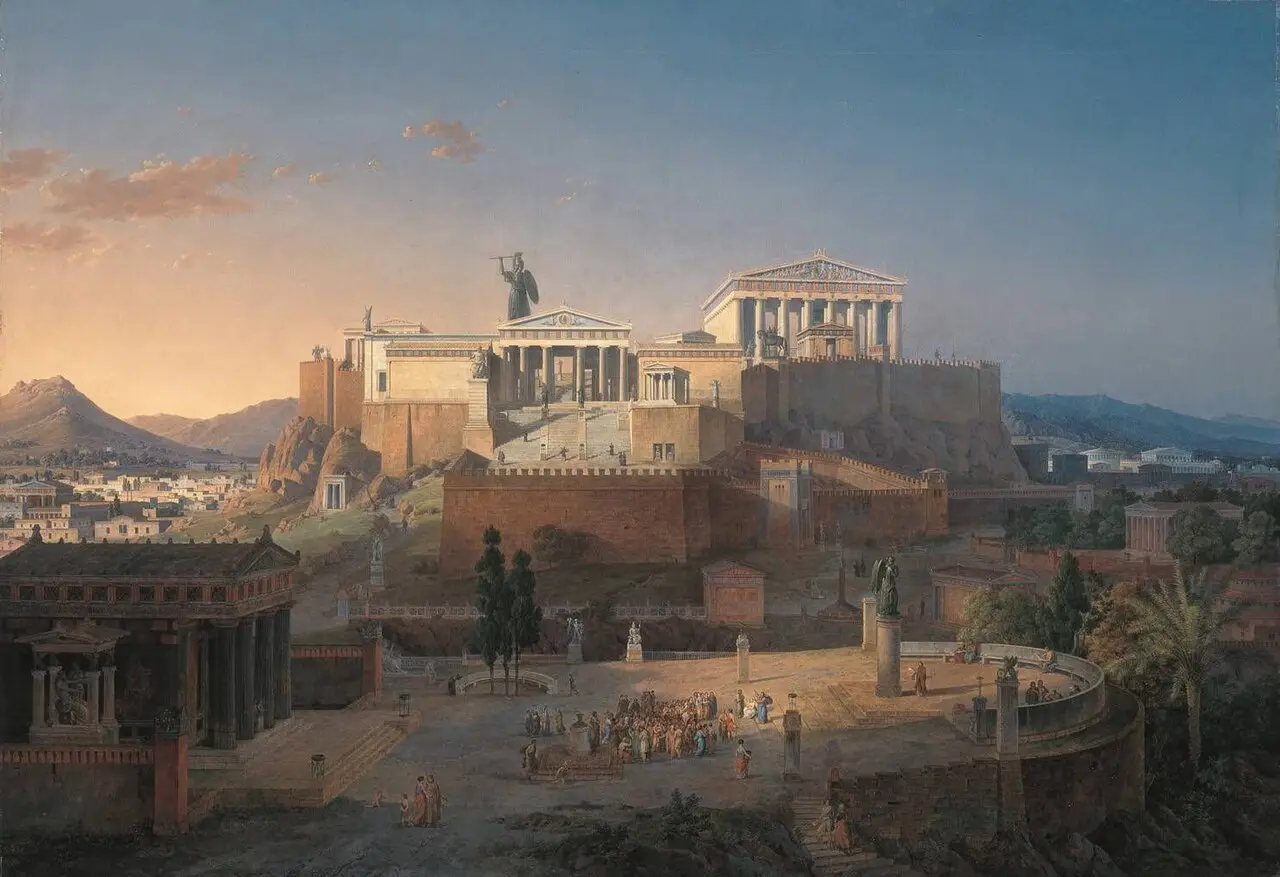
Reconstruction painting by Leo von Klenze, 1846, public domain, via Wikimedia Commons.