
The Woman Who Saw Climate Change Coming — in 1856
On August 23, 1856, the scientist Eunice Newton Foote presented the first evidence that carbon dioxide traps heat — decades before anyone else.
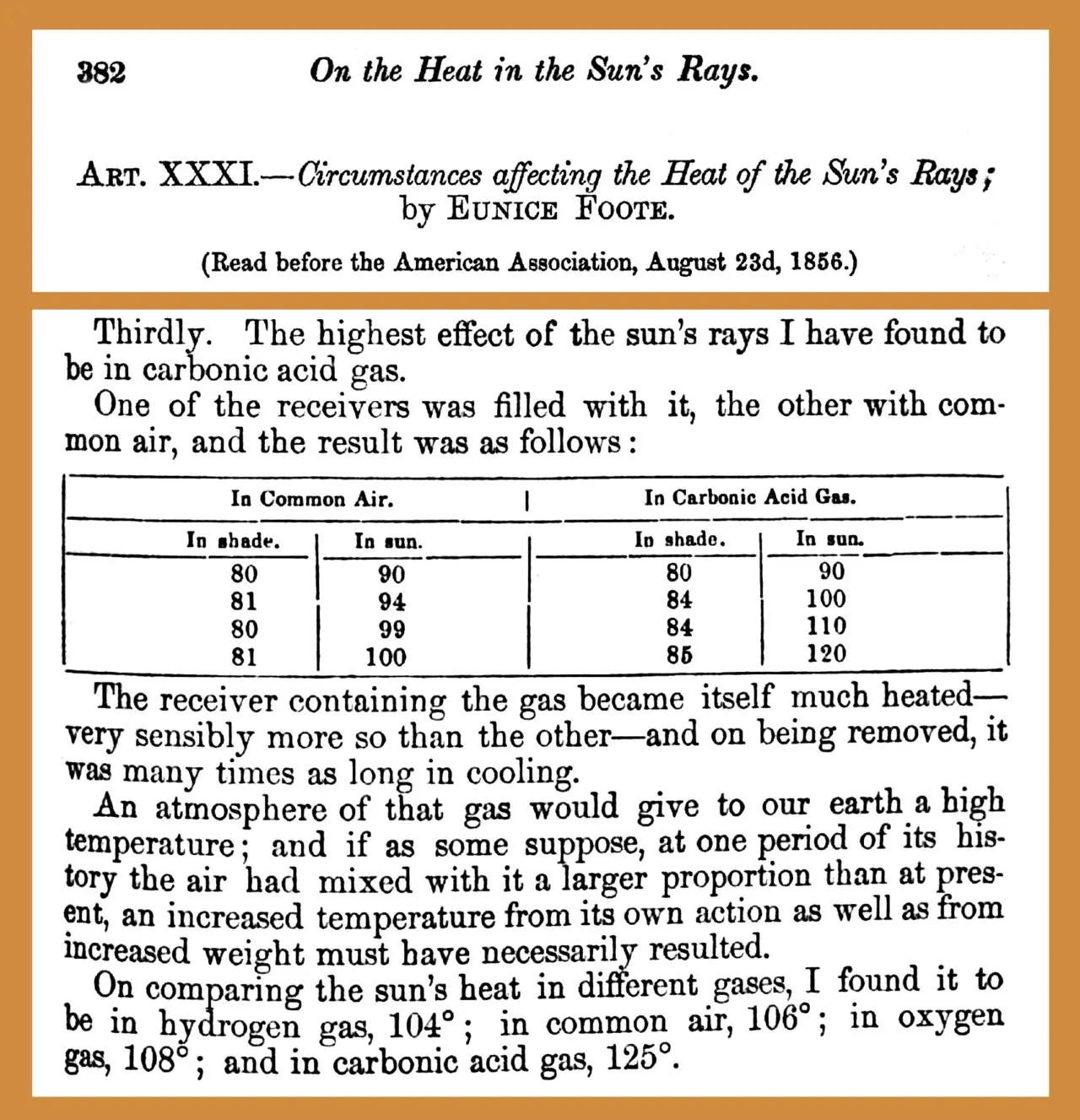
She had been doing her experiments in her own home, with an air pump and some glass cylinders. Eunice Newton Foote, a scientist, inventor, and women's rights campaigner from New York, filled the cylinders with different gases — ordinary air, hydrogen, oxygen, and carbon dioxide — set thermometers inside, and placed them in the sun. Then she watched. The cylinder of carbon dioxide grew noticeably hotter than the others, and once shaded, it stayed hot far longer. From that simple experiment, she drew an extraordinary conclusion: "An atmosphere of that gas would give to our earth a high temperature."
Foote was no stranger to standing up and being counted. Eight years earlier, she had attended the 1848 women's rights convention at Seneca Falls, New York, and signed its Declaration of Sentiments — her name appears just after that of her close friend and neighbor, Elizabeth Cady Stanton. Her husband Elisha, himself a scientist, was one of the few men who signed as well. The convention even appointed Foote and Stanton to prepare its proceedings for publication.
On August 23, 1856, Foote's paper, "Circumstances affecting the Heat of the Sun's Rays," was presented at the annual meeting of the American Association for the Advancement of Science in Albany, New York. But Foote did not present it herself. Women were not generally permitted to read their own papers at such meetings, so a colleague — Joseph Henry, secretary of the Smithsonian Institution — spoke on her behalf. Henry introduced it gracefully, saying that "science was of no country and of no sex," but he admitted afterward that he had difficulty interpreting the significance of her findings. Nobody in the audience seems to have grasped what she had done.
What Foote had done was to demonstrate, years before anyone else, that carbon dioxide traps heat — and to connect that fact to the climate of the entire planet. The credit instead went to John Tyndall, the renowned Irish physicist whose more sophisticated experiments came in 1859, three years later. Foote's work, published in the American Journal of Science that November, sank into obscurity for a century and a half.
Science was only one of her pursuits. Foote held patents of her own — including one for a thermostatically controlled cooking burner — and kept experimenting with atmospheric static electricity long after 1856. She was, in every sense, an inventor as well as a discoverer.
It was not until 2011 that a researcher stumbled across an old account of Henry's presentation and realized what Foote had accomplished. The paper that revived her argued plainly that Foote deserved credit for being the first to recognize that certain atmospheric gases absorb solar radiation and generate heat — three full years before Tyndall's research that is conventionally credited with the discovery. Today, she is rightly honored as one of the pioneers of climate science — a reminder that the woman in the audience at Albany was ahead of her time by more than a hundred years, and that the world very nearly missed her discovery.
Photo: scan of Eunice Newton Foote's 1856 paper, public domain (via Wikimedia Commons).