The Forgotten Photo That Showed Us Ourselves
On August 23, 1966, a NASA spacecraft orbiting the Moon turned its camera homeward and took the first photograph of Earth from another world.
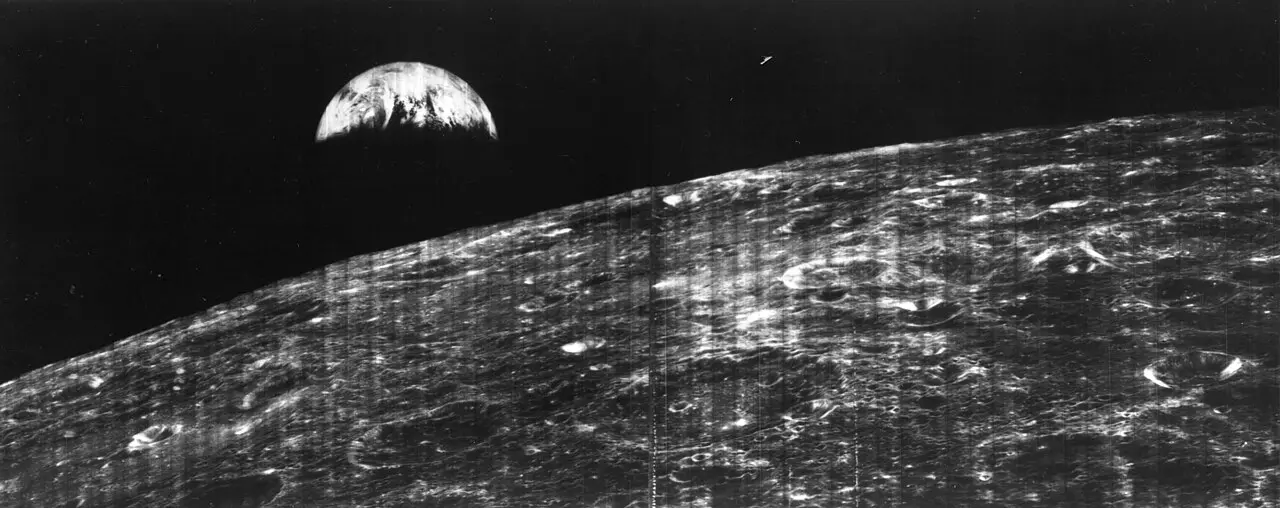
The spacecraft had no business taking the picture. Lunar Orbiter 1 — the first of five orbiters NASA would send to the Moon in the 1960s — launched from Cape Canaveral on August 10, 1966, and slipped into lunar orbit just four days later. It was a cartographer: its job was to photograph the Moon's surface and scout safe landing sites for the Surveyor probes and the Apollo missions to come. Earth was not on the assignment sheet.
But on August 23, during its sixteenth orbit, controllers sent the spacecraft a new set of commands. Across a quarter of a million miles of space, the little orbiter turned its camera — a dual-lens system designed by Eastman Kodak and adapted from Cold War spy-satellite technology — away from the Moon and toward home. At 16:35 GMT, it snapped the shutter: a grainy, black-and-white crescent Earth, hanging over the Moon's battered far side, some 239,000 miles away.
The image was developed onboard — film exposed, processed, and scanned line by line, then radioed to a ground station at Robledo de Chavela, near Madrid. What came back was the first photograph ever taken of Earth from the vicinity of another world. The Sun was setting along a line from England to Antarctica; above it, the east coast of the United States basked in afternoon light, while Africa and the Indian Ocean lay in evening darkness. As NASA's Floyd Thompson later wrote, the spacecraft had “responded to a series of commands sent to it from Earth, across a quarter-million miles of space” — and showed us home.
At the time, hardly anyone noticed. The picture was grainy and unglamorous, and two years later Apollo 8's full-color “Earthrise” would capture the world's imagination instead. But Lunar Orbiter 1 got there first — humanity's first look at its home planet as a globe in space, seen from somewhere else. NASA later called it “the image of the century” in its Langley history — not for its beauty, but for what it meant.
The mission went on to do the job it was sent for, photographing nine potential Apollo landing sites and doing the reconnaissance work that made the Moon landings possible. That October the spacecraft was deliberately crashed into the lunar surface. But that one unplanned photograph endures: the moment we first saw ourselves from the outside — a small crescent world, impossibly alone in the dark.
Photo: NASA, public domain (via Wikimedia Commons).