The Treaty That Made America a World Power
On December 10, 1898, the United States and Spain signed the Treaty of Paris, ending the Spanish-American War and turning America into an overseas empire.
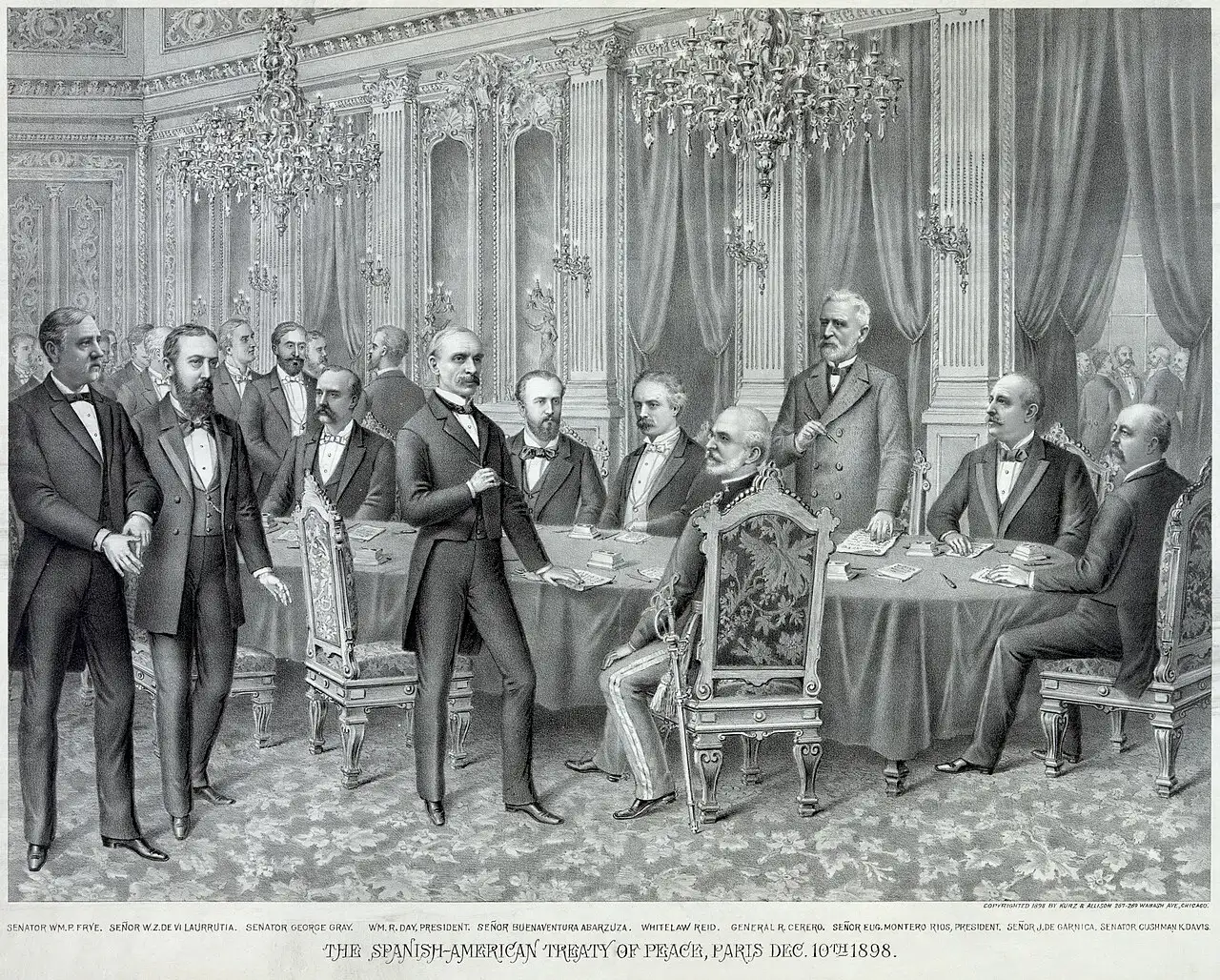
The fighting lasted barely four months. The peace took four more — and was signed in a Paris palace on a December afternoon.
The Spanish-American War began with an explosion. On February 15, 1898, the battleship USS Maine blew up in Havana harbor, and "Remember the Maine" became America's rallying cry. War was declared in April. On May 1, Commodore George Dewey destroyed the Spanish fleet at Manila Bay in the Philippines. American troops landed in Cuba in June, fought up San Juan Hill on July 1, and took Santiago two weeks later. Guam surrendered without a fight; Puerto Rico was invaded in late July. By August, Spain sued for peace, and an armistice was signed in Washington. Secretary of State John Hay called it a "splendid little war."
The real bargaining started on October 1, 1898, at the French Ministry of Foreign Affairs in Paris. The American commission was led by William R. Day, with Senators William P. Frye, George Gray, and Cushman K. Davis, plus the diplomat and journalist Whitelaw Reid. Spain's team was headed by Eugenio Montero Ríos. The sticking point was the Philippines: Spain refused to surrender the archipelago; the Americans insisted. They settled it with money — the United States would pay Spain $20 million.
On December 10, 1898, the treaty was signed. Spain recognized Cuba's independence and ceded Puerto Rico, Guam, and the Philippines to the United States, receiving $20 million for the Philippines. In a single document, a country with no overseas colonies became an empire stretching from the Caribbean to the western Pacific.
Ratification was a fight of its own. The U.S. Senate approved the treaty on February 6, 1899, by a single vote, after weeks of furious debate between imperialists and anti-imperialists over whether a republic founded on the consent of the governed could rule colonies. William Jennings Bryan made opposition to the treaty a centerpiece of the 1900 presidential campaign — and lost to William McKinley. The treaty took effect on April 11, 1899. In Spain, the defeat was a national trauma; writers of the "Generation of '98" spent years dissecting what the loss meant for Spanish identity. And in the Philippines, Emilio Aguinaldo's nationalists, who had been fighting Spain for independence, refused to trade one colonial master for another — the Philippine-American War followed.
It matters because December 10, 1898, was the day the United States stepped onto the world stage as a global power. Puerto Rico and Guam are still U.S. territories today, and the argument the treaty started — about what American power is for — has never really ended.
Photo: Kurz and Allison, public domain (via Wikimedia Commons).