The King Who Gave Up His Crown for Love
On December 10, 1936, King Edward VIII signed the Instrument of Abdication at Fort Belvedere, ending his 327-day reign so he could marry Wallis Simpson.
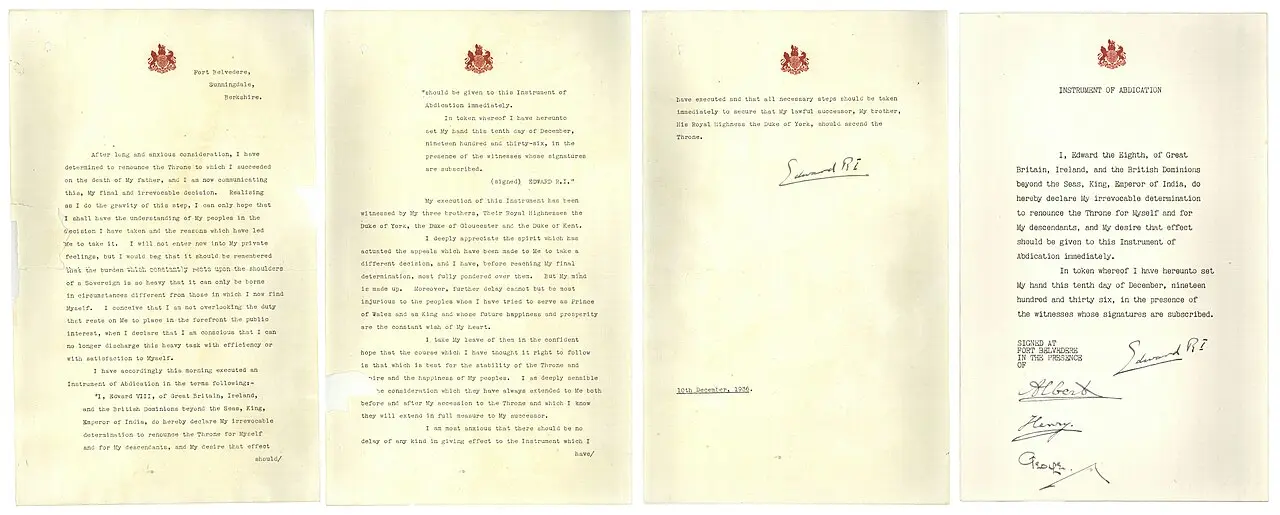
He had worn the crown for 327 days. On the evening of December 10, 1936, Edward VIII picked up a pen at his country house — and signed it away.
Edward had become king on January 20, 1936, after the death of his father, George V. The glamorous former Prince of Wales was popular, modern, and in love — with Wallis Simpson, an American socialite whose second divorce was not yet final. The match was impossible for a king: the Church of England, of which he was the head, did not recognize remarriage after divorce. Prime Minister Stanley Baldwin, Parliament, and the prime ministers of the Dominions all opposed it. Baldwin laid out three choices: give up the idea of marriage, marry against his ministers' advice — which would force the government's resignation and a constitutional crisis — or abdicate. Edward would not give up Simpson.
So on December 10, 1936, at Fort Belvedere, his home in Windsor Great Park, Edward signed the Instrument of Abdication. His three younger brothers stood as witnesses: Albert, Duke of York, the next in line for the throne; Henry, Duke of Gloucester; and George, Duke of Kent. The document, shown in the photograph above with all four signatures, declared his "irrevocable determination to renounce the Throne for Myself and for My descendants, and my desire that effect should be given to this Instrument of Abdication immediately."
The next day, Parliament passed His Majesty's Declaration of Abdication Act 1936 — the last law Edward would ever give royal assent to, his final act as king. That night, now simply Prince Edward, he explained himself to the nation and the Empire in a BBC radio broadcast: "I have found it impossible to carry the heavy burden of responsibility and to discharge my duties as king as I would wish to do without the help and support of the woman I love."
On December 12, he left Britain for Austria. His brother Albert was proclaimed King George VI, and the new king's elder daughter — ten-year-old Princess Elizabeth — became heir presumptive. Edward married Wallis in France in June 1937; they would be known as the Duke and Duchess of Windsor.
It matters because the "Year of Three Kings" ended with a timeless constitutional lesson: in Britain, no monarch rules against the will of Parliament and the people. And history holds a quiet irony — the uncle who surrendered the throne cleared the path for Elizabeth II, whose reign would last seventy years.
Photo: Archives New Zealand, CC BY-SA 2.0 (via Wikimedia Commons).