The Traitor's Torch: Benedict Arnold Burns Richmond
On January 5, 1781, turncoat general Benedict Arnold marched into Virginia's capital at the head of a British army and put Richmond to the torch.
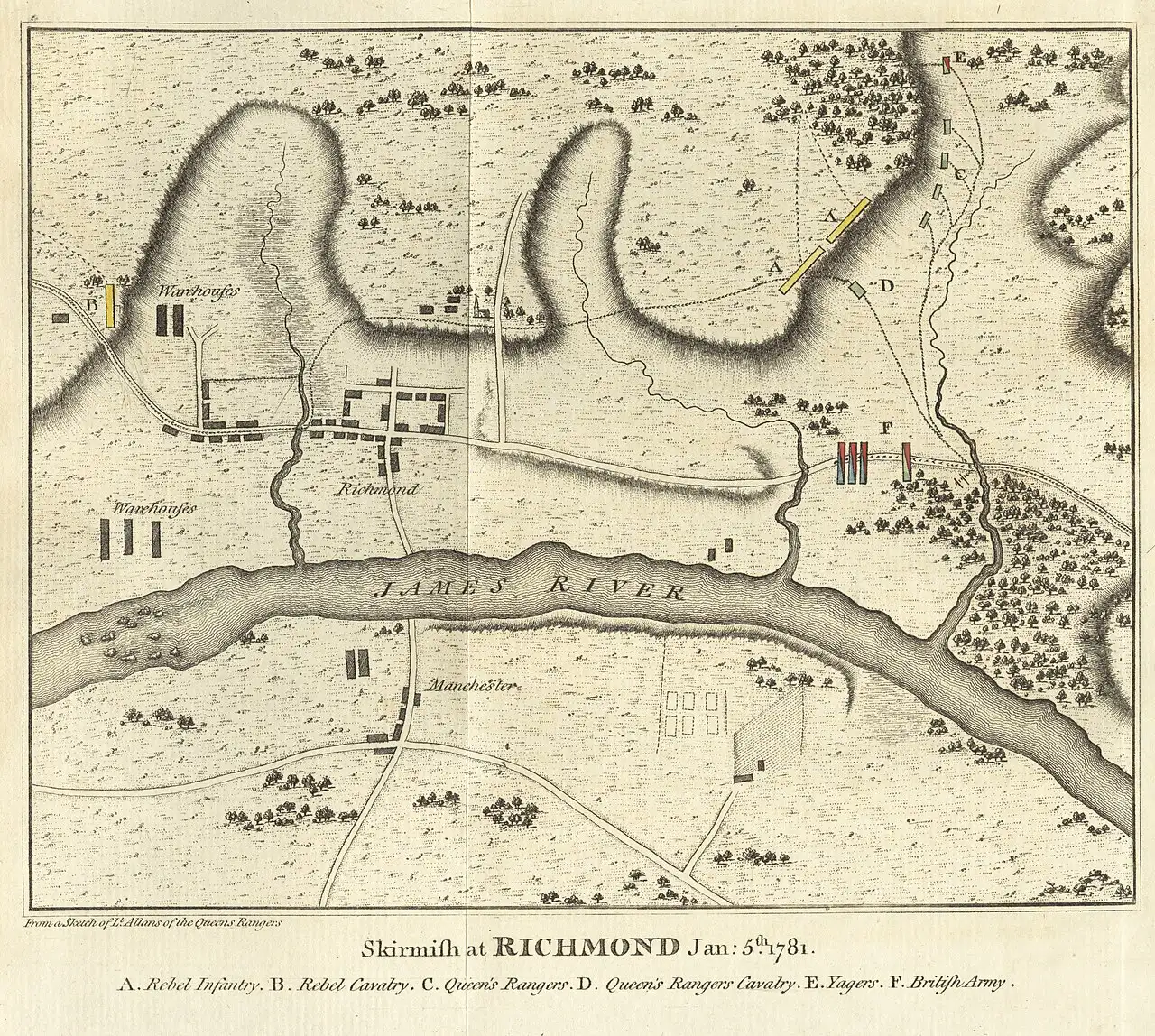
On the afternoon of January 5, 1781, the most hated man in America marched into Richmond, Virginia, at the head of an enemy army. Four years earlier, Benedict Arnold had been the Revolution's most brilliant battlefield commander. Now he wore a British brigadier general's uniform — and he had come to burn the capital of his native land.
Arnold's fall had been spectacular. He had helped capture Fort Ticonderoga, led the doomed march on Quebec, and turned the tide at Saratoga — and then, nursing grievances over money, rank, and recognition, he had agreed in 1780 to sell the fortress at West Point to the British. The plot was exposed, his handler Major John André was hanged as a spy, and Arnold fled to British lines. The British gave him a general's commission and a mission: take the war to Virginia.
In the first days of January 1781, some 1,600 of Arnold's men — mostly Loyalists — sailed up the James River and landed at Westover, the great plantation of Richmond's founding Byrd family, thirty miles from the capital. Governor Thomas Jefferson, the author of the Declaration of Independence, had moved Virginia's capital inland from Williamsburg to Richmond precisely because he believed it safe from naval attack. He was wrong. By the afternoon of January 5, Arnold's troops were in the streets of a virtually undefended city. Only about 200 militiamen answered Jefferson's call to arms.
Arnold made one offer before the torches came out: hand over the city's tobacco stores as prize goods, he wrote to Jefferson, and Richmond would be spared. Jefferson refused to bargain with a turncoat. So for two days the British systematically destroyed the town. Warehouses and tobacco factories went up in flames — Richmond was built of wood, and a hard wind did the rest. Colonel John Graves Simcoe's Queen's Rangers marched six miles upstream to the foundry at Westham, smashed the cannon, dumped 700 barrels of gunpowder into the river, and burned the powder mills. Forty-two ships at the waterfront were seized and loaded with stolen tobacco. Arnold's men even ransacked Jefferson's own house, cracking open his Madeira casks when the servants would not say where the governor had gone. Jefferson, who had sent his family to safety and overseen the removal of military stores, watched from across the river as his capital burned.
Then Arnold left, marching his loot-laden column toward Portsmouth. He had enjoyed his greatest success as a British commander — and committed the act that would define his infamy. After the war he fled to England, failed at business, and died a pauper in London in 1801, buried, with a final irony, in his old Continental Army uniform.
Jefferson faced sharp criticism for fleeing Richmond, but a later inquiry — held two months after Cornwallis surrendered at Yorktown — cleared him of any wrongdoing. Richmond rebuilt. And Benedict Arnold's name became the American synonym for traitor — not only because he plotted betrayal, but because on a January day in 1781, he carried it out.
Illustration: after Lieutenant Allans, published in John Graves Simcoe's account of the campaign (1787), public domain (via Wikimedia Commons; scan by the Boston Public Library). A period map of the January 5, 1781 attack on Richmond.