The Surrender That Won America an Ally
On October 17, 1777, British General Burgoyne surrendered his entire army at Saratoga — the victory that convinced France to join America's fight.
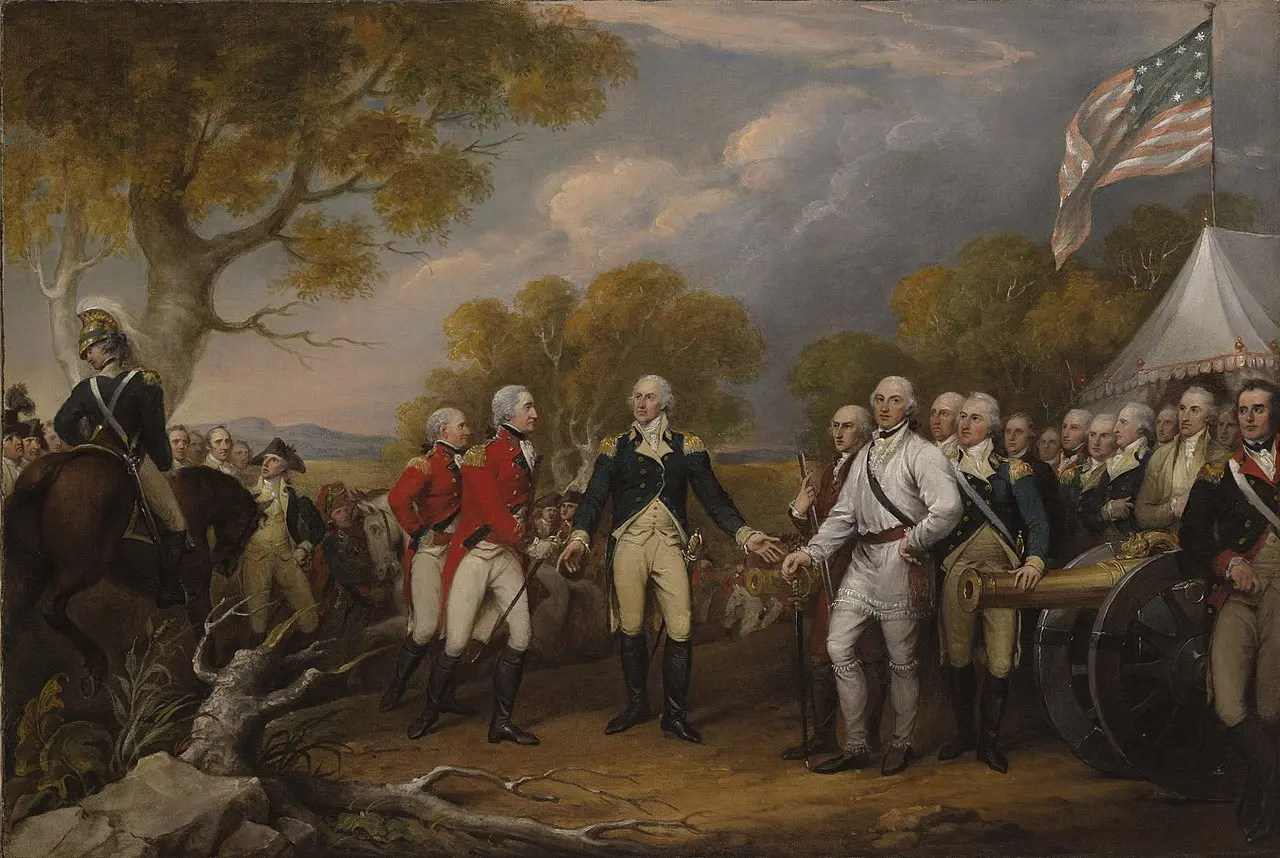
On the morning of October 17, 1777, two generals met on a field in upstate New York to perform one of the most graceful rituals in the brutal business of war. British General John Burgoyne, defeated and surrounded, offered his sword to American General Horatio Gates. Gates took it — and then, in a gesture of respect that stunned onlookers, handed it straight back.
Behind them, some 6,000 British and German soldiers marched out with the honors of war to lay down their arms. It was the first time in history a British army had ever surrendered in the field. And it changed everything.
Burgoyne's campaign had begun that summer with supreme confidence. His plan was elegant on paper: march south from Canada down the Hudson River, link up with British forces pushing north from New York City, and slice the rebellious colonies in two — isolating New England, the hotbed of the revolt, from the rest. London expected it to end the American rebellion in a single season.
Instead, Burgoyne marched into a trap of his own making. His supply lines stretched impossibly thin through dense wilderness. American militia swarmed his flanks, cutting off foragers and reinforcements. And at the fortified American position near Saratoga, he ran into an army that refused to break.
Twice Burgoyne attacked — on September 19 and again on October 7 — and twice he was bloodied. The second battle, at Bemis Heights, was the decisive one, and its hero was a man whose name would later become a synonym for treason: Benedict Arnold. Defying his commander Gates, who had relieved him of duty, Arnold rode onto the battlefield anyway, rallied the troops, was wounded in the leg, and helped smash the British line. Burgoyne lost nearly 900 men that day; the Americans lost about 150.
What followed was a slow-motion collapse. Burgoyne retreated north through rain and mud, his army shrinking, his food running out, until he found himself surrounded near present-day Schuylerville by an American force roughly three times his size. On October 13 his officers voted to negotiate. The terms were settled on the 16th — Burgoyne insisted on calling it a "convention" rather than a capitulation, a face-saving fiction — and on the morning of the 17th, the surrender became real.
An eyewitness, Baroness Frederika Riedesel — the wife of one of Burgoyne's German generals, who had sheltered with her children in a farmhouse cellar through the siege — described the scene in her journal: the generals waiting upon Gates, the troops laying down their arms. The American and British bands, in a final touch of eighteenth-century civility, played each other's tunes: "Yankee Doodle" and "The British Grenadiers."
The military result was significant. The political result was seismic. News of Saratoga crossed the Atlantic and convinced the French court what American agents like Benjamin Franklin had been arguing for two years: these rebels could actually win. In February 1778, France signed a treaty of alliance with the United States, bringing French money, French guns, French ships — and eventually French troops — into the war. Spain followed. A colonial rebellion became a world war, and Britain, suddenly fighting on multiple fronts, could not sustain it.
Congress, it must be said, did not keep its side of the bargain: it repudiated the convention's promise to ship Burgoyne's men home, and the so-called Convention Army remained in captivity until the war's end. But the sword ceremony on that October morning had already done its work.
The painter John Trumbull thought the moment so important that he made it one of the great canvases of the Revolution — and he titled it "October 16, 1777," the day the surrender terms were signed. Close enough: it was the week America proved it could defeat a British army in the open field, and the world started taking the Revolution seriously.
Photo: John Trumbull, public domain (via Wikimedia Commons) — "The Surrender of General Burgoyne at Saratoga," from the Yale University Art Gallery.