The Earthquake That Stopped the World Series
On October 17, 1989, a magnitude 6.9 earthquake struck the Bay Area during the World Series pregame show — live in front of millions of viewers.
The Bay Area was buzzing about baseball. For the first time ever, both local teams — the Oakland Athletics and the San Francisco Giants — had reached the World Series, and Game 3 of the "Battle of the Bay" was minutes from starting at San Francisco's Candlestick Park. ABC's pregame show was live on the air, with millions watching across the country.
At 5:04 p.m., play-by-play man Al Michaels was narrating highlights when the broadcast booth began to shake. "I'll tell you what," Michaels said, his voice suddenly urgent, "we're having an earth—" And then the feed went dead.
A magnitude 6.9 earthquake had just ripped through the Santa Cruz Mountains, its epicenter near Loma Prieta Peak, about sixty miles south of San Francisco. For fifteen to twenty seconds, the ground heaved across the entire Bay Area — and it happened in front of the largest live television audience ever to witness an earthquake begin.
Candlestick Park itself, packed with more than 60,000 fans, swayed but held. Concrete chunks fell from the upper deck; the crowd, remarkably, filed out in an orderly evacuation. But beyond the stadium, the quake was dealing out devastation with terrible precision.
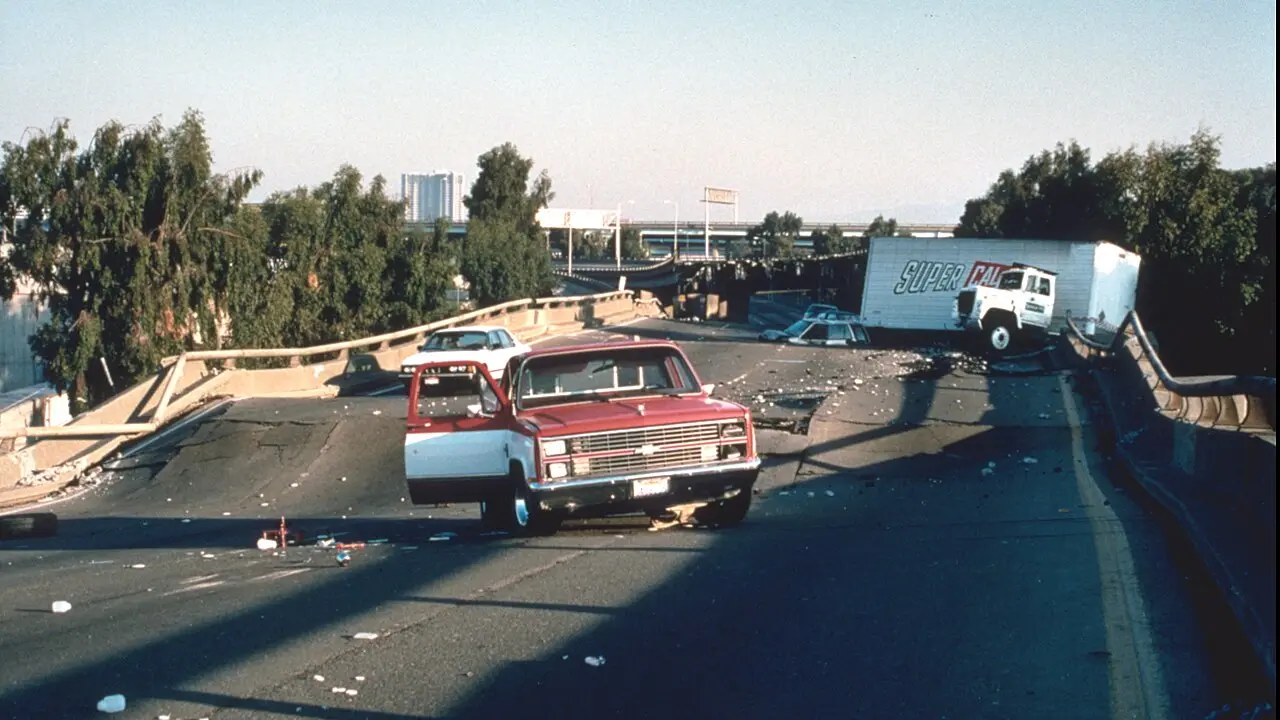
The worst of it struck in Oakland, where a 1.25-mile stretch of the double-decker Cypress Street Viaduct — part of Interstate 880, the Nimitz Freeway — collapsed. The upper roadway pancaked down onto the lower one, crushing the cars trapped beneath. More than forty people died there alone, many of them commuters heading home in the rush hour. On the San Francisco–Oakland Bay Bridge, a fifty-foot section of the upper deck crashed onto the roadway below, killing one motorist on a bridge that had been scheduled for earthquake retrofitting the following week.
In San Francisco's Marina District, built on soft landfill with no bedrock beneath, the shaking turned the ground to jelly. Buildings tilted and sank, gas mains ruptured, and fires broke out that burned into the night against a darkened skyline — power was out for hundreds of thousands. Down near the epicenter, the small farming town of Watsonville lost a third of its downtown.
When the accounting was done: 63 dead, nearly 3,800 injured, some 12,000 people homeless, and damage estimated at more than $5 billion. It was the largest Bay Area earthquake since 1906.
And yet the toll could have been far worse. The quake struck at 5:04 p.m. — the height of rush hour — but tens of thousands of Bay Area residents who would normally have been on the roads, including on the doomed Cypress Viaduct, were instead home early, watching the World Series. The game had been scheduled for an early start so East Coast viewers could watch at a reasonable hour. That quirk of television scheduling, many believe, saved countless lives.
The World Series itself was suspended for ten days while engineers inspected both stadiums. When play resumed, the Athletics completed a four-game sweep — but the celebration was muted, shadowed by grief for a region in ruins.
The Loma Prieta earthquake rewrote the Bay Area. Freeways were redesigned or torn down — the Cypress Viaduct was never rebuilt as it was. Building codes were toughened, bridges retrofitted, and emergency planning transformed. Every October 17, the region remembers the seventeen seconds that proved how fragile even the most modern city can be — and how, sometimes, a baseball game can save your life.
Photo: Joe Lewis, CC BY-SA 2.0 (via Wikimedia Commons) — cars stranded on the collapsed upper deck of the Nimitz Freeway (I-880) in Oakland after the quake.