The Planet Found by Math: Neptune, September 23, 1846
On the night of September 23, 1846, astronomers in Berlin pointed a telescope where mathematics said a planet must be — and found Neptune, less than a degree from the predicted spot.
On the evening of September 23, 1846, a letter reached the Berlin Observatory that pointed, in effect, at an empty patch of sky and said: look there. That same night, astronomers Johann Gottfried Galle and his assistant Heinrich Louis d'Arrest did — and found a new planet, almost exactly where the mathematics said it would be. They had discovered Neptune with pen and paper before they ever saw it through glass.
The hunt had begun with a wobble. Uranus, discovered by William Herschel in 1781, had by the 1840s completed nearly a full orbit of the sun — and it wasn't where Newton's laws said it should be. Something unseen was tugging at it. Two mathematicians set out to find the culprit by calculation alone: Urbain Le Verrier in Paris, encouraged by the physicist François Arago, and John Couch Adams in Cambridge, England, working independently.
Le Verrier finished first in public. On August 31, 1846, he presented his predicted position for the unseen planet to the French Academy of Sciences. Then, on September 18, he mailed the coordinates to Galle in Berlin, asking him to look. The letter arrived on the 23rd — the autumnal equinox. That evening Galle and d'Arrest aimed the observatory's Fraunhofer refractor at the spot, comparing what they saw against star charts. Within about an hour, d'Arrest spotted a star that wasn't on the map. Watching it over the following nights confirmed it was moving: a planet, less than a degree from Le Verrier's predicted position, near the boundary of Capricorn and Aquarius.
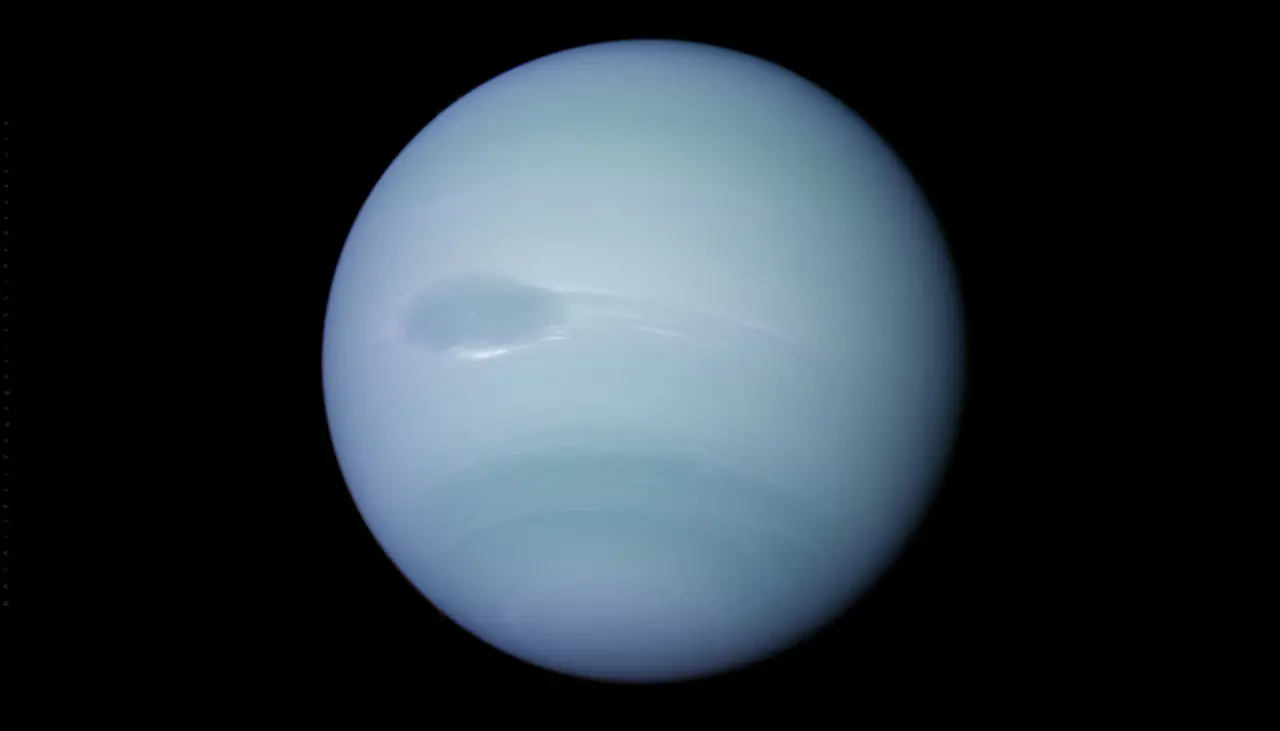
Arago captured the moment in a phrase that has echoed ever since: Le Verrier had discovered a planet "with the point of his pen." Galle wrote back with the news — the planet whose place had been computed really existed. The blue gas giant, four times the diameter of Earth, was named Neptune for the Roman god of the sea. Seventeen days later, the English astronomer William Lassell found its largest moon, Triton.
The triumph was not without a quarrel. When Britain's Astronomer Royal revealed that Adams had made a similar prediction, a fierce priority dispute erupted between the two nations. The Royal Society gave Le Verrier its Copley Medal in 1846 and Adams the same honor in 1848; historians still debate the shares of credit. But no one disputed the night of September 23.
Neptune was the first planet found by prediction rather than chance — Uranus had been spotted accidentally — and it was the most dramatic proof yet that Newton's law of gravitation ruled the heavens. A 165-year orbit means Neptune has completed barely one lap since that night. But the method born in 1846 lives on: today astronomers hunt exoplanets around distant stars by watching for the same telltale wobbles, still finding worlds with the point of a pen.
Photo: Andrea Luck, CC BY 2.0 (via Wikimedia Commons); spacecraft imagery: NASA/JPL.