The Paper Bag That Conquered the Sky
On June 4, 1783, two French papermakers launched a globe of linen and paper that rose a mile into the air — the first public flight in history, and the beginning of aviation.
In the spring of 1783, no human being had ever flown. Birds flew, myths flew, and dreamers sketched wings in their notebooks — but everyone stayed firmly on the ground. Then two brothers from a small French paper-making town decided to change that with little more than linen, paper, and hot air.
The Montgolfier brothers were not scientists or soldiers — they were manufacturers of paper. Joseph-Michel and Jacques-Étienne Montgolfier belonged to a family that had run paper mills in Annonay, France, for generations. Joseph had watched wood chips float over a fire and asked a simple question: what if you trapped that rising hot air inside a large bag? Late in 1782, he built small silk bags and flew them over an open flame. They rose. He enlisted his younger brother, and the experiments grew bolder.
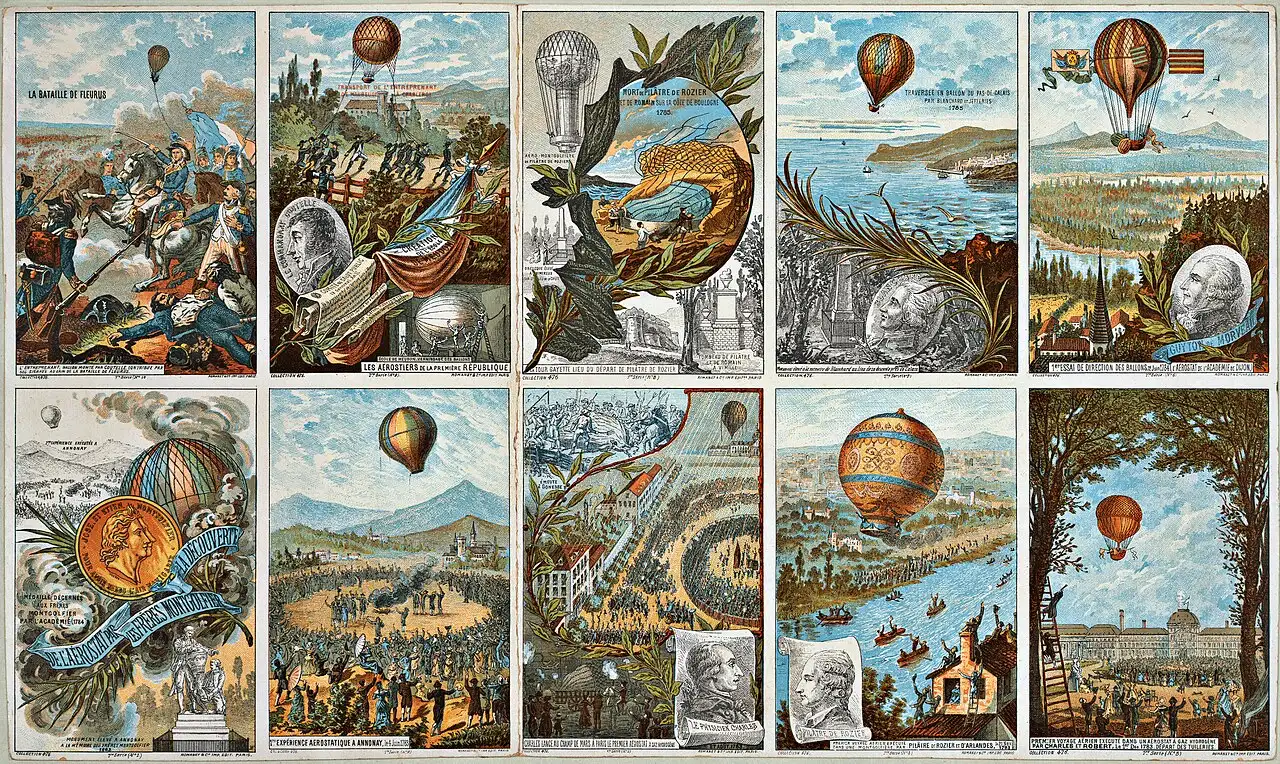
On the morning of June 4, 1783, they staged their first public demonstration in the marketplace at Annonay, before a group of dignitaries from the local assembly. Their balloon was a globe of sackcloth tightened with three thin layers of paper inside — big enough to hold nearly 790 cubic meters of air, held together by 1,800 buttons, and wrapped in a reinforcing fish-net of cord. They lit a fire of straw and wool beneath its open mouth and let it go, unmanned, into the blue sky.
The crowd gasped as it climbed. The balloon rose to an estimated 1,600 to 2,000 meters — more than a mile high — drifted for ten full minutes, and landed about two kilometers away, where an overeager bystander reportedly tore the fabric apart in the excitement. Nobody had ever seen anything leave the earth and return from such a height before. Word of the brothers' triumph reached Paris within weeks.
What followed was a year of astonishing firsts. Étienne traveled to the capital to stage grander demonstrations under royal patronage. On September 19, 1783, a Montgolfier balloon carried the first living passengers aloft at Versailles before the king and queen: a sheep, a duck, and a rooster, who touched down unharmed after eight minutes. Then, on November 21, 1783, Pilâtre de Rozier and the Marquis d'Arlandes became the first humans to make a free flight, drifting over Paris for 25 minutes while feeding straw into a brazier slung beneath the balloon to stay aloft.
Why does a paper bag matter today? Because every airplane that has ever taken off and every astronaut who has left the atmosphere stands on a line that starts in that Annonay marketplace. The Montgolfiers proved the sky was not a ceiling but a road. They did it without an engine, without a propeller, without even a theory of aerodynamics — just a paper mill's know-how and a fire under a bag. The age of aviation began with two brothers betting that hot air could lift them into history.
Photo: Library of Congress, public domain (via Wikimedia Commons).