Six Minutes That Turned the Pacific War
On the morning of June 4, 1942, American dive bombers destroyed three Japanese aircraft carriers in minutes at Midway, turning the tide of the Pacific War.
In the predawn darkness of June 4, 1942, the most powerful naval force ever assembled in the Pacific was closing in on a tiny ring of coral — and it had no idea it was sailing straight into a trap.
Six months earlier, Japan had bombed Pearl Harbor and swept across the Pacific, seemingly unstoppable. Admiral Isoroku Yamamoto now planned to finish the job: lure America's remaining aircraft carriers into an ambush near Midway Atoll and destroy them, forcing the United States to sue for peace. He sent four of Japan's finest fleet carriers — Akagi, Kaga, Soryu, and Hiryu — under Admiral Chuichi Nagumo. It should have worked. Except that American codebreakers in Hawaii, led by Commander Joseph Rochefort, had cracked Japan's naval code and read the entire plan. Admiral Chester Nimitz quietly positioned his three carriers — Enterprise, Hornet, and Yorktown, under Admirals Raymond Spruance and Frank Fletcher — to the northeast of Midway, waiting in silence.
The battle opened at dawn when Japanese planes bombed the American base on Midway. Nagumo, suddenly learning American carriers were nearby, hesitated — and his hangar decks filled with armed and fueled aircraft being hurriedly refueled and rearmed, bombs and torpedoes stacked in the open instead of stowed safely below. Then the American torpedo bombers arrived, wave after wave, flying slow and low into a wall of Japanese fighter planes. They scored no hits — and nearly all of them died. But they pulled every Japanese fighter down to sea level, leaving the sky above the carriers empty.
And then, at about 10:22 in the morning, the dive bombers fell out of the sun.
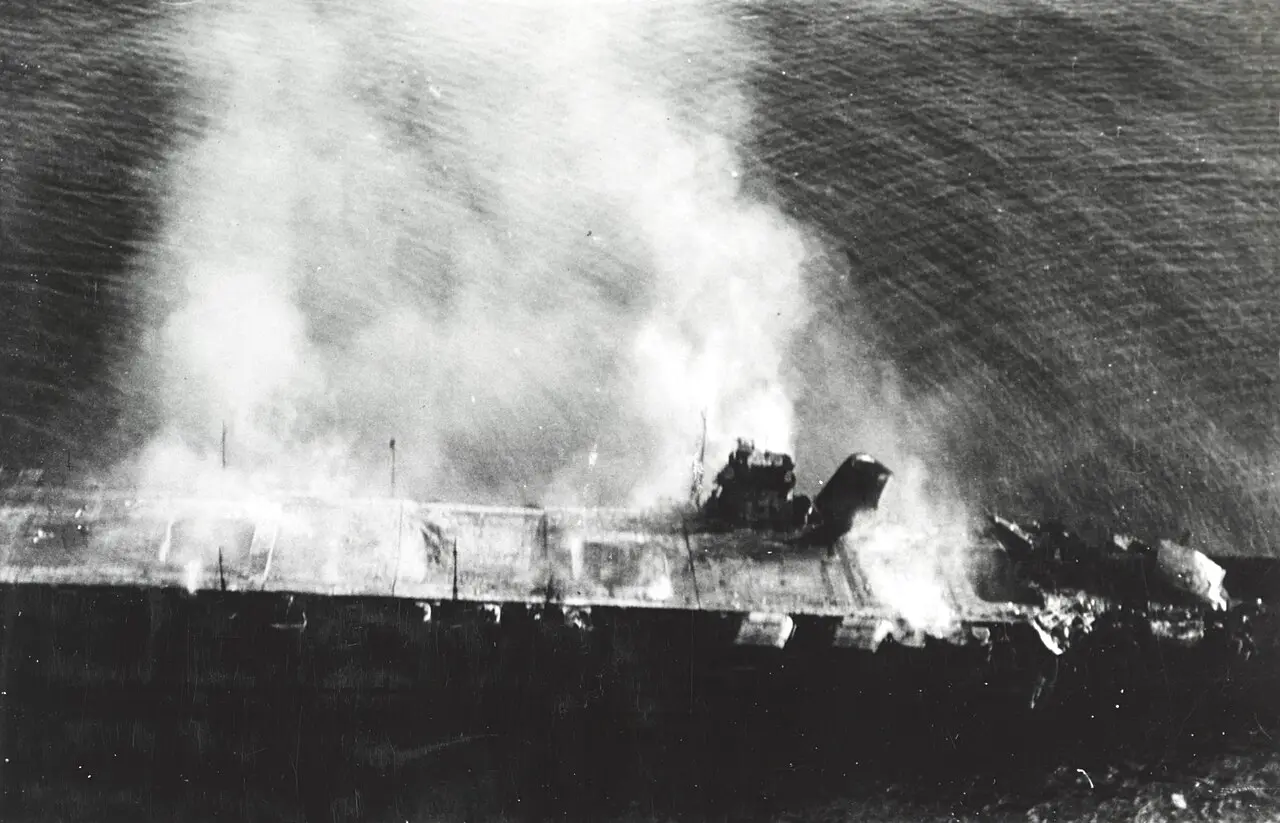
Enterprise's Lieutenant Commander Wade McClusky had followed a lone Japanese destroyer to the fleet, while Yorktown's bombers under Lieutenant Commander Maxwell Leslie found their own target. In roughly six minutes, American SBD Dauntless dive bombers turned three Japanese carriers into burning wrecks. Enterprise's Lieutenant Richard Best planted a perfect hit on Akagi's hangar deck, setting off chain explosions among the armed aircraft. Kaga took at least four bombs; Soryu took three. All three were abandoned and eventually scuttled.
The surviving Japanese carrier, Hiryu, fought back savagely and crippled the Yorktown — but American bombers found her that afternoon and knocked her out too. Nagumo ordered a retreat westward. When the smoke cleared, Japan had lost four carriers, a heavy cruiser, hundreds of aircraft, and some 3,000 sailors and airmen; the United States lost the Yorktown, a destroyer, 144 aircraft, and about 362 men.
Midway is studied in war colleges because it was won by intelligence, nerve, and sacrifice — by men in obsolete torpedo planes who flew into certain death so the dive bombers could have their six minutes. Japan never regained the initiative in the Pacific. The tide of the war turned on a June morning off a coral atoll, in the time it takes to make a pot of coffee.
Photo: U.S. Navy, public domain (via Wikimedia Commons).