The One-Day Window: Estonia Declares Independence
On February 24, 1918, Estonia seized a single day between two departing armies to declare itself an independent republic.
On February 24, 1918, no one's army controlled Estonia. The Russian Bolsheviks were fleeing; the German army was advancing — and in the gap between them, three men with a printing press seized a single day and used it to invent a country.
The backdrop was the chaos of World War I's eastern front. After the Bolshevik coup in Russia, Estonia's democratically elected Provincial Assembly — the Maapäev — refused to recognize the new rulers and was dissolved by force in November 1917. Its leaders went underground. Then, on February 18, 1918, Germany launched Operation Faustschlag, a massive offensive that sent Russian forces reeling. As the Bolsheviks evacuated Tallinn and the Germans closed in, Estonia's politicians saw a window — measured in hours.
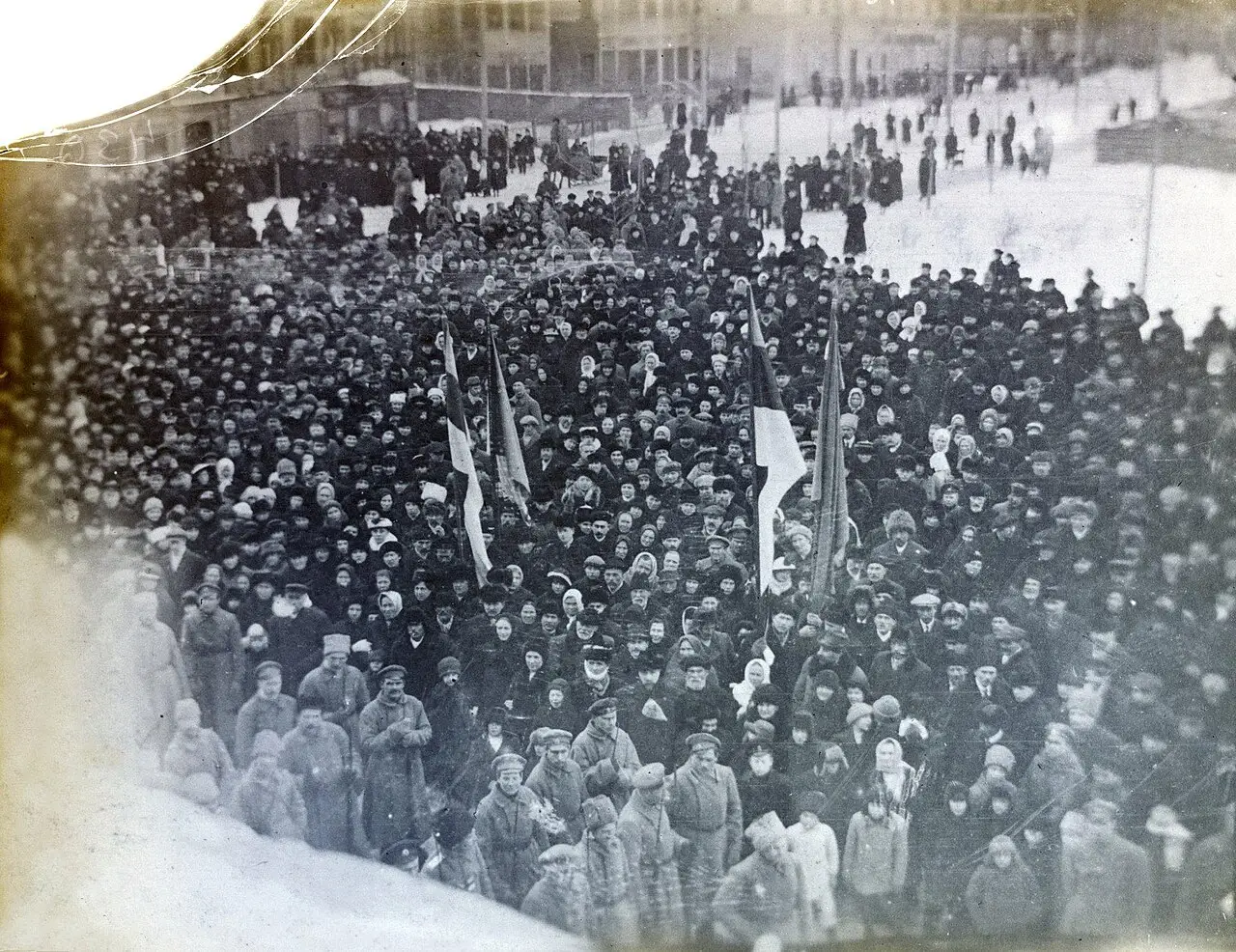
On February 19, the assembly's Committee of Elders created a three-man Salvation Committee with full powers: Konstantin Päts, Jüri Vilms, and Konstantin Konik. They drafted a declaration — the Manifesto to the Peoples of Estonia — proclaiming an independent, democratic republic. The proclamation was meant for February 21 but was delayed; on the evening of February 23 the manifesto was read aloud publicly in the town of Pärnu — the crowd in this story's photograph — and on February 24 it was printed and distributed in the capital, Tallinn, where independence was formally declared in the main hall of the Russian State Bank's local branch. A provisional government was appointed the same day.
The window slammed shut almost immediately. German troops entered Tallinn on February 25, refused to recognize the new republic, and occupied the country — arresting Päts that summer. But history intervened: Germany lost the war that November, its troops withdrew, and on November 19, 1918, power was formally handed to the Estonian Provisional Government. A War of Independence against Soviet Russia followed, ending with the Treaty of Tartu on February 2, 1920. Estonia joined the League of Nations in 1921.
February 24 is still Estonian Independence Day, the country's national day — celebrated each year with the sunrise raising of the flag over Toompea Castle's Long Hermann tower in Tallinn, followed by a military parade in Freedom Square, wreath-laying at the Freedom Struggle Memorial, and the president's address to the nation. The republic proclaimed in that one-day gap survived decades of occupation and was restored at the end of the Cold War. But its founding act was pure audacity: three men, one manifesto, and a single day when nobody was watching.
Photo: public domain (via Wikimedia Commons).