
The Day Ten Days Disappeared
On February 24, 1582, Pope Gregory XIII signed the decree that deleted ten days from the calendar - the one the world still uses today.
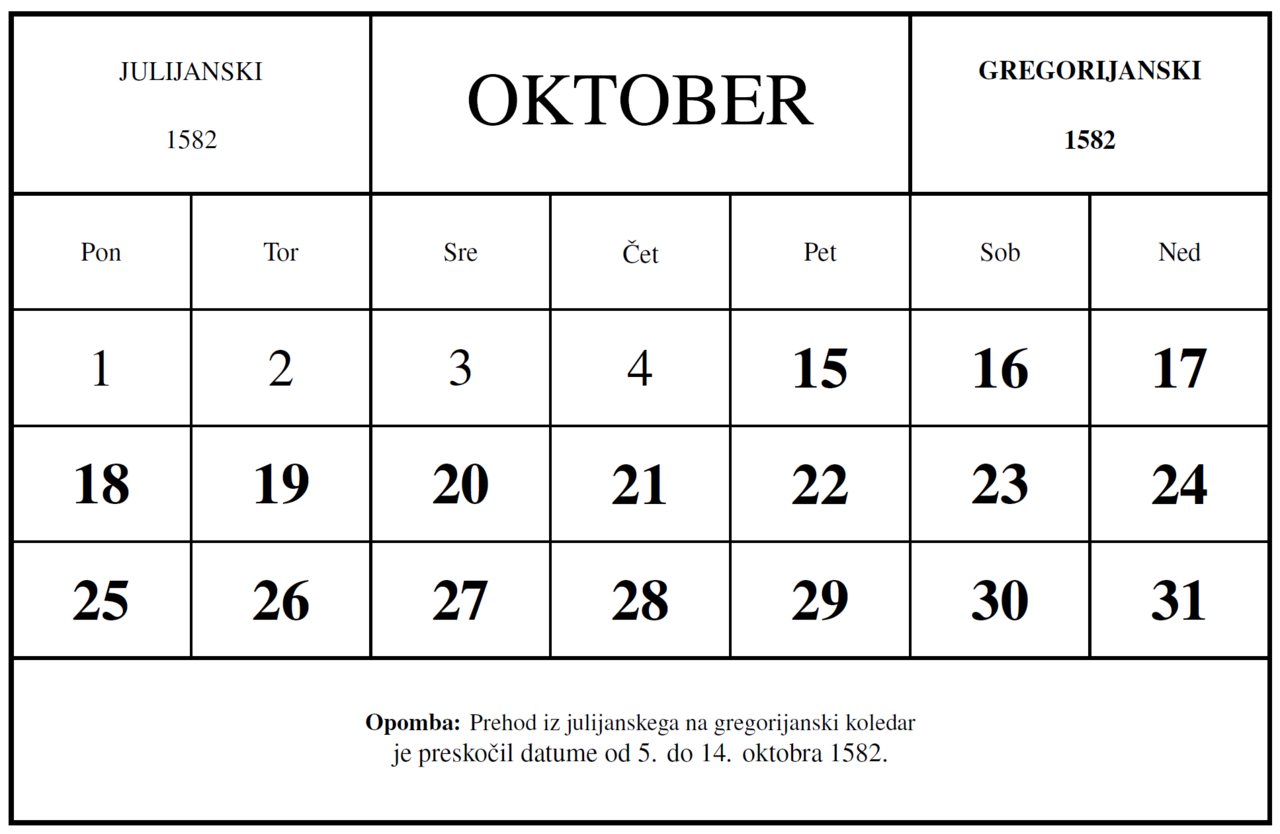
If you lived in Spain, Italy, or Poland in 1582, you went to sleep on Thursday, October 4 — and woke up on Friday, October 15. Ten days of your life were simply deleted, by order of the Pope.
The trouble had started with Julius Caesar. His Julian calendar, introduced in 45 BCE, assumed the year was exactly 365 and a quarter days long, adding a leap day every fourth February to make the math work. But the true solar year — the time Earth takes to circle the sun — is about 365.2422 days: roughly eleven minutes shorter. Eleven minutes a year sounds like nothing. Over sixteen centuries, it added up to ten full days.
By the 1500s, the calendar had drifted badly out of step with the seasons, and that was a religious crisis. The date of Easter had been tied to the spring equinox by the Council of Nicaea back in 325 CE, and the equinox was now arriving on the calendar ten days "early." Something had to give.
On February 24, 1582, Pope Gregory XIII acted. He issued a papal bull — a formal proclamation — called Inter gravissimas, Latin for "Among the most serious [of our pastoral duties]." The reform it decreed had been designed by Aloysius Lilius, a Calabrian physician and astronomer who died before his work was finished, and refined by Christopher Clavius, a brilliant Jesuit mathematician.
The bull did two things. First, it snapped the calendar back into alignment: Thursday, October 4, 1582, would be followed directly by Friday, October 15. The dates October 5 through 14 simply never happened. (Debts and contracts falling due in the missing days were legally preserved — the Pope thought of everything.) Second, it fixed the leap-year rule so the drift would not return: years divisible by four are leap years, except century years, which must also be divisible by 400. That is why the year 2000 had a February 29, but 1900 did not — and why 2100 won't either.
Catholic countries adopted the new calendar immediately. Protestant nations wanted no part of a Pope editing time: Britain and its colonies held out until 1752, by which point the gap had grown to eleven days, and Russia did not switch until 1918.
Why it matters: the Gregorian calendar is now the world's standard civil calendar. Every birthday, deadline, holiday, and anniversary you observe runs on a mathematical fix ordered on February 24, 1582 — the day science reached into everyone's daily life and moved time itself.
Image: Andrej Jakobčič, CC BY-SA 4.0 (via Wikimedia Commons).