The Oath in the Market Square: Poland's Last Stand Begins
On March 24, 1794, Tadeusz Kościuszko swore an oath in Kraków's market square — and launched Poland's doomed, glorious fight for freedom.
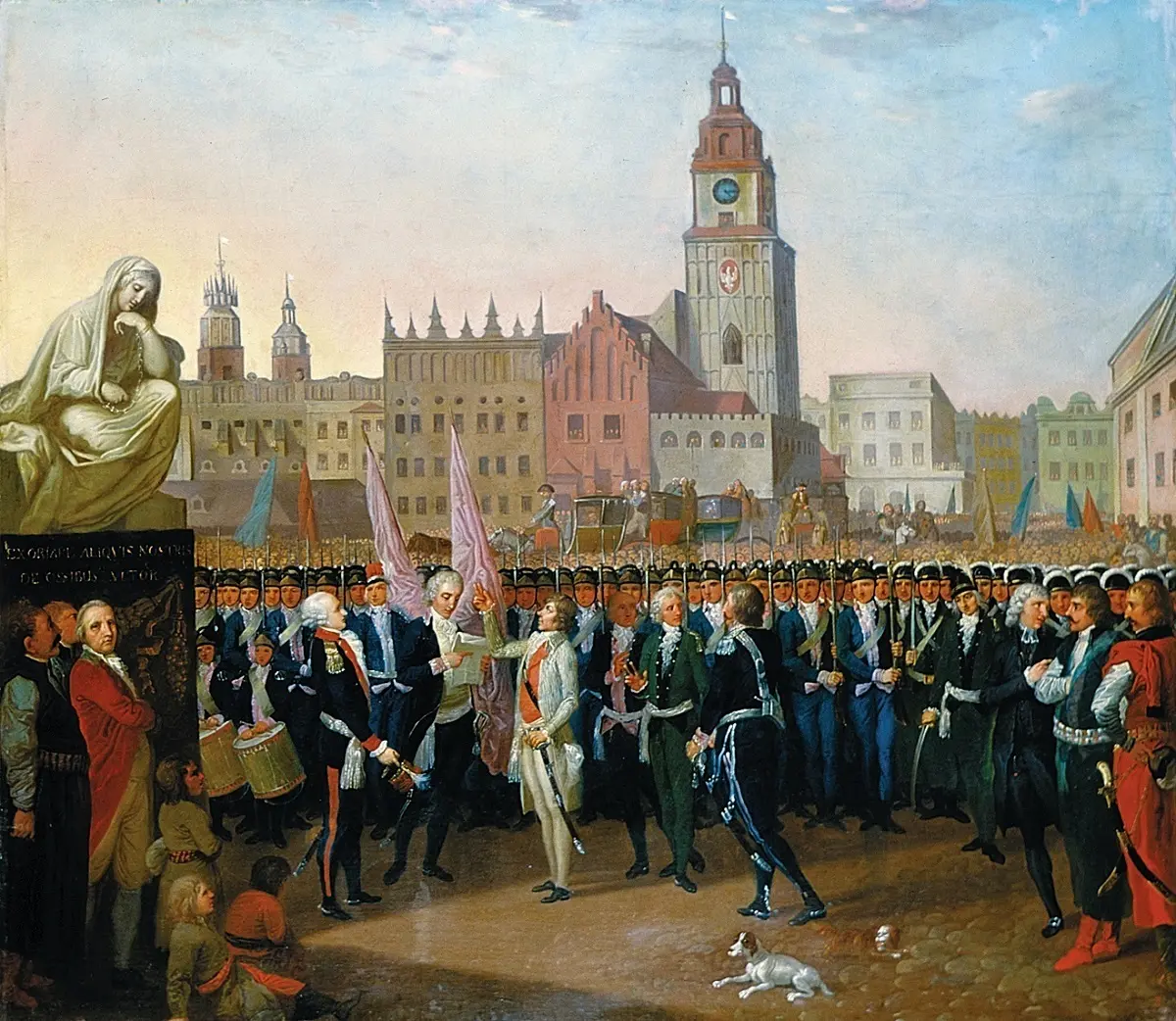
On the morning of March 24, 1794, church bells rang over Kraków's great market square. A 48-year-old general in a plain uniform climbed onto a platform before a sea of soldiers, guildsmen, priests, and peasants, raised his hand, and swore an oath that would echo for 123 years: he would use his power for no one's oppression — only for Poland's freedom.
Tadeusz Kościuszko was no stranger to lost causes. He had crossed the Atlantic as a young engineer to fight for American independence, rising to brigadier general in the Continental Army — Congress granted him the rank in 1783. Back home, he watched in anguish as Poland's neighbors, Russia and Prussia, carved up his country in the Second Partition of 1793 and demanded its army be gutted. When a Polish cavalry brigade mutinied rather than disband, the moment for talk was over.
So on March 24, in the Rynek, the Act of Insurrection was read aloud, naming Kościuszko "Naczelnik" — commander-in-chief of the National Armed Force. Then he spoke the oath himself: "I, Tadeusz Kościuszko, hereby swear by the God to the entire Polish Nation, that I shall not use the powers vested in me for anyone's oppression, but for defence of the integrity of the borders, recuperation of Nation's sovereignty and strengthening the universal freedom. So help me God and the innocent passion of His Son!"
What followed was one of history's great underdog campaigns. Kościuszko ordered a mass mobilization — every five households in the region to furnish one armed man — and when muskets ran short, he raised regiments of peasants armed with scythes straightened into pikes: the famous "scythemen." Eleven days later, at Racławice, some 4,000 regulars and 2,000 scythemen defeated 5,000 Russian veterans with 30 cannon — a victory of farm tools over artillery that electrified the nation. Volunteers flocked to his banner, including a Jewish cavalry unit; he answered with the Połaniec Proclamation, promising personal freedom to the serfs.
It wasn't enough. Prussia joined Russia, Kościuszko was wounded and captured at Maciejowice in October, and the uprising was crushed. In 1795 came the Third Partition: Poland vanished from the map of Europe, not to return for 123 years.
Kościuszko lost the war and won the argument. His oath — power as a trust, never as a weapon against one's own people — became a touchstone for every Polish generation that followed, from the November Uprising to Solidarity. And his American chapter came full circle: the engineer who helped fortify Saratoga and West Point is honored with monuments across the United States, including the country's smallest national park site at his Philadelphia home. Freedom, he proved, is one cause with many addresses.
Photo: Franciszek Smuglewicz (1797 painting of the oath), public domain, via Wikimedia Commons.