The Night Camille Came Ashore
On August 17, 1969, Hurricane Camille — one of only four Category 5 storms ever to strike the continental U.S. — slammed into Mississippi's Gulf Coast.
Late on the evening of August 17, 1969, the wind gauges along the Mississippi Gulf Coast simply stopped reporting. The hurricane destroyed them.
Hurricane Camille had been born just three days earlier near the Cayman Islands, and it had done nothing but strengthen ever since. By the time it reached the Gulf Coast late on August 17 — making landfall near Waveland, just east of Bay St. Louis — it was a Category 5 monster, one of only four such storms ever to strike the continental United States. Re-analysis later put its sustained winds near 175 miles per hour, but the true maximum will never be known: every instrument in the landfall zone was obliterated.
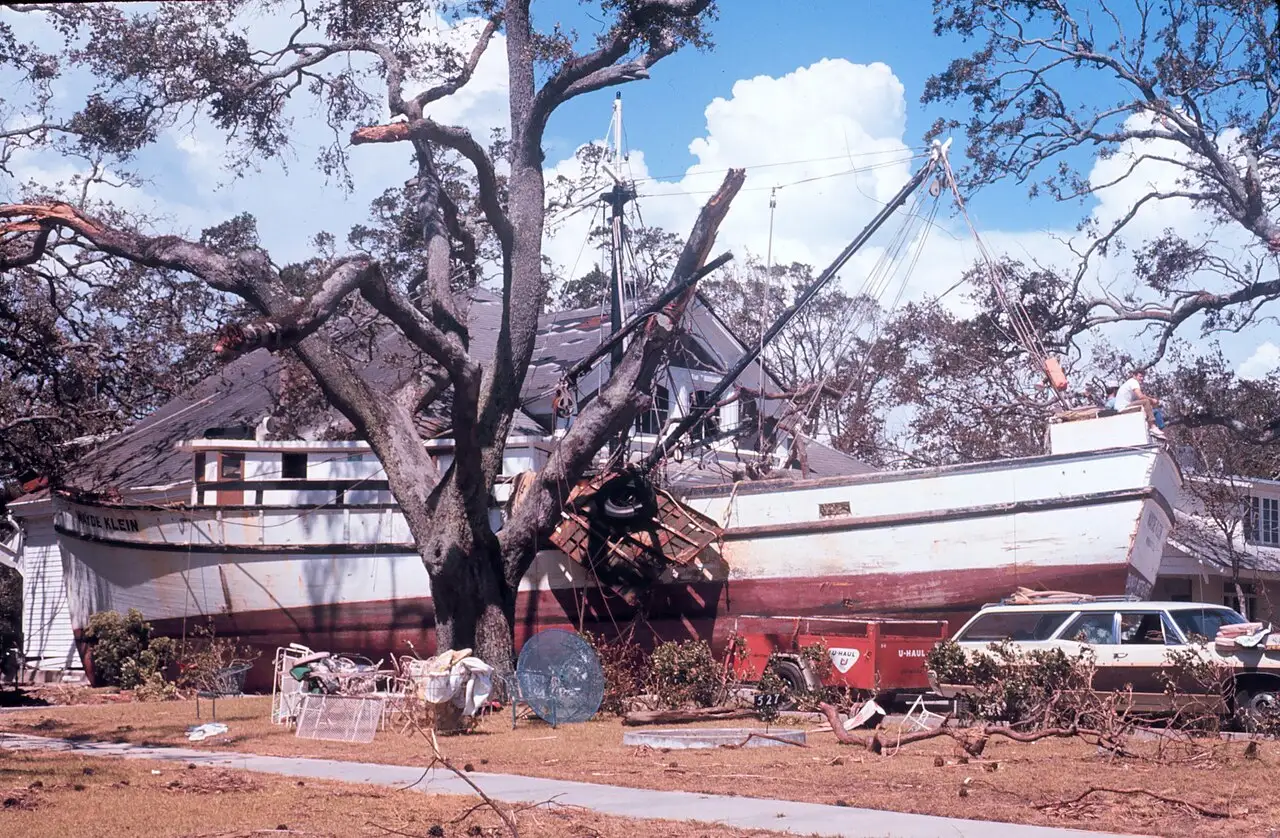
What the storm left behind told the story. A storm surge of nearly 25 feet — measured at 24.6 feet in Pass Christian — swept entire neighborhoods off their foundations. Boats were lifted clean out of the water and deposited on beaches and into houses, as one famous NOAA photograph shows. Homes, churches, and businesses along the coast from Bay St. Louis to Biloxi were flattened or flooded. The destruction was so complete that, until Hurricane Andrew in 1992, Camille was cited as the largest single act of destruction in American history.
But Camille was not finished with the coast. Weakening as it crossed Mississippi, Tennessee, and Kentucky, the dying storm turned east over Virginia — and there it unleashed a second catastrophe. In just three to five hours, parts of the Blue Ridge Mountains received up to 31 inches of rain. The resulting flash floods and landslides tore through mountain communities that had never imagined a hurricane could reach them.
When the final count came, Camille had killed 259 people — three in Cuba, 143 on the Gulf Coast, and 113 in the Virginia floods — and caused $1.42 billion in damage in 1969 dollars.
In Gulfport, the storm surge carried a tugboat some 200 feet inland and dropped it beside Highway 90, where it sat for decades as a landmark nicknamed the "S.S. Hurricane Camille" — a rusting reminder of what the water could do. Camille became the benchmark against which every Gulf hurricane was measured, and the reason "Category 5" entered the American vocabulary as shorthand for the worst nature can offer. It taught a hard lesson the coast still studies: a hurricane's dying days, hundreds of miles inland, can be as deadly as its landfall.
Photo: NOAA, public domain (via Wikimedia Commons).