
The First Drive on Another World
On July 31, 1971, Apollo 15 astronauts David Scott and Jim Irwin unfolded the Lunar Roving Vehicle and became the first humans to drive on the Moon.
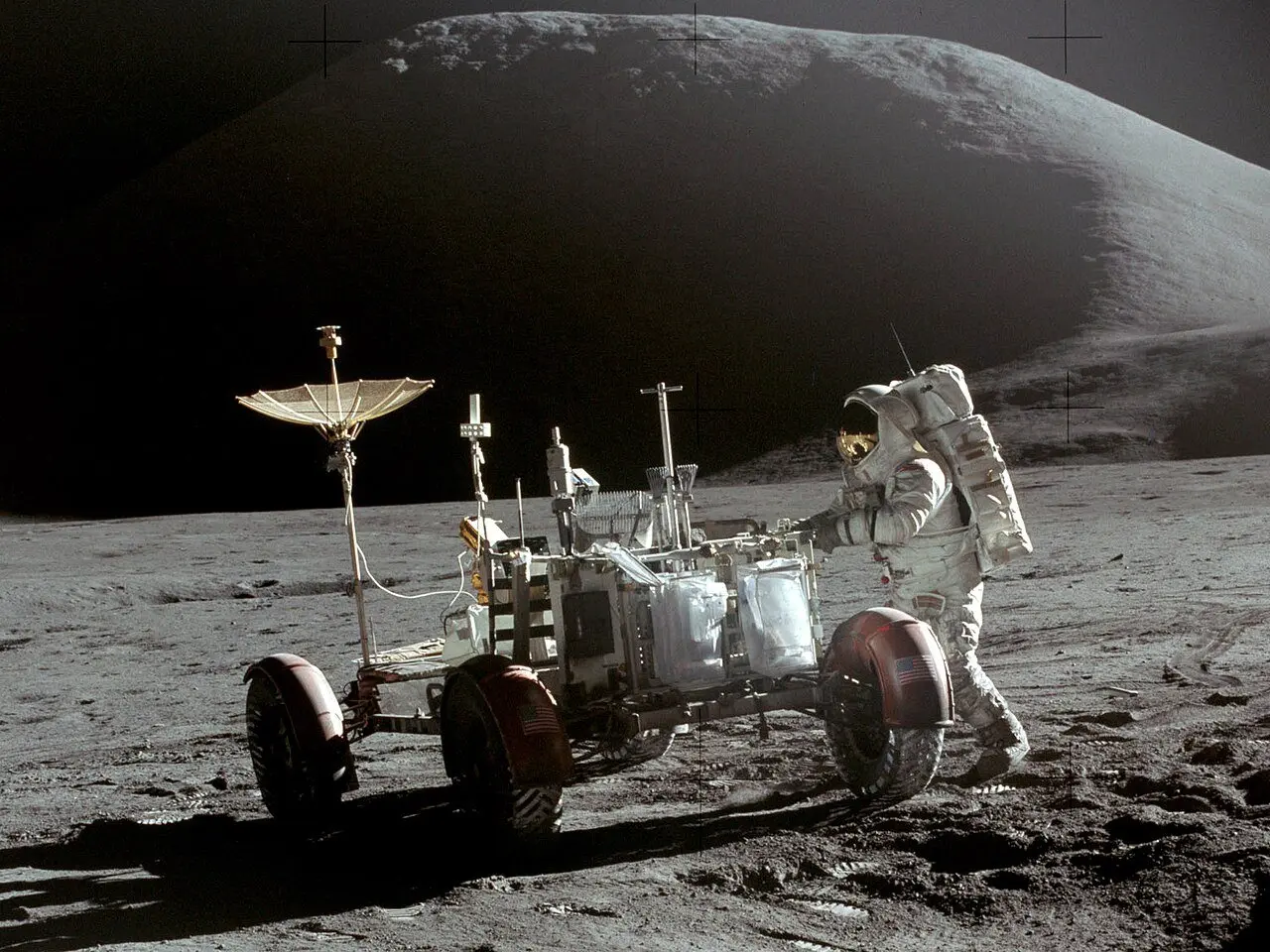
It arrived on the Moon folded up like a lawn chair, crammed into a storage bay of the lunar lander. On July 31, 1971, Apollo 15 astronauts David Scott and Jim Irwin unfolded it, switched it on, and took it for a spin — becoming the first humans to drive on another world.
The Lunar Roving Vehicle was a marvel of packing: a battery-powered, four-wheeled electric car weighing just 463 pounds, yet able to carry more than 1,000 pounds of astronauts, tools, and Moon rocks. Built by Boeing and General Motors in only 17 months at a cost of $38 million for four vehicles, it was steered not with a wheel but with a T-shaped hand controller. Top speed: about eight miles per hour — blistering, by lunar standards. Earlier missions had been limited to how far astronauts could walk in bulky suits while hauling life-support gear; the rover multiplied their range overnight.
The first drive did not go perfectly. Within minutes, the front-wheel steering failed. Scott calmly drove on with rear-wheel steering alone and kept the traverse going; engineers on Earth worked the problem overnight, and the steering was fixed by the next moonwalk.
The rover even lost a fender extension on the second moonwalk, and the crew repaired it with lunar maps and clamps — a field fix that became part of Apollo lore.
Over three days the crew put 17.5 miles on the odometer — more than four times the ground covered by all previous Moon landings on foot — and gathered some 170 pounds of lunar samples, including rocks scientists still prize today. On the way home from one traverse, Scott spotted an interesting black rock, invented a story about fidgeting with his seatbelt to justify an unscheduled stop, and pocketed it. The "Seatbelt Rock" became one of Apollo 15's most valued finds.
The two later Apollo missions each carried their own rovers — Apollo 17's Gene Cernan even set the lunar land-speed record at 11.2 miles per hour. But Apollo 15's rover was the first, and it's still parked out there on the Hadley plain, exactly where Scott and Irwin left it: the first car ever driven on another world, retired after three days of the finest road trip in history.
Photo: NASA (David R. Scott), public domain (via Wikimedia Commons). The image shows astronaut Jim Irwin with the Lunar Roving Vehicle at the end of Apollo 15's first moonwalk, with Mount Hadley rising behind.