
The Farm Boy Who Found a Planet
On February 18, 1930, 24-year-old Clyde Tombaugh, a self-taught farm boy from Kansas, spotted Pluto on photographic plates at Lowell Observatory in Arizona.
The man who found the farthest planet anyone had ever seen was a 24-year-old farm boy who had never taken a college astronomy class.
Clyde Tombaugh grew up on farms in Illinois and Kansas, where the night sky was the biggest thing he owned. He ground his own telescope mirrors and drew detailed sketches of Mars and Jupiter by hand, good enough that in 1929, when the director of Lowell Observatory in Flagstaff, Arizona, needed a tireless young worker for a boring job, he gave the Kansas kid a shot.
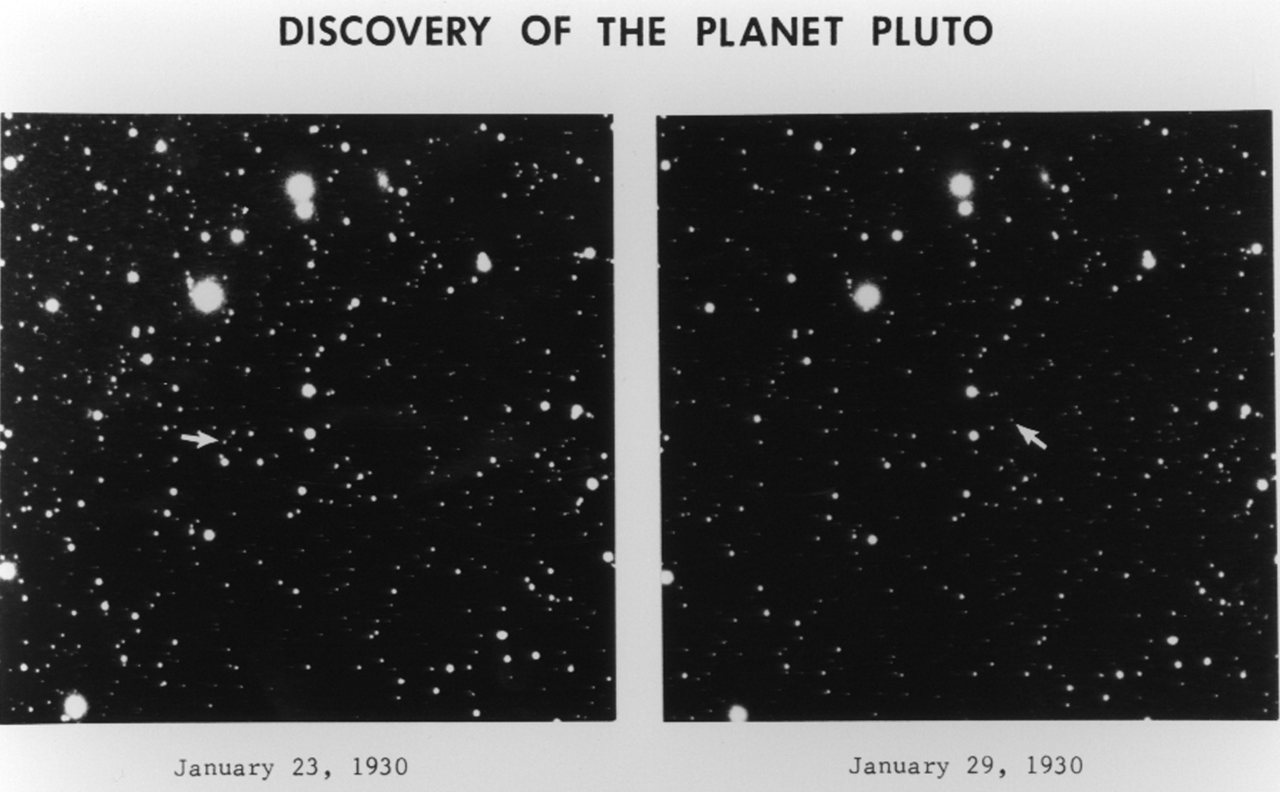
The job was the search for Planet X. Back in the early 1900s, observatory founder Percival Lowell had become convinced that a distant, unseen planet was tugging at the orbits of Uranus and Neptune. Lowell had calculated where it should be and searched for years before his death in 1916. When the hunt resumed, the instrument of choice was a 13-inch astrograph — a telescopic camera — and a device called a blink comparator, which let an astronomer flip between two photographs of the same patch of sky. Stars stayed put. A planet would jump.
Tombaugh's work was brutally tedious. Night after night he exposed glass plates of the heavens, and day after day he bent over the blink comparator, sometimes for nine hours at a stretch, scanning star fields grain by grain. Then, at about four o'clock in the afternoon of February 18, 1930, while comparing plates taken on January 23 and January 29, he saw a tiny speck popping back and forth. A world, shifting against the fixed stars.
He walked down the hall to the director's office. "Dr. Slipher," he said, "I have found your Planet X."
The observatory held the news for verification, and on March 13, 1930 — the anniversary of Lowell's birth — the discovery of the new planet was announced to the world. For its name, the observatory chose a suggestion from an 11-year-old English schoolgirl, Venetia Burney, who proposed Pluto, the Roman god of the underworld, fitting for a world so cold and far away. The name's first two letters also honored Percival Lowell.
Pluto went on to have quite the career. For 76 years it was the solar system's ninth planet, until new discoveries of similar icy worlds prompted astronomers in 2006 to reclassify it as a dwarf planet — the opening chapter of the Kuiper Belt, the vast "third zone" of the solar system beyond Neptune. Tombaugh, who died in 1997, got the last word anyway: some of his ashes rode aboard NASA's New Horizons spacecraft, which flew three billion miles to give Pluto its first close-up in 2015.
That speck on a photographic plate — found by a kid from Kansas with a homemade telescope's training — turned out to be a doorway. It opened the era of exploring the outer solar system, and it started with one patient young man, blinking photographs on a winter afternoon in Arizona.
Photo: Clyde Tombaugh, public domain (via Wikimedia Commons).