The Day the Universe Got Bigger
On November 23, 1924, the New York Times reported Edwin Hubble's proof that the 'spiral nebulae' were galaxies beyond the Milky Way — exploding the known universe overnight.
On Sunday, November 23, 1924, readers of the New York Times who made it to page six — past the large adverts for fur coats — found a small article with an enormous claim. The headline read: "FINDS SPIRAL NEBULAE ARE STELLAR SYSTEMS." A Dr. "Hubbell" of the Mount Wilson Observatory, the paper reported, had confirmed that the spiral nebulae were "island universes" like our own. The paper even misspelled his name. It was Edwin Hubble, and the universe had just gotten vastly, dizzyingly bigger.
For centuries, the Milky Way had been assumed to be the whole of the universe — every star in the sky a member of one great system. A few astronomers disagreed. In 1920, Harlow Shapley and Heber Curtis had staged the famous "Great Debate" in Washington, arguing whether the faint spiral smudges seen through telescopes were nearby clouds of gas or distant galaxies of stars. Nobody could prove either side right.
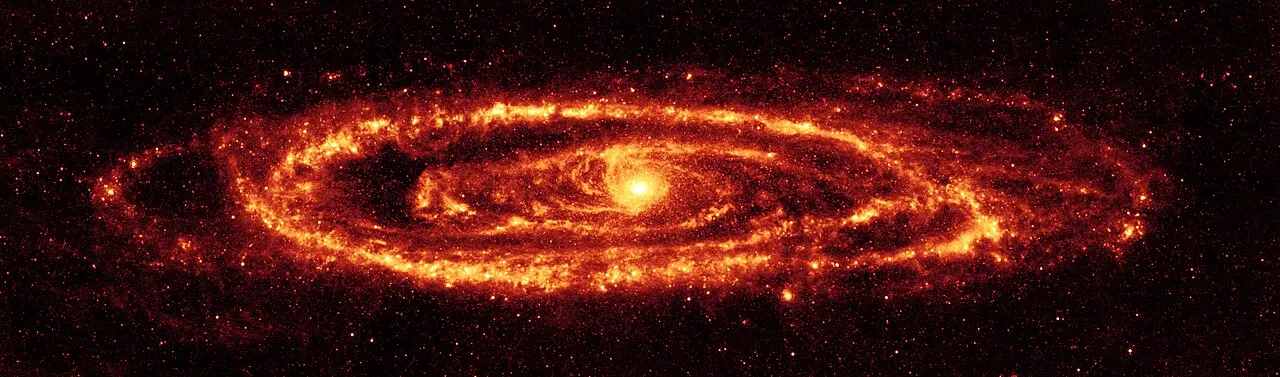
Hubble provided the proof. Working with the telescopes of the Carnegie Institution's Mount Wilson Observatory in California, he had spent the previous year photographing the great spiral in Andromeda. In 1923, on a photographic plate, he spotted something extraordinary: a Cepheid variable star, a type of star whose rhythmic brightening and dimming reveals its true distance, thanks to a law discovered by the astronomer Henrietta Swan Leavitt. Hubble's calculation put Andromeda some 285,000 parsecs away — roughly ten times farther than any distance ever measured for a celestial object.
The conclusion was inescapable: Andromeda lay far outside the Milky Way. It was not a nebula at all but a separate galaxy, an "island universe" of its own. Hubble found the same for another spiral, Messier 33. The Milky Way was suddenly one galaxy among many.
The newspaper report had jumped the gun — Hubble would not formally present his results to the American Astronomical Society until the end of December, and his paper, "Cepheid Variables in Spiral Nebulae," won the American Association for the Advancement of Science's $1,000 prize the following month. But the world had been told, and there was no going back. Within a few years, Hubble would discover that the galaxies are racing apart, opening the road to the Big Bang theory. Today astronomers estimate the observable universe holds not one galaxy but trillions.
It all began with a smudged star on a glass plate — and a newspaper that couldn't spell the discoverer's name.
Photo: NASA/JPL-Caltech, public domain (via Wikimedia Commons).