Roses Topple a President
On November 23, 2003, Georgia's Eduard Shevardnadze resigned after three weeks of peaceful protests, ending the bloodless Rose Revolution.
On the evening of November 23, 2003 — St. George's Day in Georgia — Eduard Shevardnadze walked into a meeting with his political enemies and walked out a former president. After three weeks of peaceful protests, the man who had helped end the Cold War resigned rather than turn his troops on his own people. The Rose Revolution had won without shedding a drop of blood.
Shevardnadze was one of the great survivors of the twentieth century. As Mikhail Gorbachev's foreign minister, he had been the public face of perestroika and glasnost, the Soviet reforms that helped end the Cold War peacefully. When the Soviet Union collapsed, he returned to his native Georgia and took charge of a fractured new state in 1992, winning the presidency in 1995.
By 2003, though, his government was mired in corruption, poverty, and crime. When parliamentary elections on November 2 were denounced as rigged by international observers, Georgians poured into the streets of Tbilisi. Opposition leaders Mikheil Saakashvili, Zurab Zhvania, and Nino Burjanadze demanded new elections — and the crowds kept growing.
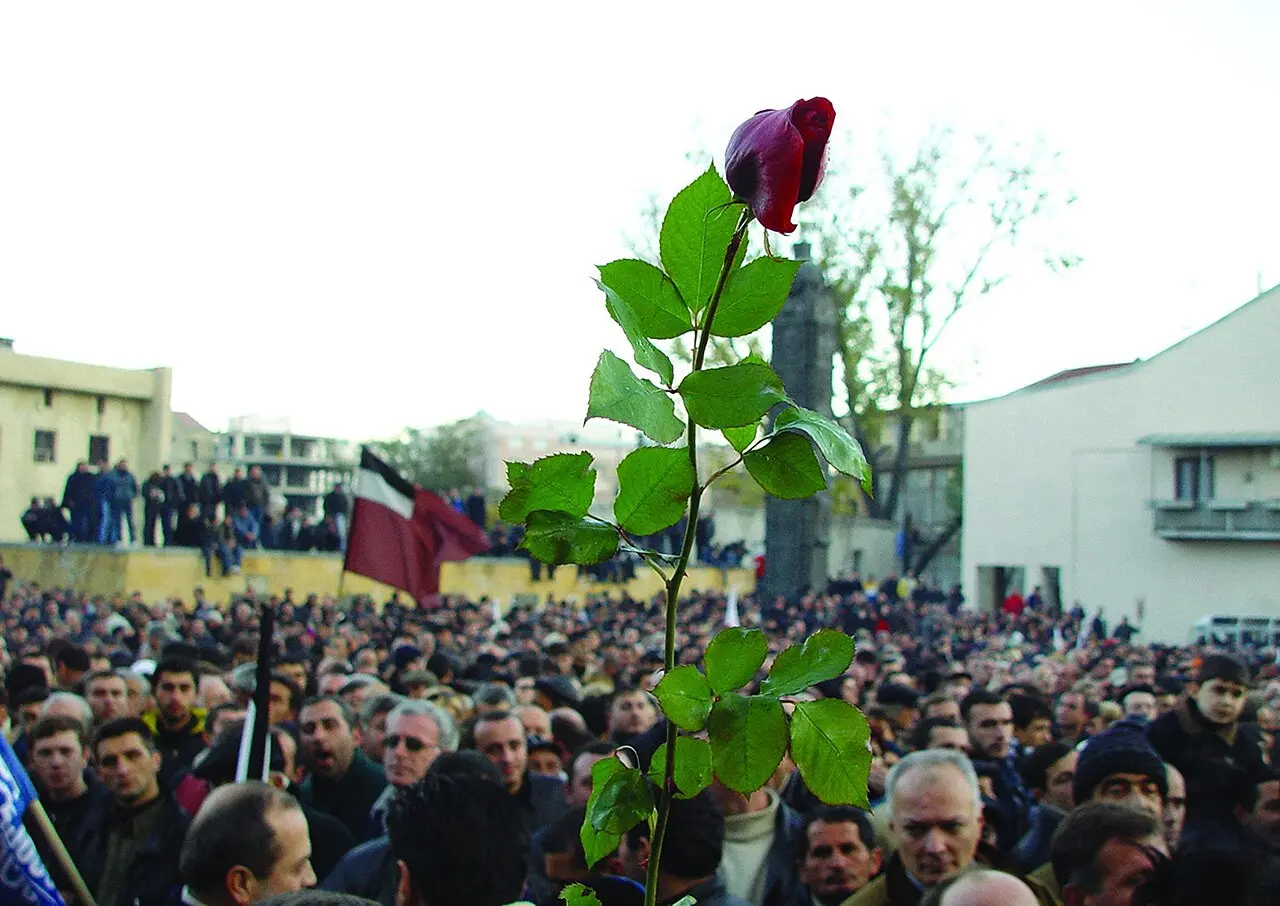
The crisis peaked on November 22, when Shevardnadze tried to open the new parliament's first session. Saakashvili led a column of protesters carrying red roses — the symbol of their nonviolent movement — straight into the chamber, interrupting the president mid-speech. Shevardnadze fled with his bodyguards as the crowd cheered. He declared a state of emergency and mobilized troops, but the army's elite units refused to move against the people.
The next evening, with Russian Foreign Minister Igor Ivanov mediating, Shevardnadze met Saakashvili and Zhvania. Then he announced his resignation, saying he wanted the crisis to end peacefully, without bloodshed or casualties. More than 50,000 people celebrated in the streets of Tbilisi through the night, with fireworks and concerts.
Parliament's speaker, Nino Burjanadze, took over as acting president, and new elections were called. On January 4, 2004, Saakashvili won the presidency with more than 96 percent of the vote and was inaugurated three weeks later — at 36, Europe's youngest president. Georgia's bloodless revolution became a model, and a warning, for the post-Soviet world: people power, armed with nothing but roses, could topple a government. Shevardnadze retired from public life, later publishing his memoirs, and died in Georgia in 2014 at the age of 86 — his legacy split between the Cold War peacemaker and the embattled president.
Photo: unknown photographer, CC BY-SA 4.0 (via Wikimedia Commons).