The Day the Computer Age Began: UNIVAC I Is Dedicated
On June 14, 1951, the UNIVAC I — the first computer built for business — was dedicated for the U.S. Census Bureau, launching the computer age.
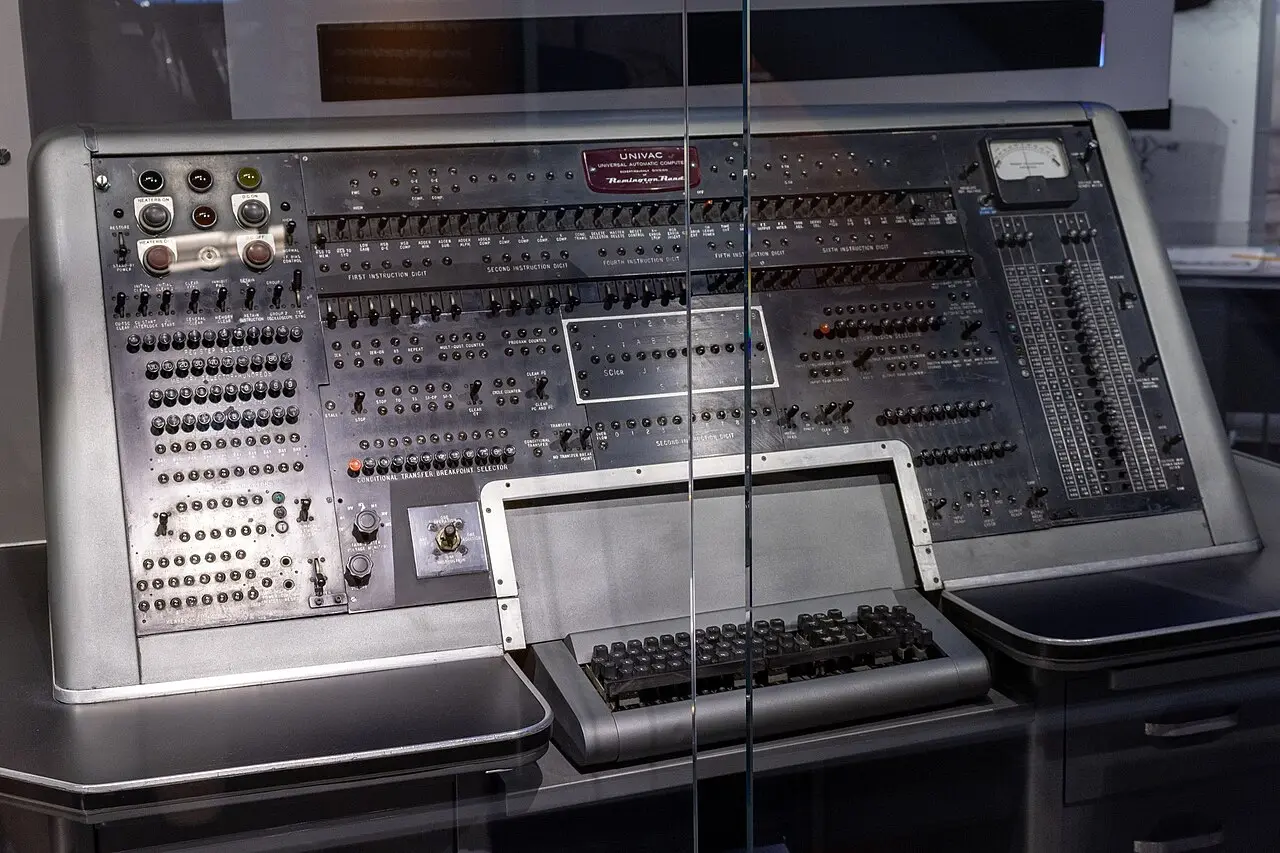
It filled a room, weighed about 29,000 pounds, and could do in seconds what took rooms of clerks far longer. On June 14, 1951, the world's first commercial computer was formally dedicated — and the computer age quietly began.
The machine was the UNIVAC I, short for UNIVersal Automatic Computer, designed by J. Presper Eckert and John Mauchly, the engineers behind the pioneering ENIAC. Eckert and Mauchly were no newcomers: a few years earlier they had built the ENIAC, a wartime calculating machine completed in 1946 that used some 17,000 vacuum tubes and was programmed by plugging and unplugging 6,000 switches by hand. After founding their own computer company — acquired by the office-equipment maker Remington Rand in 1950 — they set out to build a computer for civilian life. Their company built it for the U.S. Census Bureau, which accepted the first machine on March 31, 1951. On June 14, Census officials traveled to the Eckert-Mauchly laboratory in Philadelphia for the dedication ceremony. A plaque at the Census Bureau still marks the day it dedicated "the world's first electronic general purpose data processing computer."
The specifications sound quaint now: more than 5,000 vacuum tubes, some 29,000 pounds of steel and glass, performing about 1,900 operations per second. Its results were printed out or stored on magnetic tape — itself a novelty at the time. But UNIVAC was the first computer designed from the start for business and government work — the fast execution of huge numbers of relatively simple calculations — rather than military ballistics. It was soon tabulating part of the 1950 census and, later, the entire 1954 economic census. The Bureau was so pleased with the machine that it bought a second UNIVAC I in the mid-1950s, and two successor computers for the 1960 census.
UNIVAC became a national celebrity on election night, November 4, 1952, when CBS used one of the machines to predict Dwight D. Eisenhower's landslide victory from a sample of just 5.5 percent of the vote. Millions of Americans watching at home saw a computer do what the pollsters could not — and the age of the thinking machine arrived in the living room.
Every spreadsheet, every database, every census tabulation descends from that room-sized machine in Philadelphia. UNIVAC proved computers were not just laboratory curiosities or weapons calculators — they were business tools. Within a decade they were transforming offices, banks, and governments around the world.
Photo: The wub, CC BY-SA 4.0 (via Wikimedia Commons).