The Day Napoleon Signed Away His Empire
On April 11, 1814, Napoleon's representatives signed the Treaty of Fontainebleau, ending the emperor's reign and exiling him to the island of Elba.
The most powerful man in Europe spent the spring of 1814 haggling like a bankrupt merchant — and on April 11, 1814, his representatives put his signature to the terms of his ruin.
Two years earlier, Napoleon Bonaparte had marched half a million men into Russia; he returned with a shattered remnant. The disaster emboldened his enemies, and at Leipzig in October 1813 the combined armies of Europe crushed him in the "Battle of the Nations." By the spring of 1814, allied armies were closing on Paris itself. On March 31, Russian and Prussian troops entered the French capital. The French Senate declared Napoleon deposed, and even his own marshals — the men who had won his empire for him — refused to fight on.
At Fontainebleau, south of Paris, the fallen emperor negotiated the price of his surrender. The treaty signed on April 11 — by his plenipotentiaries, with Napoleon's own assent arriving days later — was a strange document: an abdication dressed up as a retirement package. Napoleon renounced the thrones of France and Italy for himself, his heirs, and all his descendants. In exchange, he kept the title of Emperor for life, received the Mediterranean island of Elba as his own sovereign principality, and was granted a pension of two million francs a year, along with a personal guard of 400 men.
It was, by the standards of defeated conquerors, generous. It was also a cage — and Napoleon knew it. Within weeks he sailed for Elba, a tiny island kingdom where the man who had redrawn the map of Europe now presided over a few thousand fishermen. For ten months he played at being a model ruler, building roads and inspecting mines. Then, in February 1815, he slipped off the island with a handful of followers, landed in France, and marched on Paris. The troops sent to stop him joined him instead. The Hundred Days had begun.
It ended, as everyone knows, at Waterloo that June. But the Treaty of Fontainebleau remains the moment the Napoleonic era truly broke: the first time the emperor who had crowned himself was forced to sign away the crown. The Congress of Vienna would redraw Europe's borders in the months that followed, and the age of the great conqueror-emperors passed into history.
It matters as a study in the limits of power. Napoleon had remade laws, banks, and borders across a continent — yet all of it rested on the loyalty of his armies and the fear of his enemies, and when those failed, an empire became a pension and a palace became an island. Fontainebleau is where the modern world learned that even the mightiest reign ends at a negotiating table.
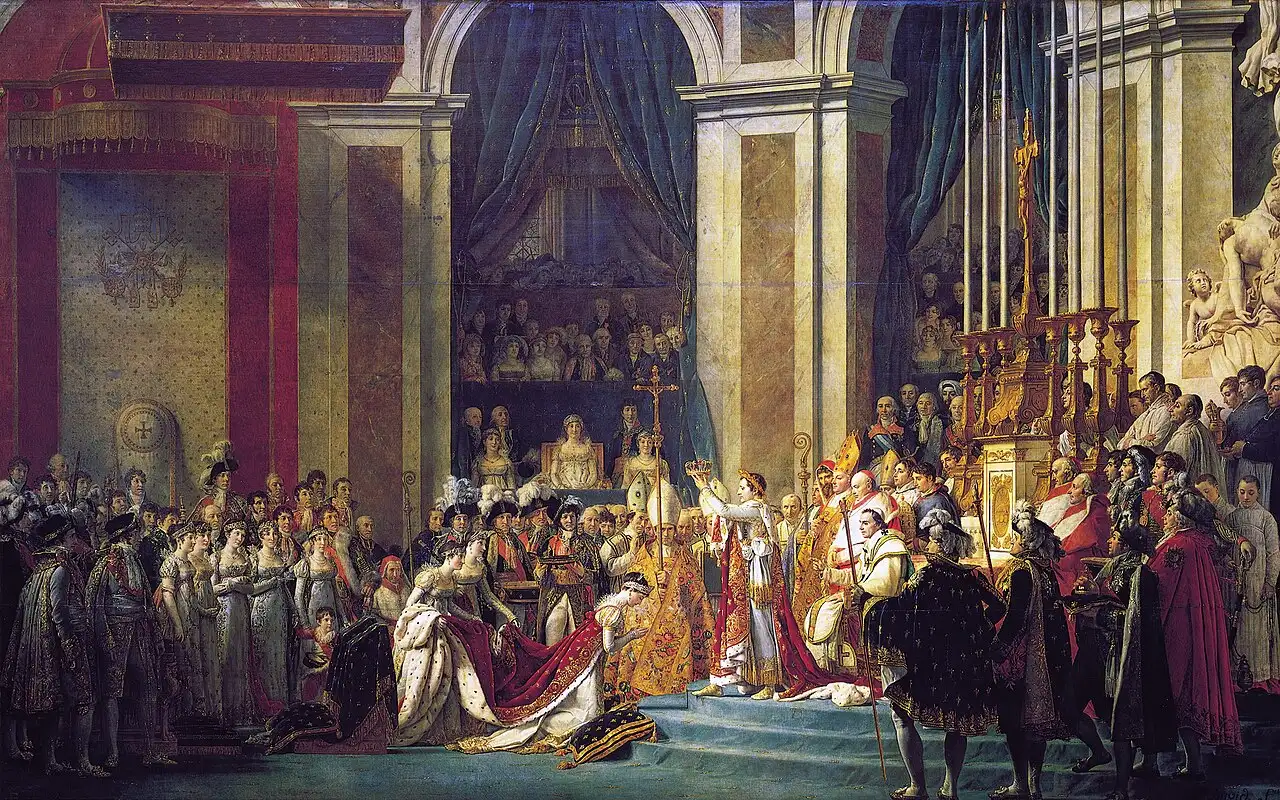
Photo: Jacques-Louis David's "The Coronation of Napoleon" (1807), showing the emperor at the height of his power — a decade before he signed it away. Painting by Jacques-Louis David, public domain (via Wikimedia Commons).