
The Day Mexico Beat the World's Best Army: Puebla, 1862
On May 5, 1862, a poorly equipped Mexican army defeated elite French forces at the Battle of Puebla — the origin of Cinco de Mayo.
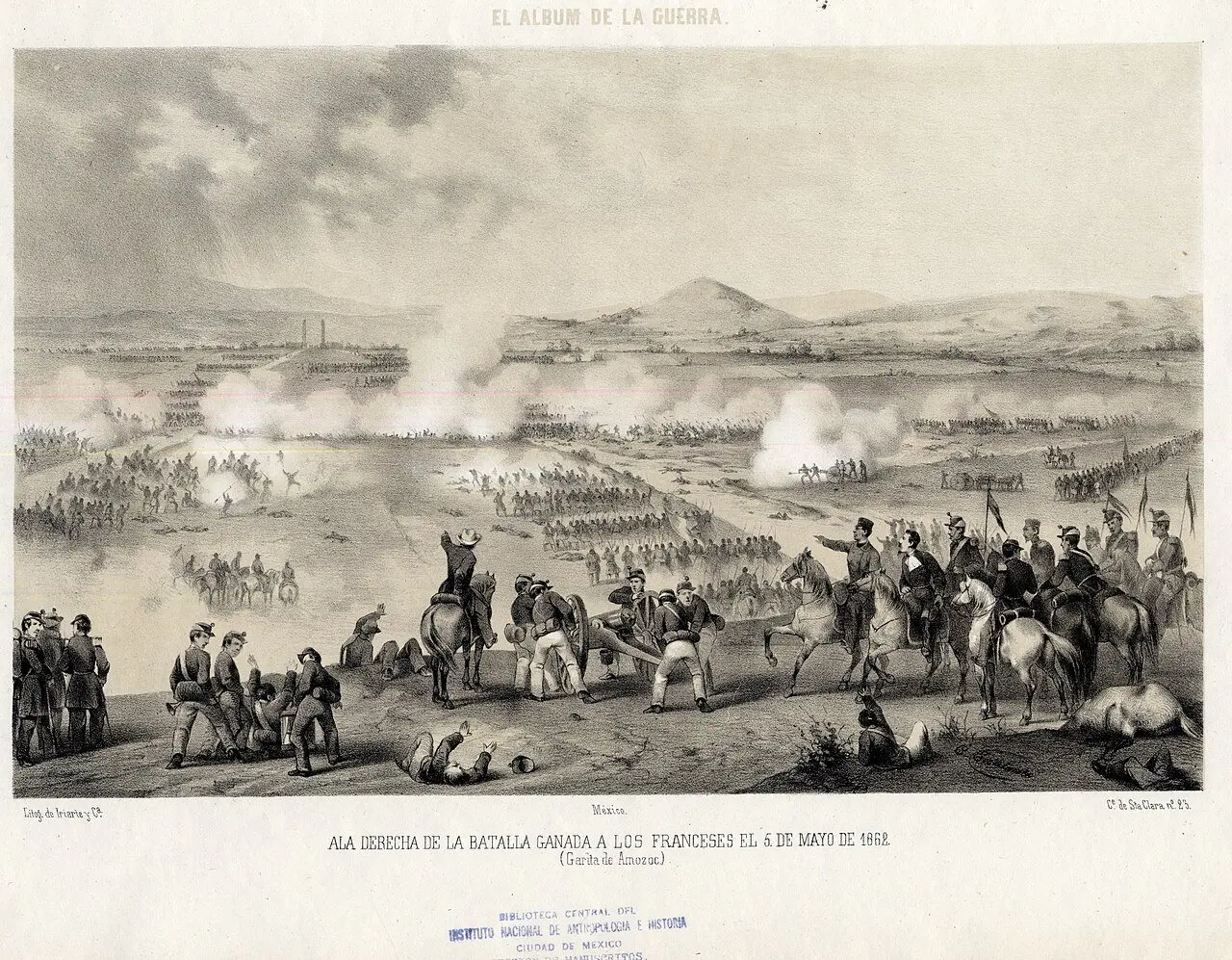
On May 5, 1862, on the hills above the Mexican city of Puebla, one of the most improbable victories in military history took place. A ragtag army of about 4,000 Mexican soldiers — many of them farmers, some barefoot, armed with machetes, spears, and old guns — defeated the French army, widely considered the finest fighting force in the world. It had not lost a battle in half a century. It lost that day.
The trouble had started a year earlier, when Mexican President Benito Juárez, facing a nation ruined by civil war, suspended payments on Mexico's foreign debts. France, Britain, and Spain all sent warships to Veracruz to collect. The British and Spanish soon cut deals and sailed home. But Napoleon III of France had bigger plans: conquer Mexico and install a European monarchy loyal to Paris.
An elite French force under General Charles de Lorencez marched inland toward Mexico City. Waiting for them at Puebla, about 80 miles southeast of the capital, was General Ignacio Zaragoza — a Texas-born officer in his early thirties who knew the ground. He placed his men on the high hills around the city, hidden behind cactus, stone walls, and the dilapidated forts of Loreto and Guadalupe.
At about 11:45 that morning, the French began shelling the fortifications. The stone walls, shored up by Zaragoza's men, held. Then the French launched direct assaults — three times they charged up the hill, and three times they were thrown back. The Mexican defenders fought with every weapon they had, and the French, running low on ammunition, found themselves sliding in a hillside turned to slick mud by sudden rain. Lorencez ordered a retreat. It would take the French nearly a year to regroup, and Napoleon III promptly fired the defeated general.
The victory did not last. In 1863 the French returned with 30,000 troops, captured Puebla and Mexico City, and installed the Austrian Archduke Maximilian as emperor of Mexico. His empire survived only until 1867, when Mexican forces recaptured the capital and Maximilian was executed. Mexico was a republic again.
So why is May 5 still celebrated? In Mexico, Cinco de Mayo — officially El Día de la Batalla de Puebla — is observed mainly in the state of Puebla itself, where the victory became a symbol of national pride and resistance to foreign domination. In the United States, it grew into something bigger: a celebration of Mexican heritage and culture, especially in Mexican-American communities. It is often mistaken for Mexican Independence Day — that is actually September 16.
Why it matters: the Battle of Puebla is proof that courage can outfight certainty. Outnumbered, outgunned, and dismissed by the great powers of the day, a young republic's farmers and soldiers held the line — and gave Mexico, and millions of Mexican-Americans, a day to remember what resilience feels like.
Illustration: Constantino Escalante, public domain (via Wikimedia Commons).