Fifteen Minutes That Changed the World: Alan Shepard's Flight, 1961
On May 5, 1961, Navy pilot Alan Shepard rode a Redstone rocket 116 miles up and became the first American in space — 23 days after the Soviets got there first.
At 9:34 on the morning of May 5, 1961, a converted Army missile roared off a Florida launch pad carrying a man in a silver suit, 45 million Americans watching on live television — and the entire pride of a nation riding on fifteen minutes of flight.
America was losing the space race, and badly. The Soviets had launched the first satellite, the first animal, the first man — Yuri Gagarin had orbited the Earth just 23 days earlier, on April 12. NASA's Project Mercury had one job: put an American in space and bring him home alive. The man chosen was Alan Shepard, a 37-year-old Navy commander and test pilot, one of the seven original Mercury astronauts.
The morning did not go smoothly. Delays stacked up — weather, technical glitches — while Shepard lay on his back in the tiny Freedom 7 capsule, waiting. Growing impatient during one hold, he radioed the launch team with the line that became legend: "Why don't you fix your little problem and light this candle?" Finally, at 9:34 a.m., the Redstone rocket lit, and Shepard was pressed into his couch at more than six times his own weight.
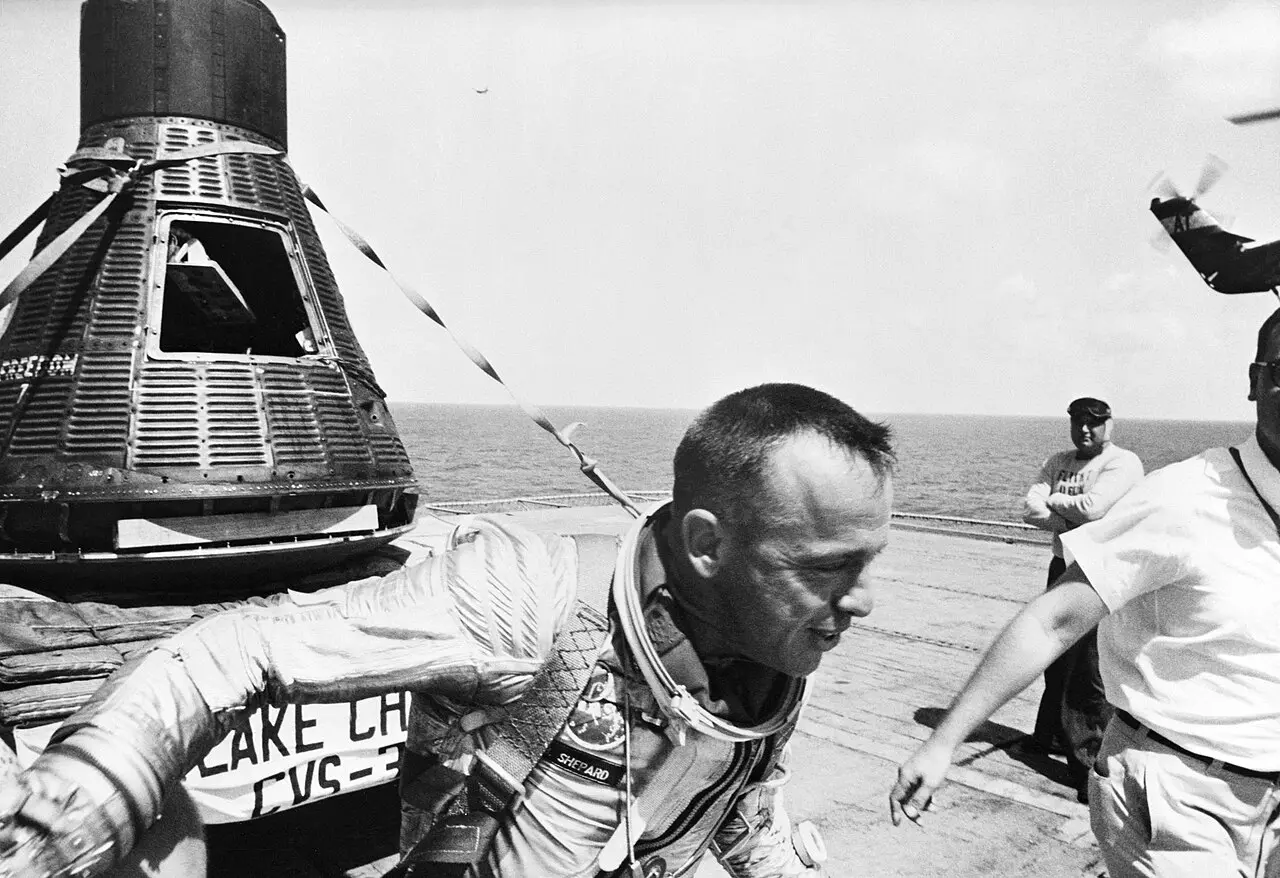
The flight lasted 15 minutes and 22 seconds and never reached orbit — a steep up-and-down arc 116 miles high. But in those minutes, Shepard became the first space traveler to manually control his craft's orientation, spent about five minutes weightless, and looked out at the Earth, marveling, "What a beautiful view." Then Freedom 7 fell back through the atmosphere, its heat shield glowing, and splashed into the Atlantic 302 miles from the launch pad. A helicopter fished capsule and astronaut from the sea and ferried them to the aircraft carrier USS Lake Champlain, where a grinning Shepard stepped onto the deck as a national hero.
The story didn't end there. Ten years later, Shepard commanded Apollo 14 and became the fifth person to walk on the Moon — where, with millions watching, he pulled out a makeshift club and hit two golf balls across the lunar dust. Not bad for a fifteen-minute commute.
Why it matters: Shepard's flight didn't beat the Soviets — but it proved America could fly a man into space and bring him home, and it turned a demoralized nation into believers. Eight years later, those believers landed on the Moon. Every giant leap starts with someone willing to light the candle.
Photo: NASA, public domain (via Wikimedia Commons).