The Day Europe Found a Sea Road to India
On May 20, 1498, Vasco da Gama's ships anchored off Calicut, India — completing the first sea voyage from Europe to Asia and changing world trade forever.
For decades, Portuguese sailors had been creeping farther and farther down the west coast of Africa, chasing a dream: a sea route to the riches of India — pepper, cinnamon, silk, and gold — that would free Europe from the middlemen who controlled the overland trade and its prices. Dozens of ships had been lost to storms, reefs, and hostile shores. Then King Manuel I of Portugal entrusted the gamble to a nobleman named Vasco da Gama.
Da Gama sailed from Lisbon in July 1497 with four ships and some 170 men. That November his little fleet rounded the Cape of Good Hope at Africa's southern tip — the point of no return — and turned north up Africa's eastern coast, stopping at Mozambique, Mombasa, and Malindi. At Malindi he took aboard an experienced Arab navigator, traditionally identified as Ahmad ibn Majid, to guide the fleet across the open Indian Ocean — a crossing no European had ever made.
On May 20, 1498, after nearly a year at sea, the ships anchored off Kappad, a beach near the great spice port of Calicut on India's Malabar Coast — today Kozhikode, in the state of Kerala. Da Gama had done it: he was the first European to reach India by sailing around Africa, linking Europe and Asia by ocean for the first time in recorded history.
The welcome was polite but cool. Da Gama was received by the Zamorin, the powerful ruler of Calicut, but the gifts he had brought looked shabby beside the treasures offered by the Arab, Persian, and Chinese merchants who already crowded the port — and those merchants saw the newcomers as dangerous rivals. The Portuguese left that August with little to show in trade goods but everything in knowledge: the route worked.
The return voyage was brutal. Scurvy and exhaustion killed many of the crew, and when da Gama finally sailed back into Lisbon in September 1499, only two of his four ships remained. But Portugal now held the key to the spice trade, and it would keep a commercial monopoly on the Cape route for decades. Da Gama was ennobled as Count of Vidigueira and, in 1524, named Viceroy of India.
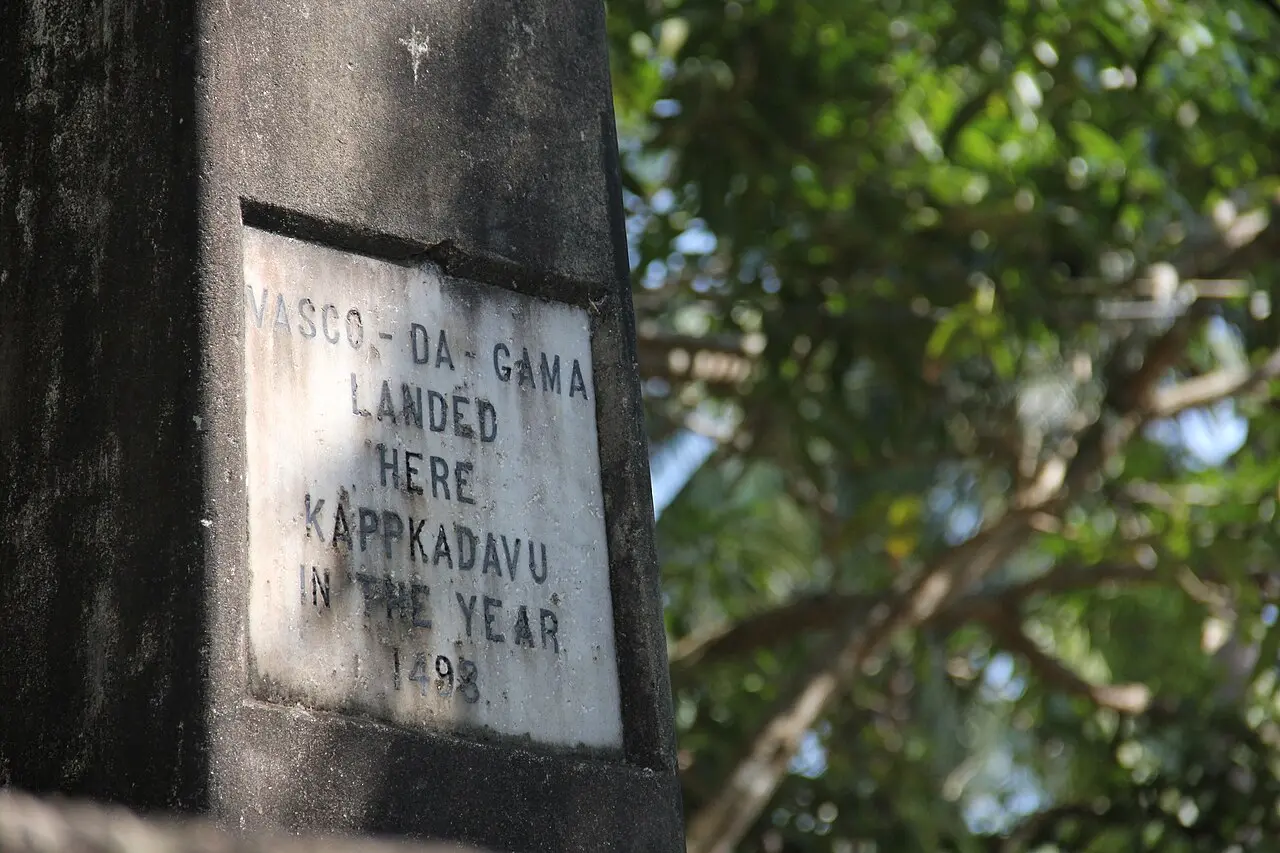
The voyage's shadow is as long as its glory: the sea road da Gama opened made Portugal rich, but it also ushered in centuries of European colonial power in Asia — conquest and hardship alongside trade. Both truths belong to the story. On the beach at Kappad, a weathered stone marker still stands where he came ashore, its inscription plain: "VASCO-DA-GAMA LANDED HERE... IN THE YEAR 1498." It marks the day the world got smaller — for better and for worse.
Photo: Join2manish, CC BY-SA 4.0 (via Wikimedia Commons).