
'Lucky Lindy' Takes Off for Paris
On May 20, 1927, Charles Lindbergh took off from Roosevelt Field for the first solo nonstop transatlantic flight, landing in Paris 33½ hours later.
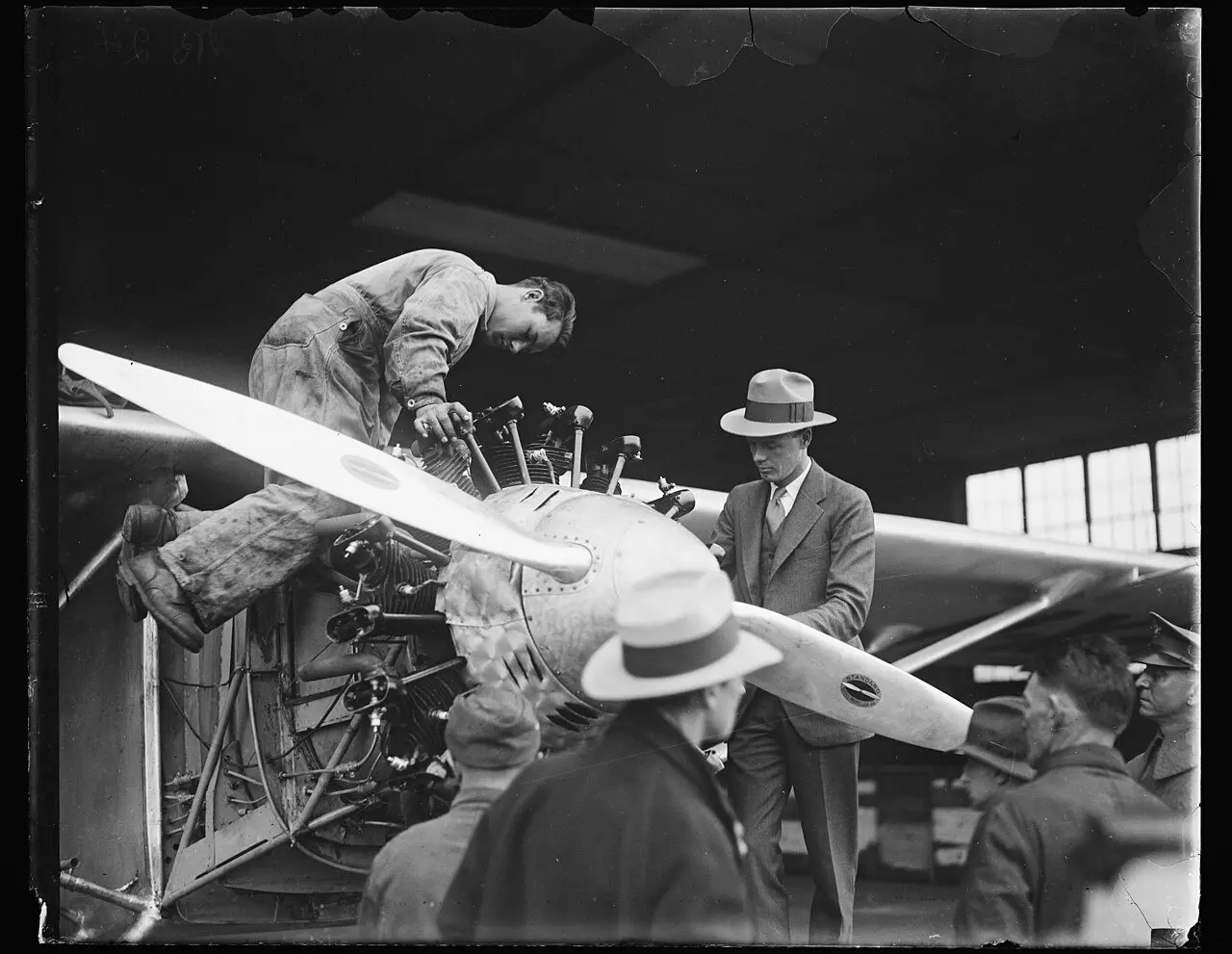
At 7:52 on a rainy morning, an unknown mail pilot aimed an airplane at a patch of sky over the Atlantic — and simply refused to come down.
Charles Lindbergh was 25 years old, a former barnstormer flying air mail between St. Louis and Chicago. In 1919 a New York hotel owner named Raymond Orteig had offered $25,000 to the first person to fly nonstop from New York to Paris, and by 1927 the prize was still unclaimed — six aviators had died trying. Lindbergh believed he could do it with a different recipe: not a big multi-engine machine, but a small, light, single-engine monoplane with room for little else but fuel. He had one custom-built in San Diego in just 60 days and named it the Spirit of St. Louis after his backers' hometown.
On May 20, 1927, he took off from Roosevelt Field on Long Island. The morning was wet and muddy, and the plane was so dangerously overloaded — more than 2,000 pounds of fuel — that it barely cleared the telephone wires at the end of the runway. He flew northeast up the East Coast and, as night fell, left Newfoundland behind and headed out over the open Atlantic. Alone in a cramped cockpit with no radio and no autopilot, his greatest enemy was sleep. He wrote later that he held his eyelids open with his fingers and hallucinated ghostly figures passing through the cockpit. For hours he flew blind through fog, navigating only by compass, stars and dead reckoning.
Then, after 33 and a half hours and 3,610 miles, lights appeared below — the coast of France. He landed at Le Bourget airfield outside Paris at 10:22 p.m. on May 21 to a surging crowd of some 150,000 people. He had done what no one had: the first solo, nonstop flight across the Atlantic, and the first nonstop flight between New York and Paris.
Lindbergh went to sleep a nobody and woke up the most famous man in the world. He was awarded France's Legion of Honor and America's Distinguished Flying Cross, and was cheered across Europe and America. More importantly, his flight changed minds. In 1927 most people still regarded airplanes as toys for daredevils; after Lindy, the public began to believe in aviation as something real — a machine that could carry ordinary people across oceans. The age of the airliner began in the slipstream of a young man who would not land.
Photo: Harris & Ewing, public domain (via Wikimedia Commons).