The Day Britain Said Goodbye to Churchill
On January 24, 1965, Winston Churchill died at his London home at age 90, and the world prepared the grandest farewell given to a statesman in modern times.
Shortly after 8 o'clock on the morning of Sunday, January 24, 1965, Winston Churchill died quietly at his London home, 28 Hyde Park Gate. He was 90 years old. Ten days earlier he had suffered a severe stroke, and the world had been holding its breath ever since, waiting on the daily medical bulletins. His physician, Lord Moran, issued a simple 18-word announcement: the great man was gone.
The date carried a final, eerie symmetry. Churchill died exactly seventy years to the day after the death of his father, Lord Randolph Churchill, on January 24, 1895. Within minutes, flags across Britain dropped to half-mast, church bells tolled, and special prayers were said in churches of every denomination. The BBC interrupted its regular programming, and newspapers around the world cleared their front pages.
Few lives have spanned so much history. Born in 1874 at Blenheim Palace, Churchill had ridden in the last great cavalry charge of the British Army at Omdurman in 1898, reported wars as a young journalist, and entered Parliament in 1900. He held nearly every great office of state, served as prime minister twice, and, above all, led Britain through the Second World War, when his speeches, his defiance, and his refusal to consider surrender stiffened a nation standing nearly alone against Nazi Germany. After the war he warned of the Soviet threat in his famous 1946 "Iron Curtain" speech, and in 1953 he won the Nobel Prize in Literature for his histories and orations.
What followed his death was a farewell without precedent for a commoner. On January 30, his coffin was borne to St. Paul's Cathedral for a state funeral attended by representatives of more than a hundred countries, with Queen Elizabeth II among the mourners. From the cathedral, the coffin traveled by barge up the River Thames, past dockworkers who lowered their cranes in salute, then by special train to Bladon in Oxfordshire, where he was laid to rest in the churchyard near his birthplace.
The tributes poured in from every corner of the globe. President Lyndon Johnson called him one of the greatest men of the age. Charles de Gaulle of France attended in person, setting aside years of prickly history with his wartime ally. Newspapers that had opposed him in life praised the wit, the tenacity, and the sheer scale of personality, the man who, in John F. Kennedy's phrase, had "mobilized the English language and sent it into battle."
Why does it matter? Churchill's death marked the passing of the last great figure of the Second World War's leadership, and the end of an era when one person's voice could steady an entire nation. Sixty years on, his life remains the supreme example of leadership under existential pressure, proof that words, courage, and stubbornness can change the course of history. Britain still pauses on the anniversary, and the world still studies how he did it.
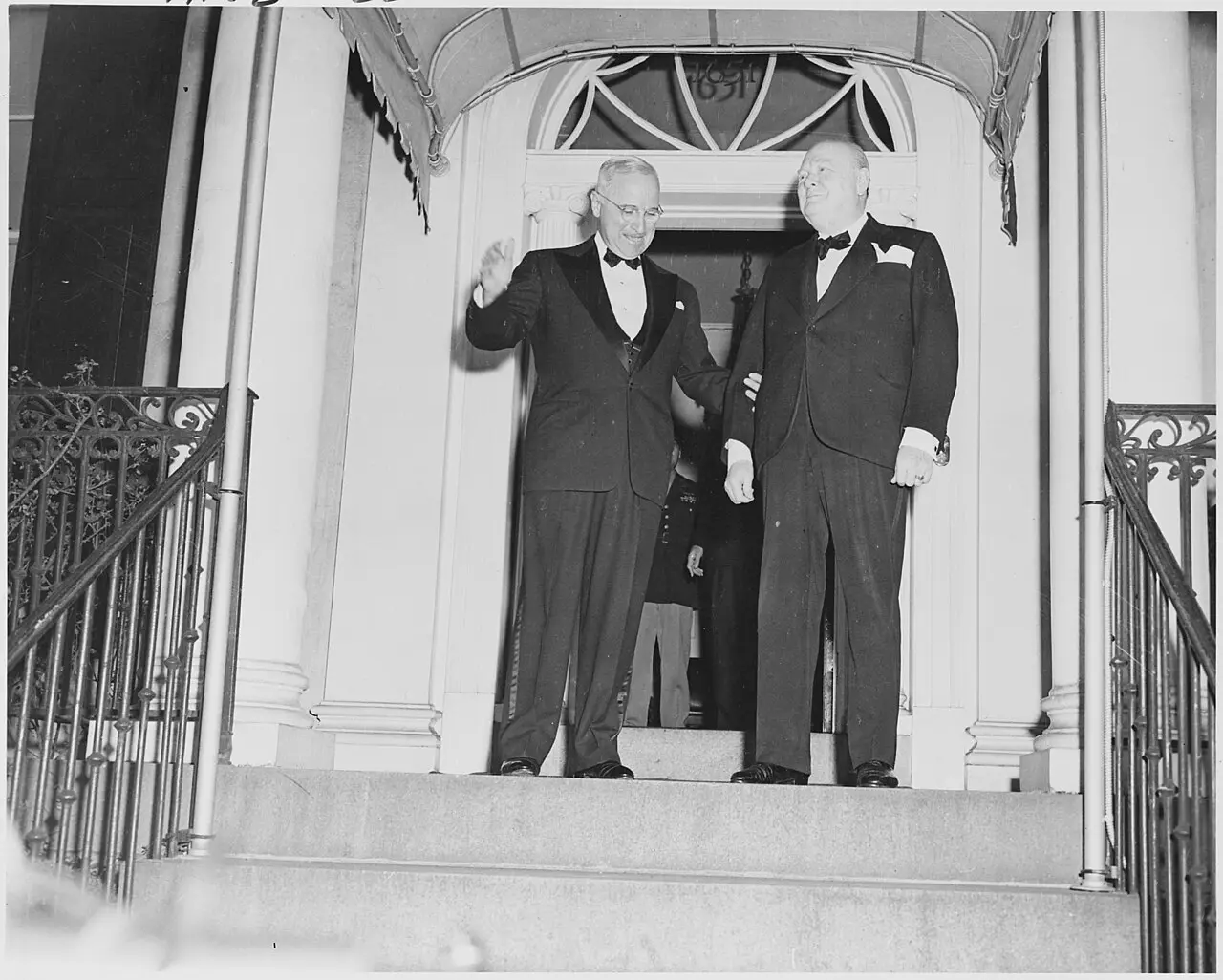
Photo: Abbie Rowe, U.S. National Archives, public domain (via Wikimedia Commons). Winston Churchill with President Harry Truman outside Blair House in Washington, D.C., in 1946, the year of his "Iron Curtain" speech.