The Lonely Flyby of the Sideways Planet
On January 24, 1986, NASA's Voyager 2 swept within 50,600 miles of Uranus, the first and still the only spacecraft ever to visit the tilted ice giant.
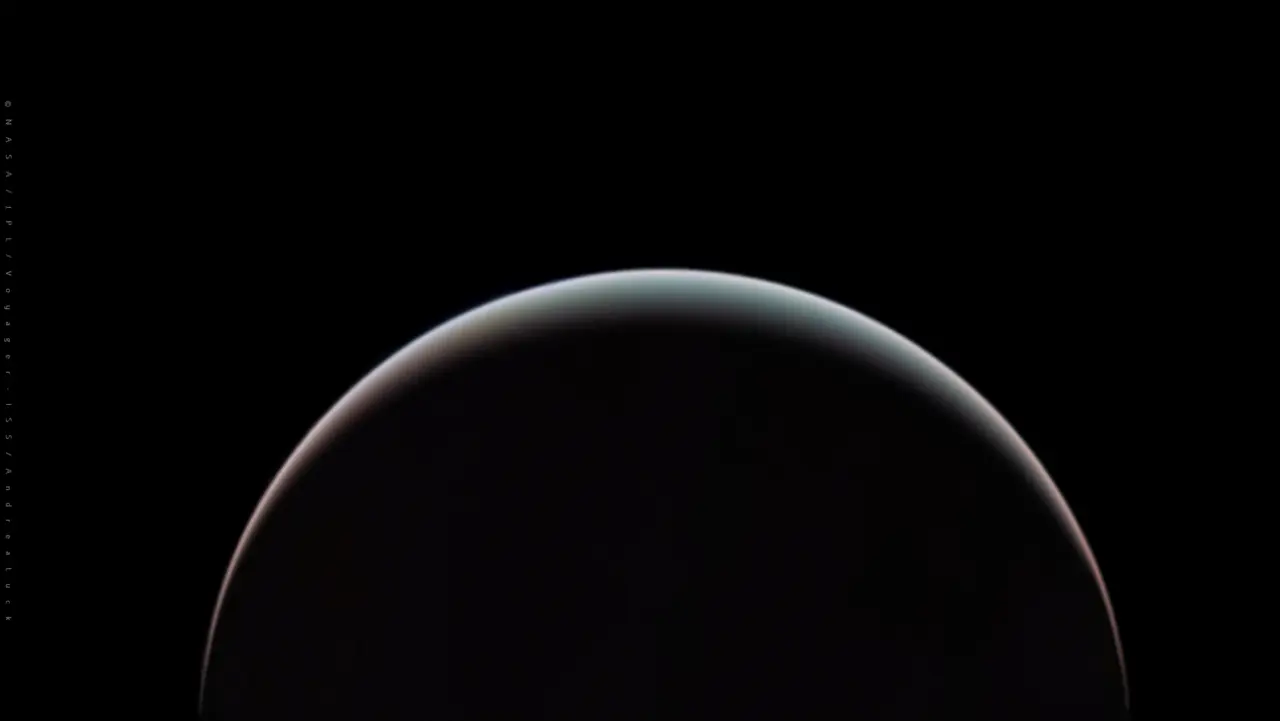
For eight and a half years it had been falling outward through the dark, past Jupiter, past Saturn, past a billion miles of nothing. Then, on January 24, 1986, NASA's Voyager 2 finally reached the strangest planet in the solar system, and in five and a half hours of close study it rewrote everything we thought we knew about Uranus.
Uranus is the oddball of the planets. Knocked on its side by some ancient collision, it rolls around the sun tipped 98 degrees, like a ball rolling on its edge, with each pole taking 21-year turns in sunlight and darkness. Voyager 2 arrived near the planet's southern solstice, so one entire hemisphere had been baking in decades of continuous daylight while the other froze in decades of night. No one knew what the probe would find.
At 17:59 Universal Time on January 24, the spacecraft swept within 81,500 kilometers, about 50,600 miles, of the pale blue-green cloud tops, closer than any human-made object had ever come. Radio signals carrying its data took two and a half hours to crawl back to Earth across nearly two billion miles of space, arriving in light 400 times dimmer than sunlight on Earth.
What Voyager saw was a world of quiet weirdness. Uranus, it turned out, is the coldest planet in the solar system, colder even than far-off Neptune, with an average temperature around minus 350 degrees Fahrenheit, because unlike the other giant planets it gives off almost no internal heat. Yet somehow heat moved evenly from pole to pole, keeping both hemispheres the same temperature despite one pole facing the sun for decades. The probe measured winds screaming through the atmosphere at 450 miles per hour and found evidence of a boiling ocean of water some 500 miles beneath the cloud tops.
The magnetic field was the biggest surprise. At every other planet it roughly lines up with the axis of spin, but at Uranus it was tilted about 55 degrees and shoved off-center, twisted by the planet's rotation into a long corkscrew tail streaming behind it. Voyager also discovered ten new moons, with Shakespearean names like Puck, Portia, Cordelia, and Ophelia, and two new rings to add to the nine already known from Earth. Its images of the moon Miranda revealed one of the most bizarre landscapes ever photographed: a patchwork of cliffs, grooves, and jumbled terrain that looked, as one scientist put it, as if the moon had been shattered and reassembled at random.
Voyager 2 had already completed its official mission at Saturn. The Uranus flyby was a bonus, made possible by engineers who had aimed the Jupiter encounter years earlier to slingshot the craft onward. From Uranus it flew on to Neptune in 1989, then outward to interstellar space, where it still travels today, now some 14 billion kilometers from the sun.
Why does it matter? In a single day in 1986, humanity met Uranus, and we have never been back. Every fact we know about the sideways planet, its moons, its rings, its corkscrew magnetosphere, comes from those few hours. As astronomers now plan a dedicated Uranus mission, Voyager 2's lonely flyby stands as a reminder of what one small machine, falling through the dark for nearly a decade, can accomplish.
Image: Andrea Luck, CC BY 2.0 (via Wikimedia Commons). A crescent view of Uranus processed from Voyager 2 imaging data taken during the January 1986 encounter; raw data courtesy NASA/JPL.