
A Sparkle in the Millrace: The Discovery That Built California
On January 24, 1848, James Marshall spotted gold flakes at Sutter's Mill, setting off the California Gold Rush and the largest mass migration in U.S. history.
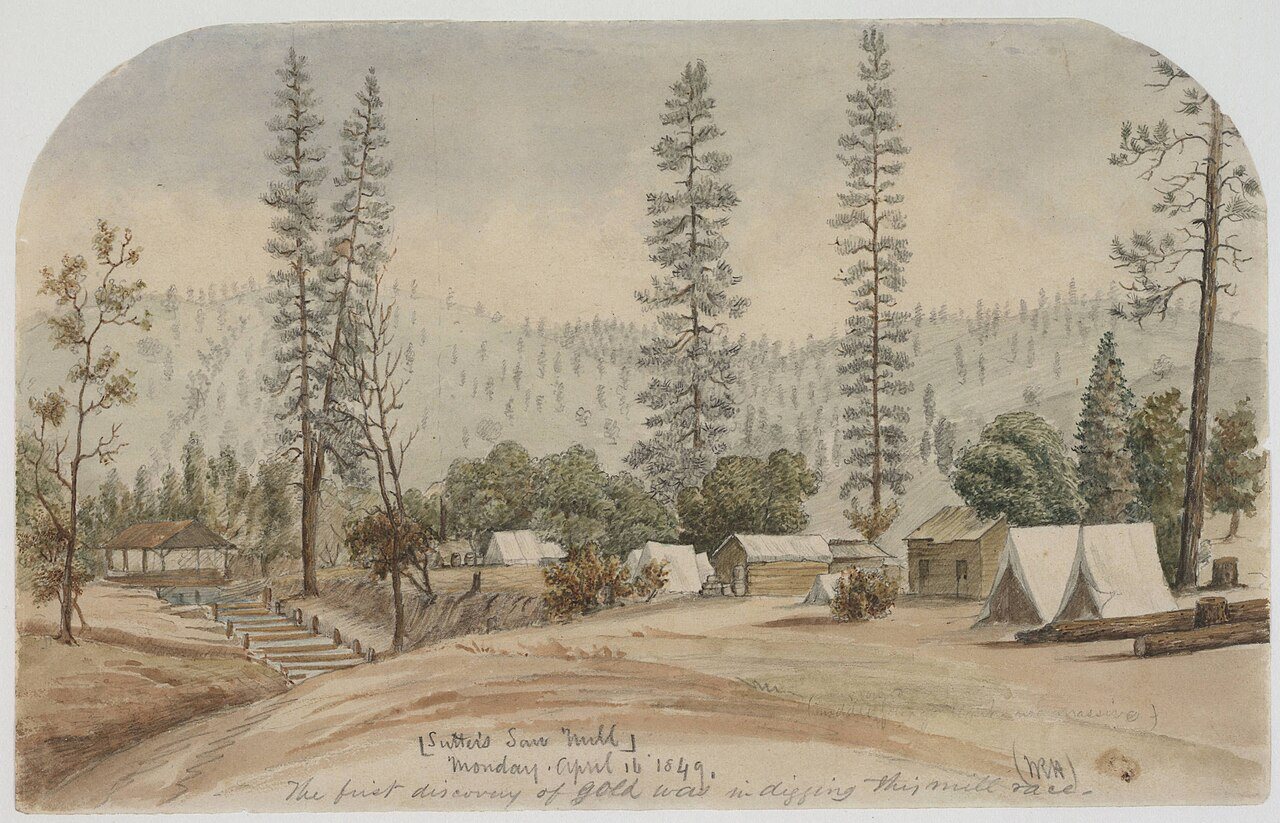
On the morning of January 24, 1848, a carpenter named James Wilson Marshall bent over a millrace in the Sierra Nevada foothills and saw a sparkle in the dark earth. He reached down and picked it up. "It made my heart thump," he would later say, "for I was certain it was gold."
Marshall was not a prospector. He was a millwright from New Jersey, hired by a Swiss settler named John Sutter to build a water-powered sawmill on the South Fork of the American River, near what is now Coloma, California. To make the mill work, Marshall had his crew dig the millrace deeper so water would flow more efficiently under the wheel. That routine bit of engineering exposed what had been hidden in the riverbed for ages: the water glittered with gold flakes.
Tests confirmed it. Workers bathed the flakes in lye; Marshall rode to Sutter's Fort, where the two men checked the metal against an encyclopedia and tested it with acid. It was pure gold. Sutter swore everyone to secrecy, knowing his workforce would desert him if word got out. The secret did not last.
Just days later, on February 2, the Treaty of Guadalupe Hidalgo ended the Mexican-American War and transferred California from Mexico to the United States, an extraordinary twist of timing. When President James K. Polk confirmed the gold discovery in his December message to Congress, the rush truly began. Over the next few years, roughly 300,000 people, the forty-niners, poured into California from across America, Latin America, Asia, and Europe, traveling by wagon, by ship around South America, and across the Panama isthmus. Miners would pull more than 750,000 pounds of gold from California's hills.
The transformation was staggering. San Francisco exploded from a sleepy port of fewer than 1,000 people to a booming city of 25,000. The flood of newcomers demanded government, and California was fast-tracked to statehood, joining the Union as the 31st state on September 9, 1850.
But the gold rush had a dark side that must be told honestly. For California's Native communities, the invasion brought disease, violence, and the loss of their lands, a catastrophe from which many never recovered. And for the two men at the center of it all, gold brought no fortune. Prospectors overran Sutter's lands, slaughtered his herds, and trampled his fields; by 1852 his empire was ruined, and he spent his remaining years petitioning the government for compensation. Marshall died poor as well.
Why does it matter? A few flakes in a millrace set off the largest mass migration in American history, built the state of California almost overnight, and proved that a single morning's discovery can redraw the map of a nation, for better and for worse.
Drawing: William Rich Hutton, public domain (via Wikimedia Commons).