The Day Anne Sullivan Opened Helen Keller's World
On March 3, 1887, a 20-year-old half-blind teacher arrived at an Alabama farmhouse to meet a deaf-blind 6-year-old — and began one of history's great transformations.
On March 3, 1887, a 20-year-old woman stepped off the train in Tuscumbia, Alabama, and walked up to a white cottage called Ivy Green. Her name was Anne Sullivan, and she was nearly blind herself. Waiting inside was her new pupil: Helen Keller, six years old, deaf and blind since a fever at nineteen months — a bright, wild child who communicated only through a handful of homemade signs and ruled the household with her temper. Helen would later call this "the most important day I remember in all my life... the light of love shone on me in that very hour."
The Kellers had searched desperately for help. They consulted Alexander Graham Bell — the telephone inventor, who devoted much of his life to deaf education — and he sent them to the Perkins School for the Blind in Boston. Perkins sent its star: Anne Sullivan, who had graduated valedictorian the year before.
Sullivan was no ordinary graduate. The daughter of poor Irish immigrants, she had developed trachoma at seven and remained legally blind until she was fifteen. When she was nine, her mother died of tuberculosis; a year later Anne and her little brother Jimmie were sent to the notorious Tewksbury Almshouse, where Jimmie died within months. Anne fought her way out and into Perkins, where she learned to read, to think, and to refuse to be pitied. She arrived in Alabama determined that no child would be written off the way she nearly had been.
She began at once, spelling words into Helen's palm with her fingers — d-o-l-l for the doll she had brought as a gift, c-a-k-e. Helen mimicked the finger movements eagerly but understood nothing; to her they were a game. Before language could begin, Sullivan decided, obedience had to come first. With the Kellers' reluctant permission, she moved Helen into the small garden cottage, away from the family's indulgence, and waged a two-week battle of wills. "I saw clearly that it was useless to try to teach her language or anything else until she learned to obey me," she wrote to a friend. "Obedience is the gateway through which knowledge, yes, and love, too, enter the mind of the child."
About a month later came the moment the world remembers. At the water pump, as cool water flowed over one of Helen's hands, Sullivan spelled w-a-t-e-r into the other — over and over — until suddenly Helen understood. The finger movements were not a game. They were names. Everything had a name, and names could be shared. In her autobiography, Helen described the revelation as the moment her soul was born: the dark, silent world cracked open, and language poured in.
What followed is legend: Helen learned to read Braille, to speak, to write; in 1904 she graduated from Radcliffe College, the first deaf-blind person to earn a bachelor's degree. She became an author, lecturer, and tireless advocate for people with disabilities, with Sullivan at her side for nearly fifty years.
It all began with a 20-year-old teacher who knew what it meant to be left in the dark — and refused to leave a child there.
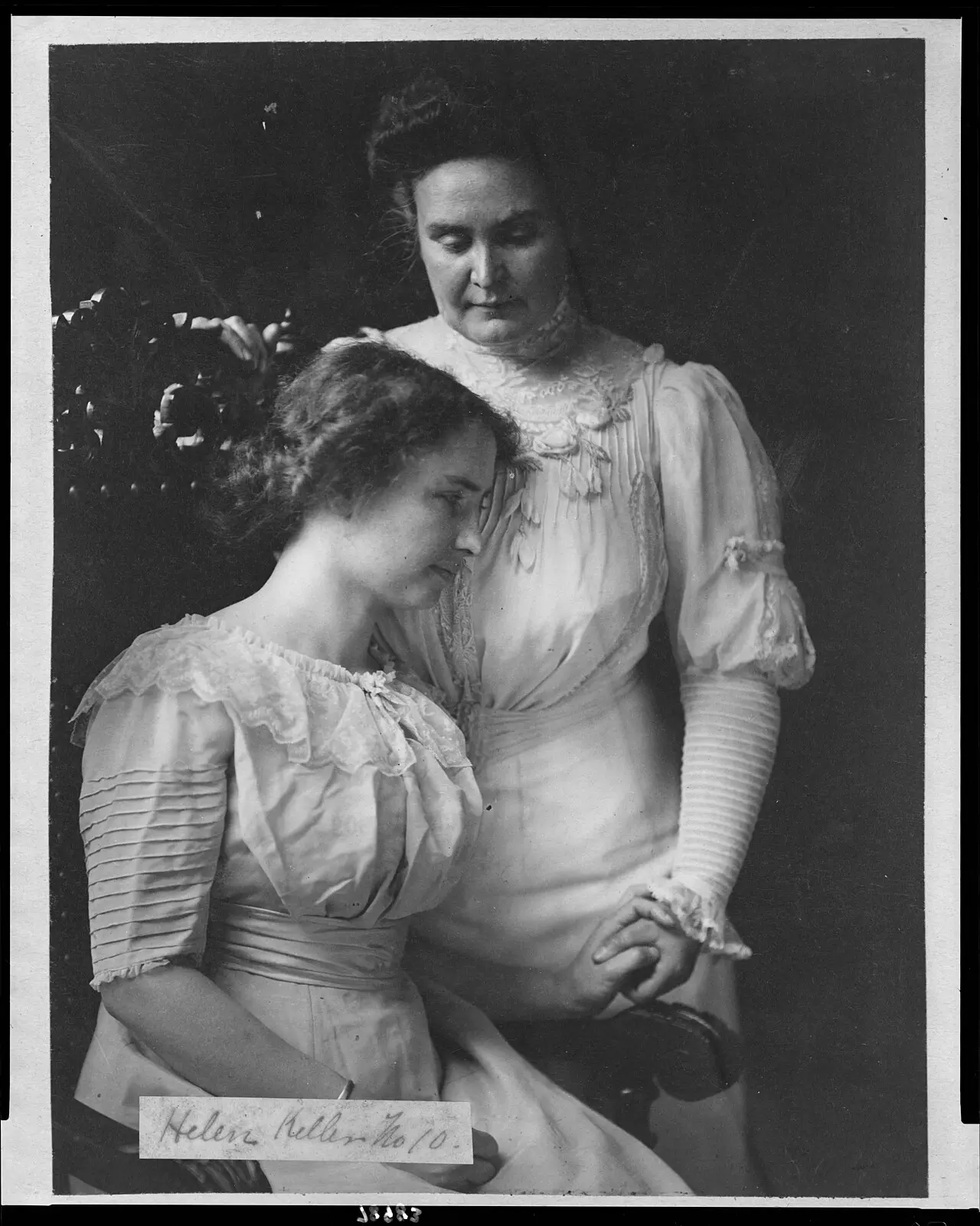
Photo: Helen Keller holding the hand of her teacher Anne Sullivan, photographed in 1909, Library of Congress, public domain via Wikimedia Commons.