The Day a Meteorite Crashed Through Ann Hodges' Roof
On November 30, 1954, an 8.5-pound meteorite crashed through Ann Hodges' Alabama roof and struck her as she napped — the only verified case of a meteorite injuring a human.
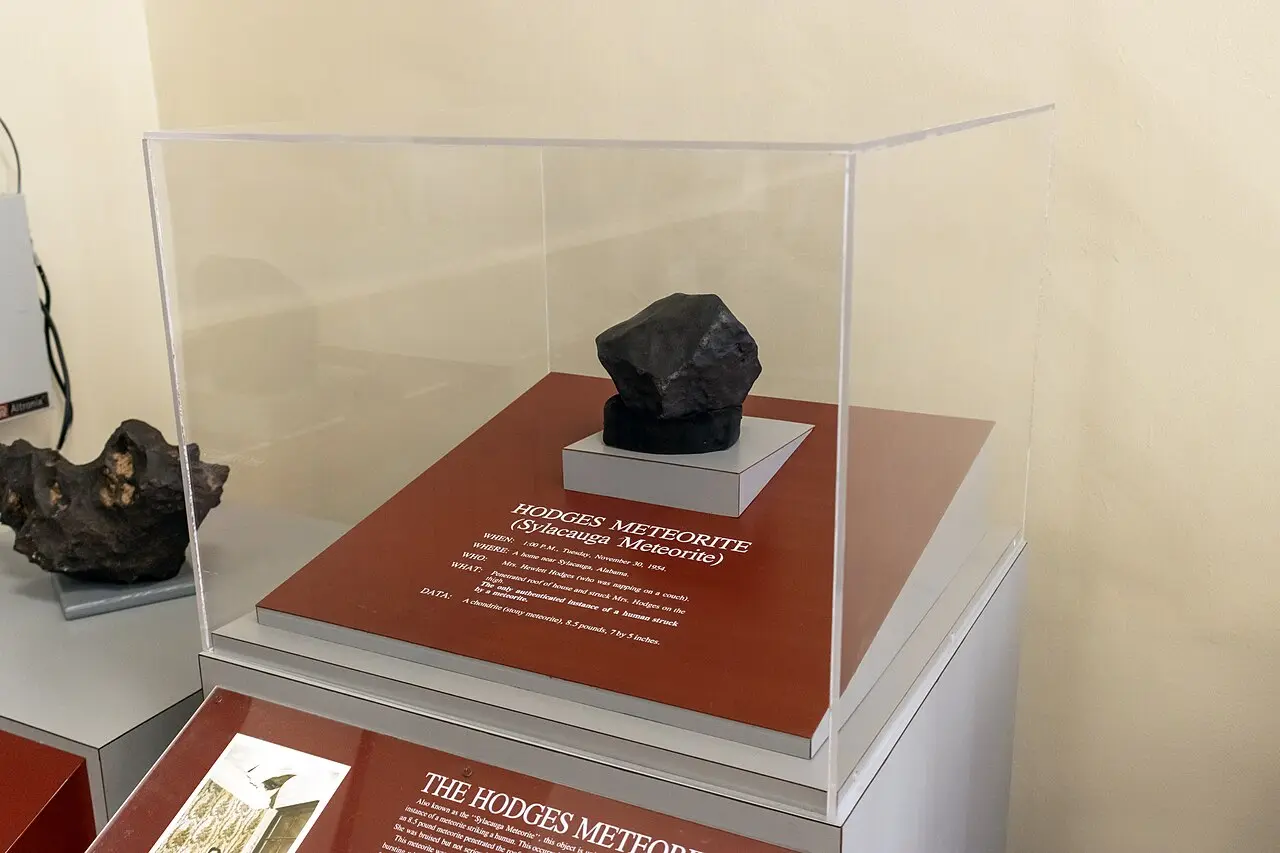
Ann Hodges was doing what thousands of Alabamians were doing on the afternoon of November 30, 1954: napping on the couch a few days after Thanksgiving. Outside her rented house in Oak Grove, near Sylacauga, witnesses saw a fireball streak across the sky and heard what sounded like explosions. Then, with a crash, a 4.5-billion-year-old rock from space punched a three-foot hole through her roof.
The grapefruit-sized meteorite, weighing about 8.5 pounds, slammed into her wooden console radio, ricocheted, and struck Hodges on the thigh and hand as she lay dozing under her quilts. She and her mother, home at the time, first thought the chimney had collapsed in the dust and debris. Her husband Eugene came home that evening unaware that anything had happened; she told him there had been "a little excitement." She went to the hospital the next day — less for the bruise than for the distress of the whole ordeal. What she had instead was an enormous, dark bruise — and a place in history.
Hodges became the first — and still only — person verified to have been injured by a direct meteorite strike. The rock was confiscated by the local police chief and the mayor, investigated by the Air Force, and passed to the Smithsonian. Then came a very earthly dispute: Hodges and her landlord fought in court over who owned the fallen rock. She won — and, over her husband's objections, donated it to the Alabama Museum of Natural History in 1956.
For a while she was famous: she appeared on the TV quiz show "I've Got a Secret," posed for newspaper photographers with the rock and the hole in her ceiling, and Life magazine ran a photo of her bruise under the headline "A big bruiser from the sky." Scientists identified the stone as a chondrite — an H4 ordinary chondrite, richer in iron and nickel than most specimens — likely broken off an asteroid between Mars and Jupiter. Its twin — the meteorite split as it fell — landed a few miles away and now sits in the Smithsonian's collection. Decades later, in 2017, a mere 10.3-gram chip of the Hodges stone sold at auction for $7,500.
Ann Hodges died in 1972, never having profited from her cosmic encounter. Her meteorite is still on display in Alabama — proof that the odds, however astronomical, occasionally come due.
Photo: Kai NeSmith, CC BY 4.0 (via Wikimedia Commons).