The Committee of Five: Drafting America's Declaration
On June 11, 1776, Congress appointed five men — including Jefferson, Adams, and Franklin — to draft the document that became the Declaration of Independence.
The most famous sentence in American history began as a committee assignment. On June 11, 1776, the Continental Congress handed five men a daunting job: write the document that would justify treason — and call it independence.
Four days earlier, on June 7, Virginia delegate Richard Henry Lee had stood in the Pennsylvania State House in Philadelphia and moved that "these United Colonies are, and of right ought to be, free and independent states." Congress debated the resolution but held off on a vote, hoping more colonies would come around. In the meantime, on June 11, it appointed a committee to draft a declaration in anticipation of the expected vote.
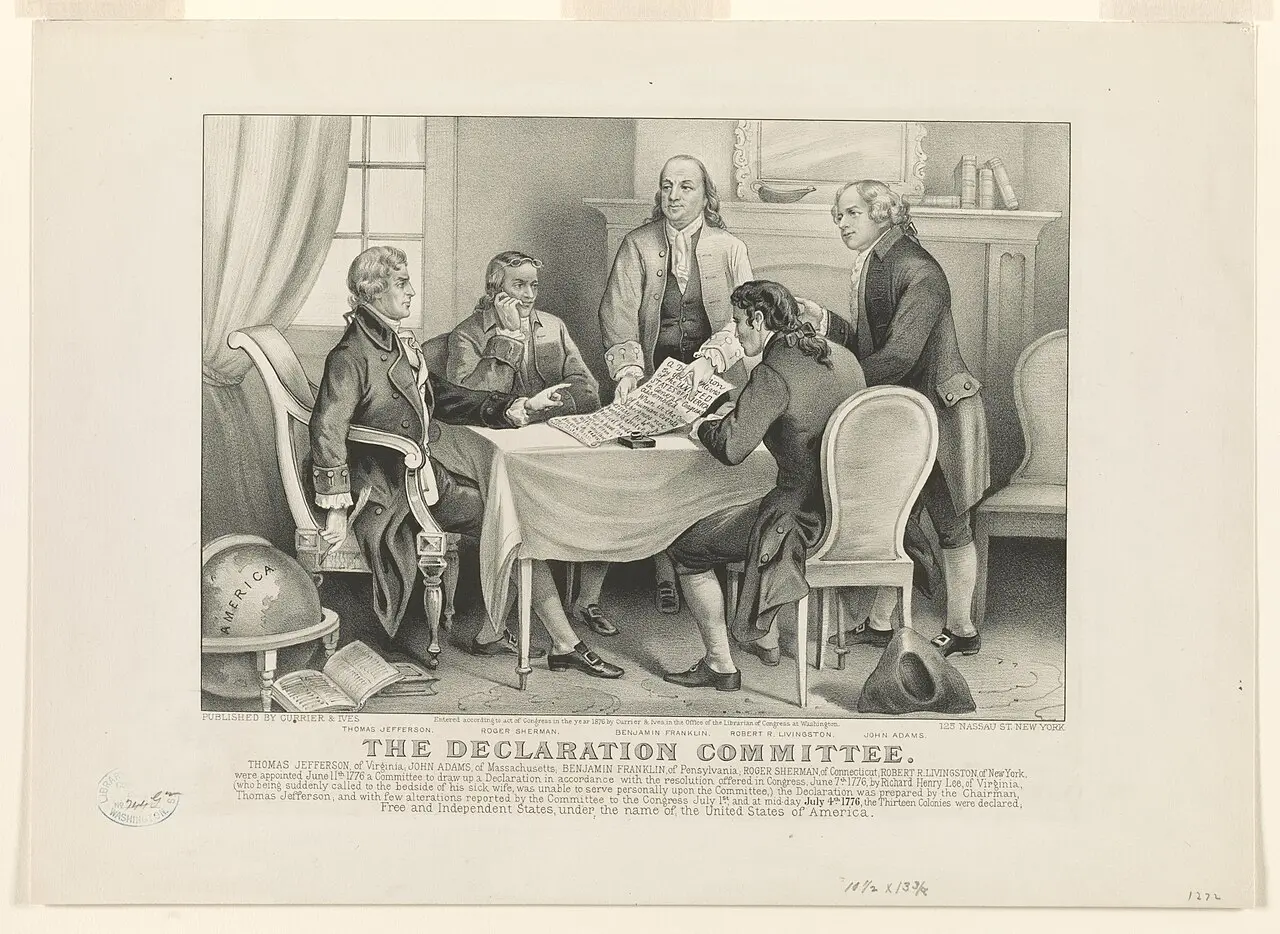
The declaration committee — soon famous as the Committee of Five — was a roster of the revolution's heaviest hitters: Thomas Jefferson of Virginia, John Adams of Massachusetts, Benjamin Franklin of Pennsylvania, Roger Sherman of Connecticut, and Robert R. Livingston of New York.
Adams, the fiercest champion of independence in the room, did the smartest thing a committee chairman can do: he gave the writing job to someone else. Knowing Jefferson's way with a pen, Adams pressed the quiet 33-year-old Virginian to author the first draft. Jefferson wrote the bulk of it between June 11 and June 28, with Adams and Franklin reviewing and revising his pages.
Jefferson later recalled that the committee held several meetings to settle the declaration's outline before handing him the pen. His surviving "original Rough draught," now in the manuscript collections of the Library of Congress, shows the committee's fingerprints: Franklin and Adams made edits in their own hands before the document ever reached the full Congress.
On June 28 the committee laid its draft before Congress. After days of debate and editing — and after Congress had voted for independence itself on July 2 — the Declaration was formally adopted on July 4, 1776, its preamble declaring that "all Men are created equal" and endowed with "certain unalienable Rights," among them "Life, Liberty, and the Pursuit of Happiness."
Why it matters: July 4 gets the fireworks, but June 11 was the starting gun. Without that committee appointment, there is no draft, no debate, no Declaration. The five men chosen that day produced a document that outgrew its moment — cited by abolitionists, suffragists, and civil-rights leaders, and echoed in independence movements around the world. It all began with five names read aloud in a Philadelphia meeting room.
Photo: Currier & Ives, public domain (via Wikimedia Commons).