The Anthem That Closed Woodstock
On the morning of August 18, 1969, Jimi Hendrix closed Woodstock with a searing Star-Spangled Banner that became the sound of a generation.
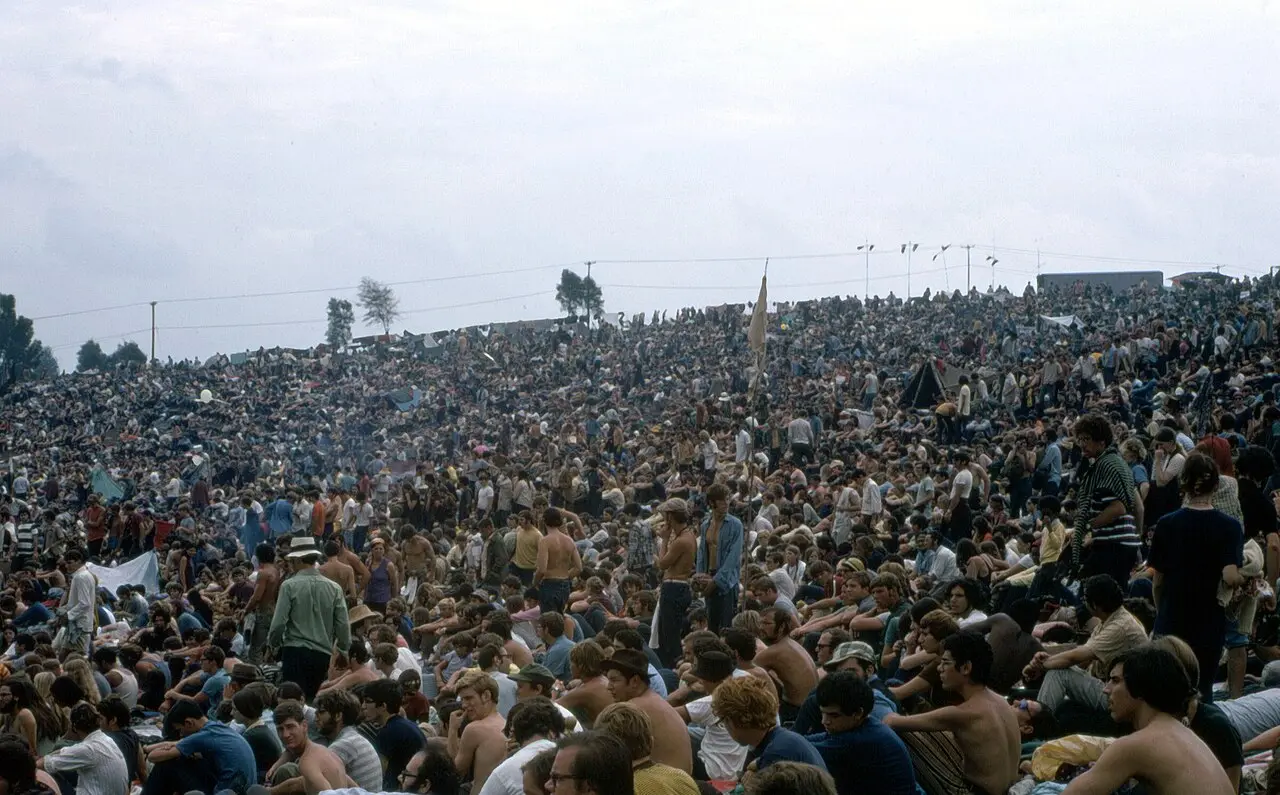
By the time the headliner played, most of the audience had gone home.
Jimi Hendrix — the highest-paid act at the Woodstock Music & Art Fair — had been scheduled to close the festival on Sunday night, August 17, 1969, on Max Yasgur's 600-acre dairy farm in Bethel, New York. But rain delays and a jammed schedule of 32 acts pushed everything back by hours. Hendrix was offered the midnight slot and turned it down. He would close the festival in the morning instead.
So it was around 9 a.m. on Monday, August 18, that Hendrix finally walked onto a damp stage in a blue-beaded white leather jacket with fringe and a red headscarf, backed by a brand-new band, Gypsy Sun and Rainbows — old friend Billy Cox on bass, Mitch Mitchell on drums, plus Larry Lee, Juma Sultan, and Jerry Velez. The peak crowd of some 400,000 had thinned to a fraction of itself; those who remained were tired, muddy, and about to witness the most famous guitar performance of the century.
What followed was a two-hour set — the longest of Hendrix's career — roaming through "Purple Haze," "Voodoo Child," "Red House," "Foxy Lady," and "Hey Joe." Midway through, on a spontaneous impulse, he launched into "The Star-Spangled Banner." It was not the anthem anyone knew. Using feedback, his whammy bar, and distortion, Hendrix bent the melody into falling bombs, screaming rockets, and hovering helicopters — the sounds American soldiers were hearing in Vietnam at that very moment. He even wove in a fragment of "Taps," the bugle call of military funerals. It was at once a tribute and a protest, a love letter and a scream.
The cameras caught it all. In a stroke of luck, the clear morning light gave the Woodstock film crew perfect shooting conditions, and the footage carried that Monday morning into legend. Interpretations have argued ever since — was it patriotism, was it dissent? Hendrix himself never settled it, which may be the point. Everyone agrees on what it felt like: a portrait of a nation at war with itself, played on one electric guitar, and the single most imitated guitar performance of the rock era.
Hendrix had barely a year left. He died on September 18, 1970, at 27. But on that Monday morning, for the muddy faithful who stayed, he gave the sixties their closing anthem — not with a speech, but with six strings and feedback.
Photo: Woodstock Whisperer, CC BY-SA 4.0 (via Wikimedia Commons).