The 14-Day Flight That Made the Moon Possible
On December 4, 1965, astronauts Frank Borman and Jim Lovell launched aboard Gemini 7 for a grueling two-week mission that proved humans could survive the trip to the Moon.
Imagine spending two weeks locked in the front seat of a car — with another person, no shower, no standing up, no fresh air, and nowhere to go. That was the assignment Frank Borman and Jim Lovell accepted on December 4, 1965, when their Titan II rocket roared off Launch Complex 19 at Cape Kennedy at 2:30 that afternoon, carrying them into orbit aboard Gemini 7.
The stakes could hardly have been higher. NASA was racing to the Moon, but nobody knew whether the human body could survive the round trip. The longest anyone had spent in space was eight days — the crew of Gemini V had come home exhausted and depleted. Gemini 7 would nearly double that. As NASA's chief medical officer put it, the flight would "medically commit man to a lunar mission." If Borman and Lovell broke down, the Moon would have to wait.
The two astronauts, both members of NASA's second astronaut class, had prepared obsessively. They had learned from earlier crews to sleep and work on the same schedule, and they had talked NASA into lightweight pressure suits they could partially remove — a small mercy in a cabin one of them compared to a men's room. Conditions were miserable anyway: stuffy noses, burning eyes, stale warm air. As the rocket cleared the pad, Lovell yelled to his commander: "We're on our way, Frank!"
Eight days into the ordeal came the mission's second act. On December 15, Gemini 6A — carrying Wally Schirra and Tom Stafford — launched and pulled off the first rendezvous of two crewed spacecraft in history, maneuvering to within about a foot of Gemini 7's hull. For hours the two tiny ships flew in formation, and the photographs Schirra snapped of Gemini 7 against the blackness of space became some of the most famous images of the Space Age.
Borman and Lovell splashed down after nearly fourteen days aloft — an endurance record that stood for years. Both men flew again: together with Bill Anders, they became the crew of Apollo 8, the first humans to orbit the Moon, at Christmas 1968. Lovell would later command the ill-fated Apollo 13. But everything they did afterward rested on what they had proven in that cramped capsule.
Gemini 7 answered the question the entire Moon program depended on: yes, human beings can live and work in space long enough to get to the Moon and back. It was not a glamorous flight — no Moon rocks, no giant leaps. Just two men enduring, day after grinding day, so that bolder journeys could follow. Every lunar voyage traces back to a December afternoon in 1965, when two astronauts climbed into a phone booth and stayed there for two weeks.
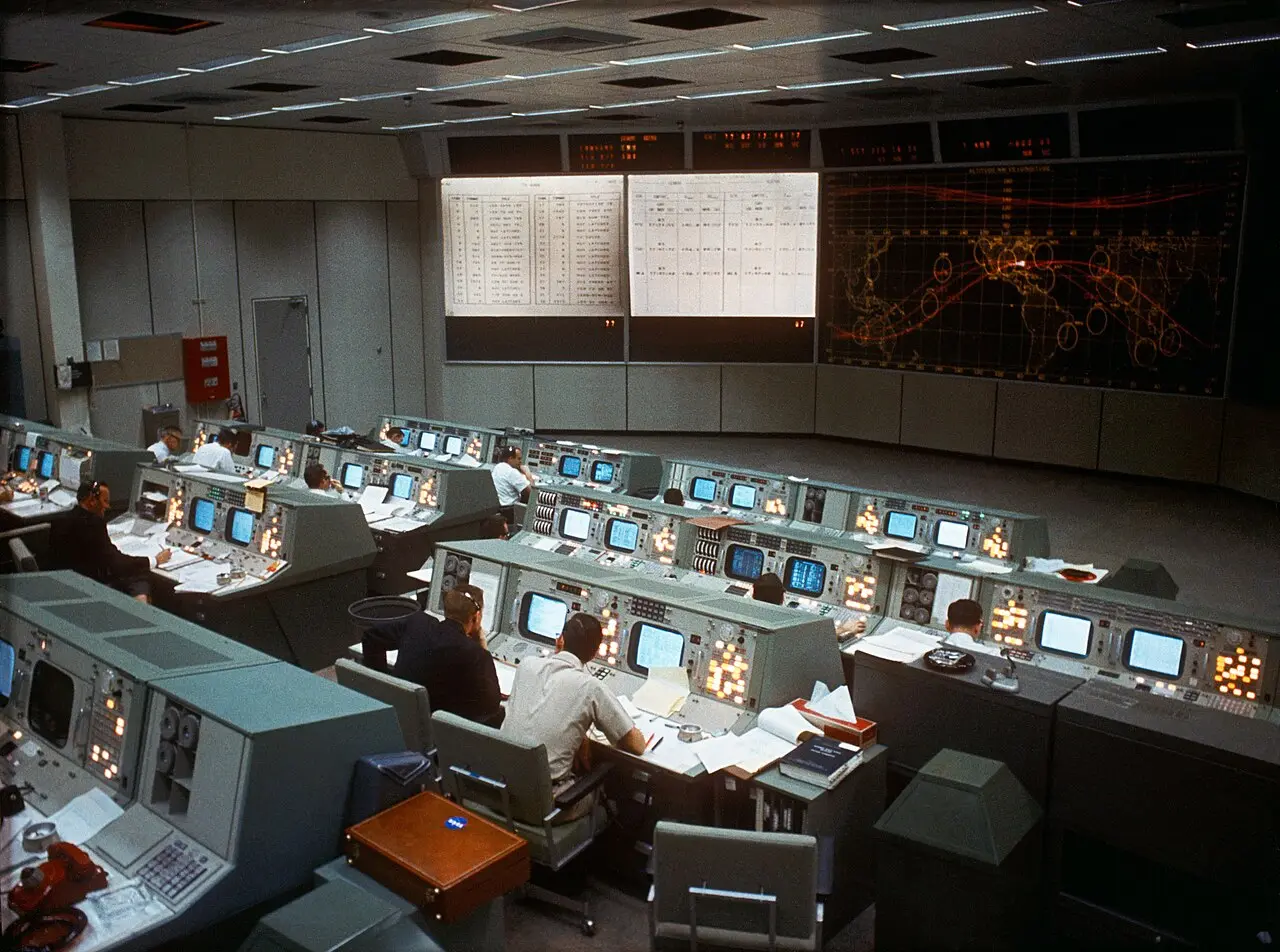
Photo: NASA, Public domain (via Wikimedia Commons).