The General Who Walked Away From Power
On December 4, 1783, George Washington summoned his officers to Fraunces Tavern in New York, raised a glass in farewell, and chose civilian life over military power.
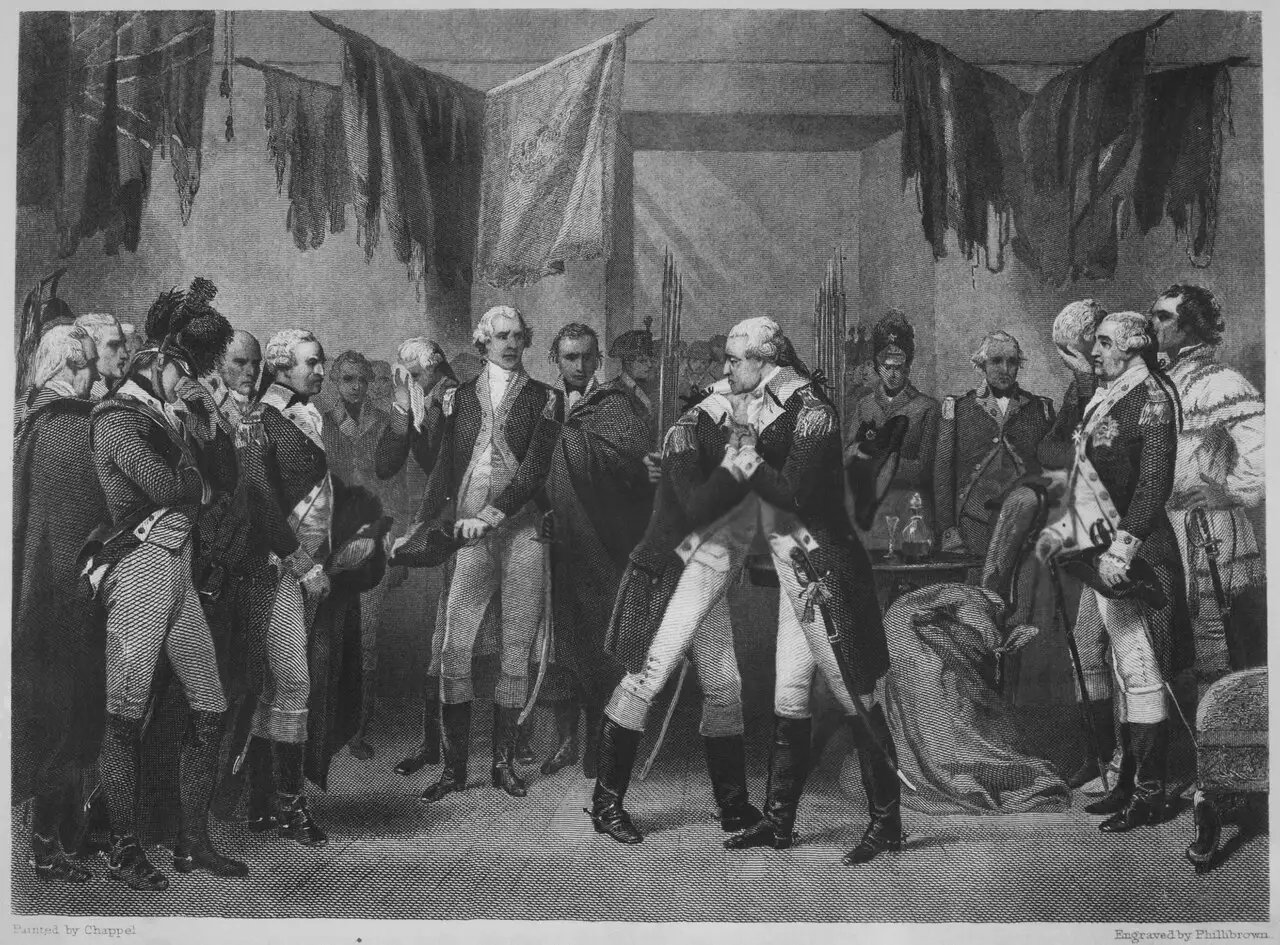
The most powerful man in America was weeping. On the afternoon of December 4, 1783, George Washington walked into the Long Room of Fraunces Tavern in New York City, filled a glass of wine, and turned to face the officers who had followed him through eight years of war. What happened next would become one of the most famous farewells in history — not because Washington seized power, but because he was giving it up.
The war was won. The last British soldiers had sailed out of New York Harbor on November 25, and Washington had ridden into the liberated city in triumph. The Treaty of Paris was signed; American independence was a fact. Now the commander in chief had one final duty: saying goodbye to the men of the Continental Army.
At noon, his senior officers gathered at the tavern on Pearl Street. The best-known account comes from Colonel Benjamin Tallmadge, who wrote his memoirs decades later. As Tallmadge recalled, Washington's emotions were too strong to conceal. After a few moments of almost breathless silence, the general filled his glass and spoke: "With a heart full of love and gratitude I now take leave of you. I most devoutly wish that your latter days may be as prosperous and happy as your former ones have been glorious and honorable."
Then came the moment no one expected. "I cannot come to each of you," Washington said, "but shall feel obliged if each of you will come and take me by the hand." General Henry Knox stepped forward first. Washington — "suffused in tears," Tallmadge wrote — grasped his hand and embraced him in silence. One by one, every officer in the room came forward to do the same. "Such a scene of sorrow and weeping," Tallmadge wrote, "I had never before witnessed."
Washington then walked out into streets lined with a silent guard of honor, boarded a barge at Whitehall, and sailed for Annapolis. There, on December 23, he stood before Congress and resigned his commission as commander in chief. The next morning he rode for Mount Vernon, arriving home on Christmas Eve, a private citizen at last. When Britain's King George III was told that the victorious American general intended to resign and retire to his farm, he is said to have replied: if he does that, he will be the greatest man in the world.
History is full of generals who turned victory into a throne — Caesar, Cromwell, Napoleon. Washington turned his into a farm. His farewell at Fraunces Tavern was the moment the American Revolution became a republican revolution: proof that the army served the republic, not the other way around. The Long Room where he wept with his officers still exists, preserved as the centerpiece of the Fraunces Tavern Museum. The precedent he set that December afternoon — that leaders lay down power and go home — remains the foundation of American democracy.
Photo: Engraving by Phillibrown after a painting by Alonzo Chappel, Public domain via the U.S. National Archives (Wikimedia Commons).