Sixteen Men and a Balloon Over the North Pole
On May 12, 1926, the airship Norge carried Roald Amundsen, Umberto Nobile, and Lincoln Ellsworth over the North Pole — the first undisputed flight over the top of the world, then on to Alaska.
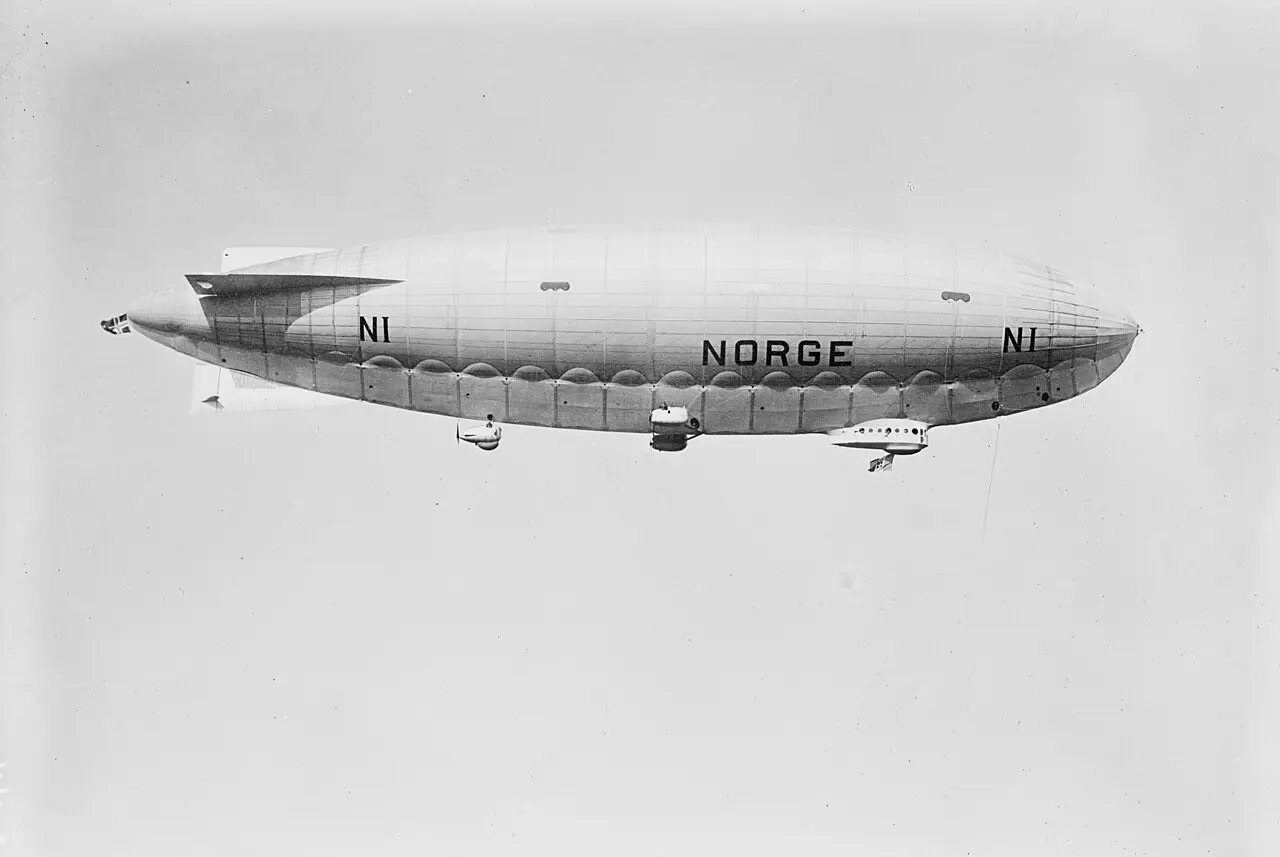
Just after one in the morning on May 12, 1926, sixteen men drifted silently over the top of the world. Below them: nothing but ice, stretching white to every horizon. Above them: a 348-foot Italian airship with NORGE painted on its flank. They had done what no one in history had ever verifiably done — flown over the North Pole.
The expedition was a three-way gamble. Roald Amundsen, the Norwegian who had beaten Robert Scott to the South Pole in 1911, was the leader. Lincoln Ellsworth, a wealthy American explorer, put up much of the money. And Umberto Nobile, the Italian engineer who had designed the airship, flew it. Their crew of sixteen — Norwegians, Italians, an American, and a Swede — lifted off from Ny-Ålesund in Spitsbergen on May 11 and droned north through fog and icing that nearly ended the flight more than once.
Getting the Norge to the Arctic had been an expedition in itself. Nobile had flown her all the way from Rome — by way of London, Oslo, Leningrad, and Vadsø — a delivery flight of some 4,500 miles across a continent, before she ever pointed her nose at the Pole. And aboard with the sixteen men was an unlikely seventeenth crew member: Titina, Nobile's small fox terrier, who rode in the control car the whole way and became the expedition's mascot.
The Pole itself was almost an anticlimax: at about 1:25 in the morning, the navigators fixed their position, and three flags — Norwegian, American, and Italian — fluttered down onto the ice. Then the Norge kept going, crossing the entire Arctic Ocean to land at Teller, Alaska, some 72 hours after leaving Spitsbergen. It was the first verified overflight of the North Pole, and the first flight across the polar cap between Europe and America.
The achievement came shadowed by rivalry. Three days earlier, American Richard Byrd had claimed to reach the Pole by airplane — a claim later challenged and still debated by historians, which is why the Norge's flight stands as the first undisputed one. And the triumph curdled into feud: Amundsen and Nobile quarreled bitterly afterward, Amundsen charging that the Italian flags dropped at the Pole had been bigger than the others. Two years later, Nobile's airship Italia crashed on the ice; Amundsen vanished in 1928 while flying to rescue him.
For all its bitterness, the flight proved something magnificent: the Arctic, the great blank on the map, could be crossed by air. Polar aviation — and with it the modern age of intercontinental flight — began with sixteen men in a hydrogen airship, dropping flags onto the ice at the top of the world.
Photo: unknown photographer, public domain (via Wikimedia Commons).