"Love Day": The Invasion of Okinawa Begins
On April 1, 1945, more than 50,000 U.S. troops stormed ashore on Okinawa, opening the bloodiest battle of the Pacific War.
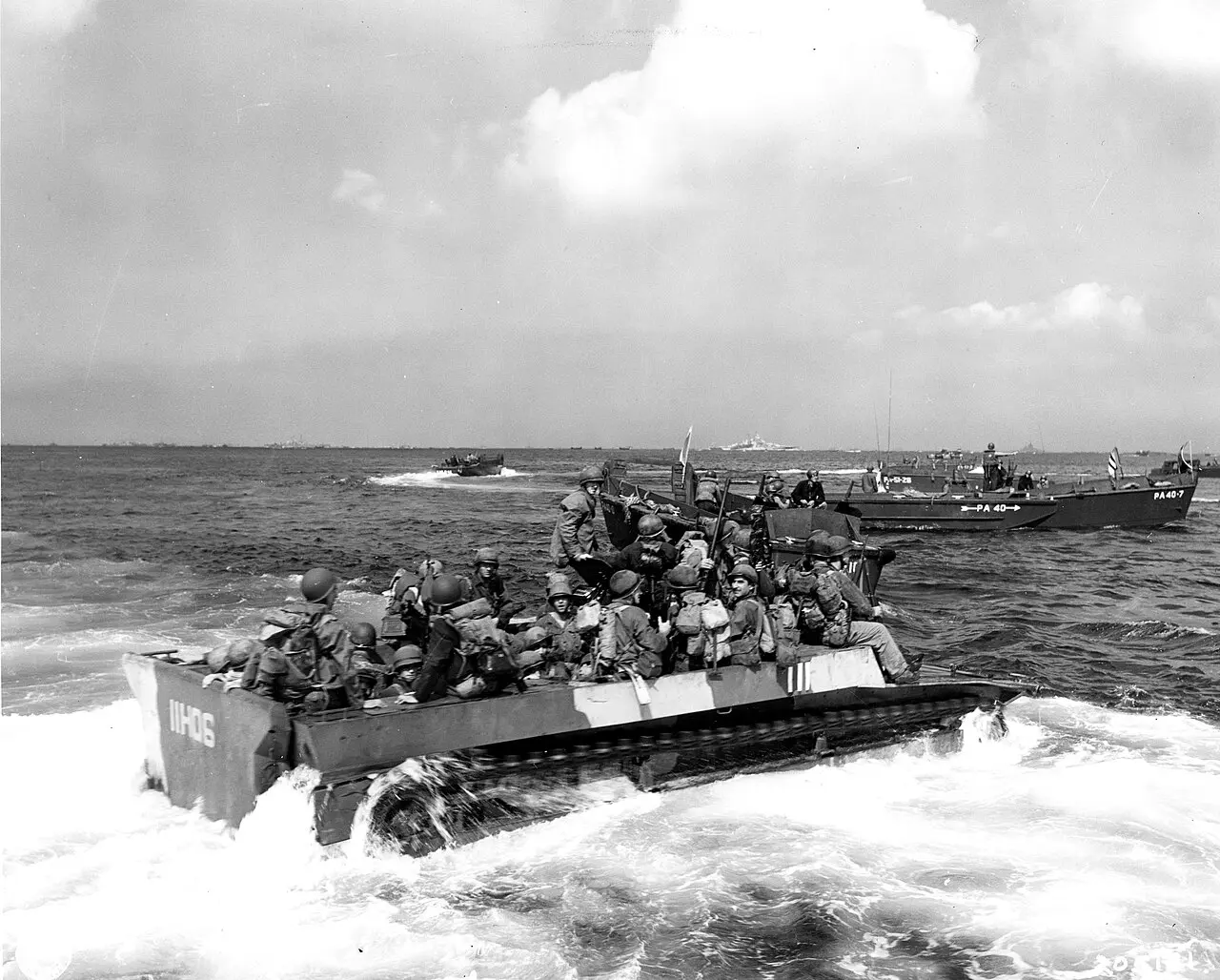
At dawn on Easter Sunday, April 1, 1945, the greatest armada the Pacific had ever seen closed in on a small island 350 miles south of Japan. More than 1,300 American ships — plus 50 British ones — carried the U.S. Tenth Army toward Okinawa for Operation Iceberg. The troops knew the landing day as L-Day — "Love Day."
War correspondent Ernie Pyle watched the first waves go in and could hardly believe what he saw. "Never before had I seen an invasion beach like Okinawa," he wrote. "There wasn't a dead or wounded man in our whole sector of it... The carnage that is almost inevitable on an invasion was wonderfully and beautifully not there."
By day's end, more than 50,000 American troops were ashore — and the Japanese had barely fired a shot. The Americans quickly seized the Kadena and Yontan airfields and pushed inland to cut the island's narrow waist, while the Japanese army waited in the south.
The quiet was a trap. Lieutenant General Mitsuru Ushijima, commanding Japan's 32nd Army of roughly 120,000 troops, had made a deliberate choice: no fight on the beaches. Instead his men waited in a maze of caves, tunnels, and ridgelines in the island's rugged south, around Shuri Castle, ready to bleed the Americans in a battle of attrition. The plan worked. What followed was nearly three months of the bloodiest fighting of the Pacific War — cave by cave, ridge by ridge, under waves of kamikaze attacks that sank 26 Allied ships and damaged 168 more.
The cost was staggering. More than 12,000 American soldiers, sailors, and Marines died; total U.S. casualties topped 50,000. Around 100,000 Japanese troops were killed. And an estimated 100,000 or more Okinawan civilians — roughly one in four people on the island — died in the crossfire or by their own hand as the battle consumed their homes.
The battle claimed its commanders too. Lieutenant General Simon Bolivar Buckner Jr., leading the Tenth Army, was killed by Japanese artillery fire on June 18 — the highest-ranking American officer to die in the war. Ushijima took his own life in the ritual manner of a defeated Japanese commander as organized resistance collapsed days later. Amid the fighting at Hacksaw Ridge, an Army medic named Desmond Doss — a conscientious objector who refused to carry a weapon — rescued 75 wounded comrades and earned the Medal of Honor.
Why it matters: Okinawa showed what an invasion of Japan's home islands would cost — and the price was unthinkable. The battle's terrible arithmetic loomed over every plan made in Washington that summer, in the final weeks before the war ended.
Photo: U.S. Army Signal Corps, public domain (via Wikimedia Commons).