Italy Joins the Great War: The Declaration of May 23, 1915
On May 23, 1915, Italy declared war on Austria-Hungary, abandoning its old allies and opening a brutal 600-kilometer mountain front that would bleed both armies for three and a half years.
On May 23, 1915, Italy did something that shocked Europe: it went to war against its own allies. Though formally a member of the Triple Alliance with Germany and Austria-Hungary since 1882, Italy had declared itself neutral when war broke out in August 1914, arguing that its treaty obligations did not cover an offensive war. For nine months both sides courted Rome. On May 23, Italy chose — declaring war on Austria-Hungary and joining the Allies.
The decision had been made in secret weeks earlier. On April 26, 1915, Foreign Minister Sidney Sonnino signed the Treaty of London with Britain, France, and Russia, promising Italy's entry into the war within a month in exchange for rich territorial prizes: Trentino and the South Tyrol up to the Brenner Pass, Trieste, parts of Dalmatia, and other Austrian lands. Prime Minister Antonio Salandra saw the war as the triumphant climax of the Risorgimento — the completion of Italian unification by freeing Italian-speaking lands from Austrian rule. Parliament, voting extraordinary war powers on May 20, went along.
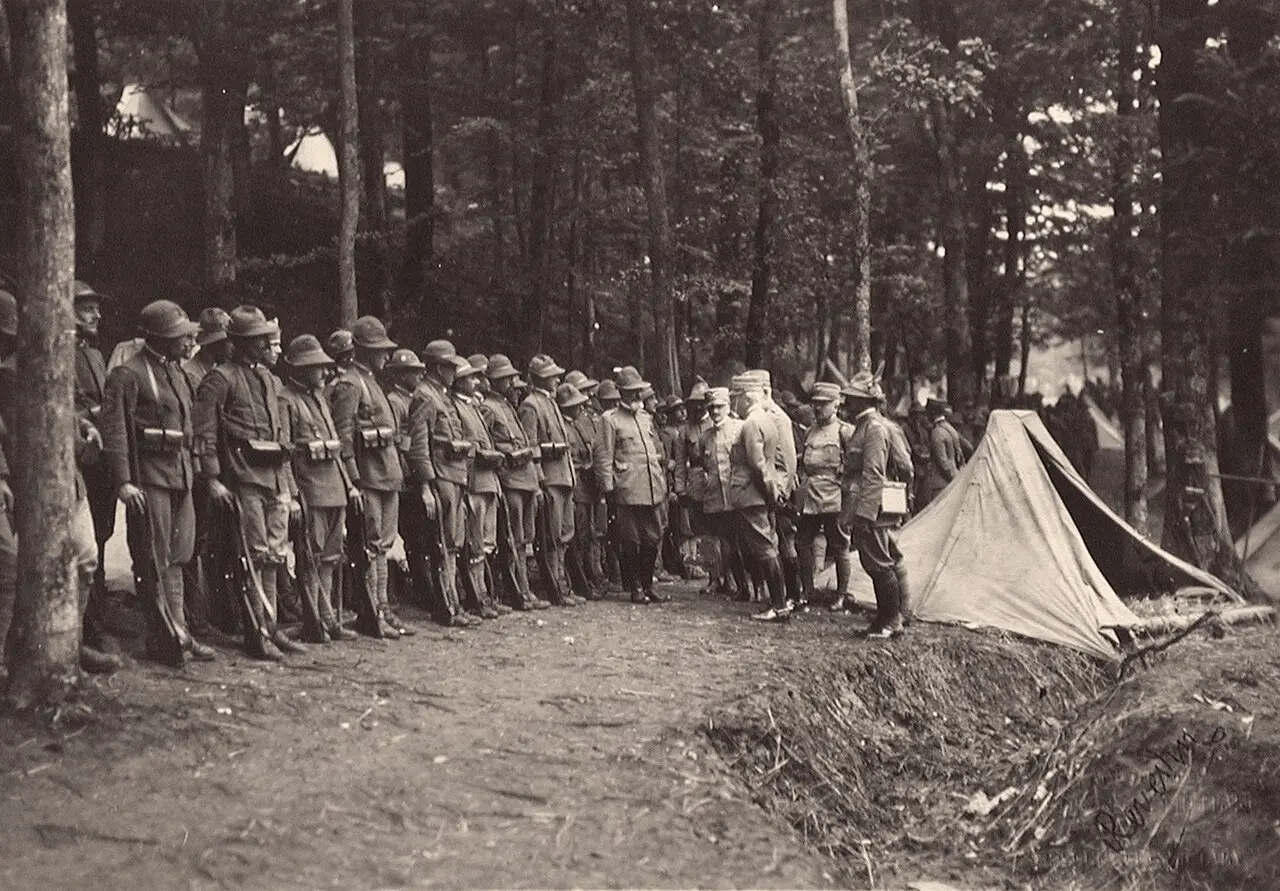
What followed was one of the grimmest campaigns of the war. The new front stretched some 600 kilometers, most of it through the Alps and the Dolomites — the "White War," fought in snow and ice at altitudes where avalanches killed as surely as shells. Italy mobilized 1.2 million men in the spring of 1915 but had equipment for only about 732,000. Italian troops advanced into the South Tyrol and toward the Isonzo River, where Austro-Hungarian troops met them with a stiff defense in treacherous mountain terrain.
The fighting settled into a brutal stalemate. By late 1917 the two sides had fought no fewer than eleven battles along the Isonzo, with negligible gains and terrible losses on both sides. Then, in late October 1917, German troops reinforced the Austrians and smashed the Italian line at Caporetto — the Twelfth Battle of the Isonzo — inflicting some 300,000 Italian casualties, about 90 percent of them prisoners, and forcing a desperate retreat. The disaster toppled the army's chief of staff, Luigi Cadorna, replaced him with Armando Diaz, and brought a coalition government under Vittorio Orlando.
With British, French, and later American help, Italy recovered, and the war on the Italian front ended in victory at Vittorio Veneto in October and November 1918. The territorial promises of London were only partly kept — Dalmatia went mostly to Yugoslavia — sowing resentment that would poison Italian politics for a generation. But the deeper legacy was human: an enormous toll of dead in a war Italy had chosen freely on May 23, 1915 — a choice made for land, glory, and the dream of completing a nation's unification.
Photo: Italian Army Photographers 1915–1918, CC BY 2.5 (via Wikimedia Commons).