"It Is Well That War Is So Terrible"
On December 13, 1862, Union troops launched wave after wave of frontal assaults against Confederate defenses at Marye's Heights, in one of the Civil War's most one-sided battles.
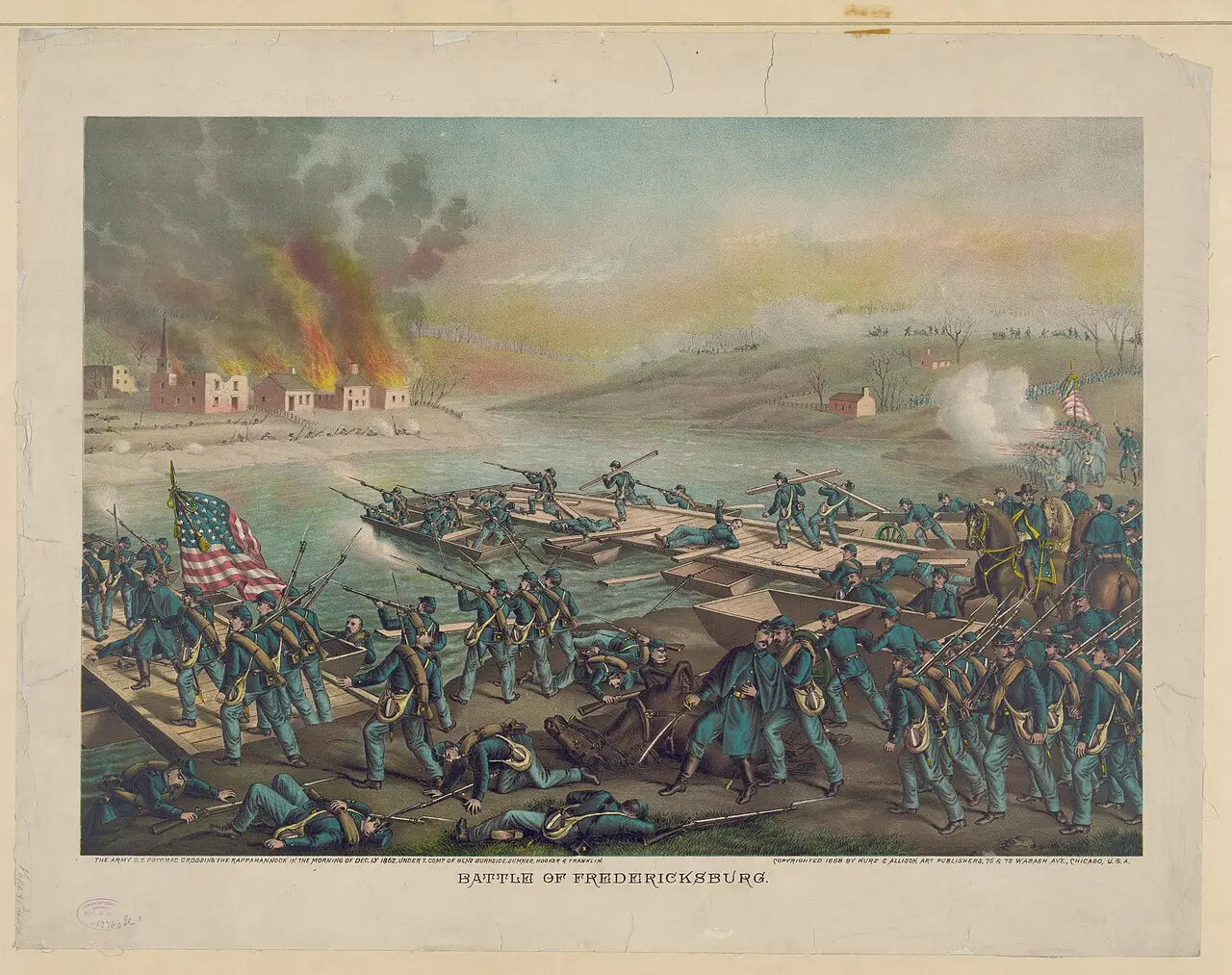
Just before dawn on December 13, 1862, the mist lifted over the Rappahannock River, and the Army of the Potomac began one of the most futile marches in American military history.
Its commander, Maj. Gen. Ambrose Burnside, had taken charge only weeks earlier after President Lincoln dismissed George McClellan for moving too slowly. Washington wanted action and a strike at Richmond, the Confederate capital. Burnside's plan was sound enough: cross the river at Fredericksburg quickly and punch through before Robert E. Lee's Army of Northern Virginia could concentrate. But the army's pontoon bridges arrived days late, and by the time Union soldiers crossed on December 11–12, Lee had dug in on the heights behind the town — most formidably along Marye's Heights, where his men waited behind a stone wall fronting a sunken road.
On the 13th, Burnside ordered frontal assaults anyway. At the southern end of the line, near Prospect Hill, Union troops briefly broke through, only to be thrown back. Then, brigade after brigade, the blue columns stepped across some 600 yards of open ground below Marye's Heights and into a storm of rifle fire from Confederates who never had to leave cover. Fourteen separate assaults went forward; not one reached the wall. A Confederate officer watching wrote afterward of the Federals' courage, born of duty and love of country — and of how no courage could overcome the position.
By nightfall the fields were carpeted with the dead and wounded, and the freezing cold finished many of the wounded left lying out. The Union had lost 12,653 men, more than 1,280 of them killed; the Confederates about 5,370, with just over 600 dead. Northern newspapers called it the "Fredericksburg Butchery." Lee, surveying the slaughter, is reported to have said: "It is well that war is so terrible, or we should grow too fond of it."
Burnside withdrew across the river on December 15. A month later he was relieved of command, replaced by Joseph Hooker. The battle ended any immediate Union threat to Richmond and set the stage for Lee's invasion of the North the following summer — and for Gettysburg.
Fredericksburg was the most one-sided major battle of the Civil War, and its lesson endures: courage alone cannot beat entrenched firepower, and a general's duty is to read the ground before ordering men to cross it. The battlefield is preserved today as part of the Fredericksburg and Spotsylvania National Military Park, where the stone wall still stands.
Photo: Lithograph by Kurz & Allison, Chicago, public domain (via Wikimedia Commons).