A Large Land, Uplifted High: New Zealand's First European Sighting
On December 13, 1642, Dutch explorer Abel Tasman became the first European to sight New Zealand, spotting the Southern Alps from 60 miles offshore.
Near noon on December 13, 1642, a lookout aboard a Dutch yacht did something no European had ever done: he saw New Zealand.
The man in charge was Abel Janszoon Tasman, a seasoned skipper in the service of the Dutch East India Company — the mighty VOC — which had ordered him to hunt for the fabled southern continent, Terra Australis Incognita, rumored to lie somewhere in the vast Pacific. He had sailed from Batavia (today's Jakarta) on August 14, 1642, with two ships, his flagship the yacht Heemskerck and the smaller flute Zeehaen, carrying 110 men in all.
On November 24 he had already found one new land, naming it Van Diemen's Land after his patron, Governor-General Anthony van Diemen (it would later be renamed Tasmania). Then the ships turned east, and strong winds pushed them farther east than intended, across the sea that now bears his name.
Tasman's diary entry for December 13 reads, in translation: "towards noon saw a large land, uplifted high," lying southeast of the ships. His reckoning put him at 42°10' south, off what is now Punakaiki on the South Island's west coast. He thought the land was only about 15 miles away — but he measured in Dutch miles, each one four English miles, so he was really some 60 miles, about 100 kilometers, offshore. What he was seeing was almost certainly the Southern Alps; from that distance he may even have glimpsed the far southern peaks later named Mount Cook and Mount Tasman.
Tasman named the land Staten Landt — "Land of the States-General" — for the Dutch parliament, because he believed it might connect to a Staten Island his countrymen had found off South America decades earlier. He had no idea he was looking at the islands that would one day be called New Zealand.
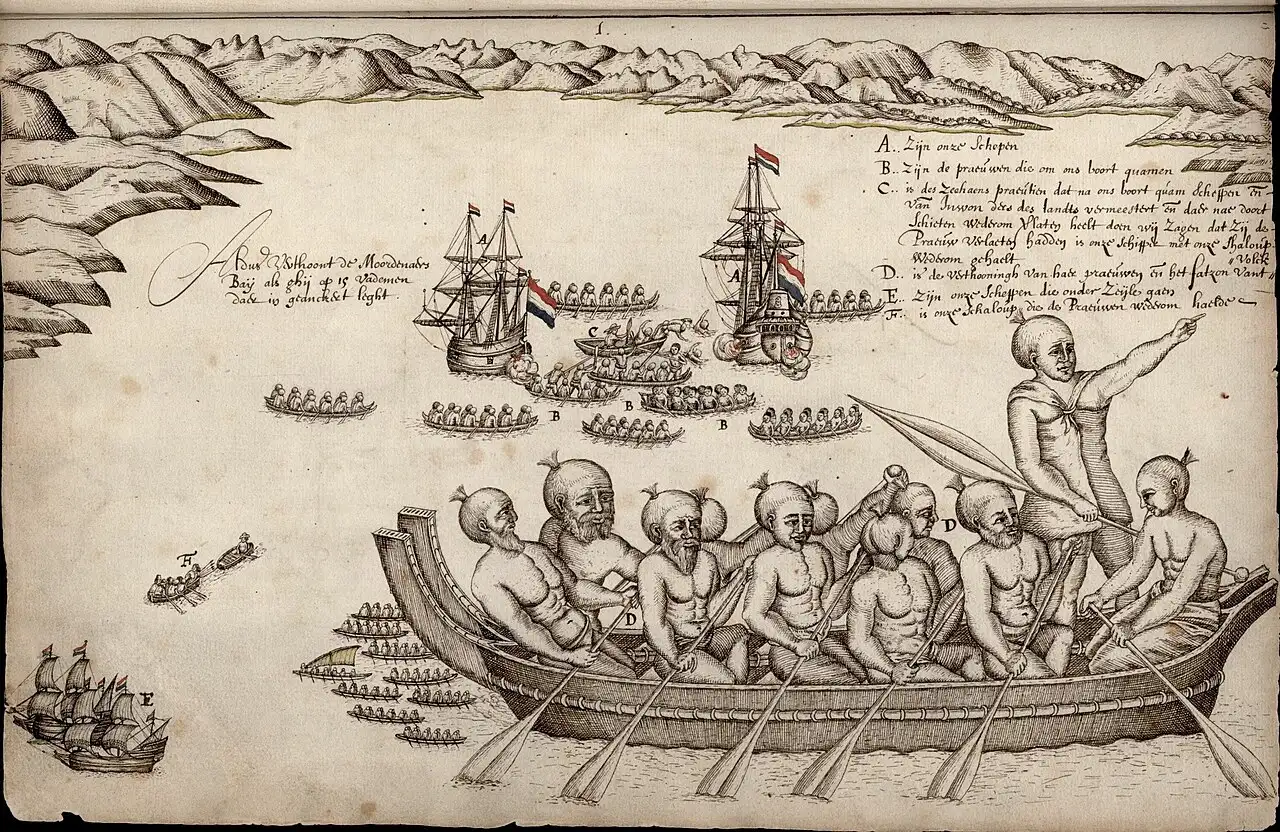
He would never set foot there. On December 18 the ships anchored in what is now Golden Bay, and waka (canoes) of the Ngati Tumatakokiri people came out to inspect the strangers. A tense encounter spiraled: the Dutch fired a cannon in answer to ritual challenges, a waka rammed one of the ships' boats, and four of Tasman's men were killed. Tasman named the anchorage Moordenaers Baij — Murderers' Bay — and sailed on, north along the coast and away by early January 1643. The expedition's artist, Isaack Gilsemans, sketched the encounter, producing the first European images of Maori people.
The VOC, unimpressed by a voyage that found no gold and no spices, sent Tasman home to Batavia, where he arrived in June 1643. It would be 127 years before another European — Captain James Cook in 1769 — returned. Yet the sighting on December 13, 1642, is the moment New Zealand entered European history, and the names linger: the Tasman Sea, Tasman Bay, and the Abel Tasman National Park, where the monument to that first encounter still stands.
Photo: Drawing by expedition artist Isaack Gilsemans (1642) of the Dutch ships in Golden Bay, New Zealand, public domain (via Wikimedia Commons).