Into the Valley of Death: The Charge of the Light Brigade
On October 25, 1854, a misunderstood order sent about 670 British horsemen riding straight into Russian guns on three sides.
At 11:10 on the morning of October 25, 1854, about 670 British horsemen began riding into the worst trap of the Crimean War — and they knew it.
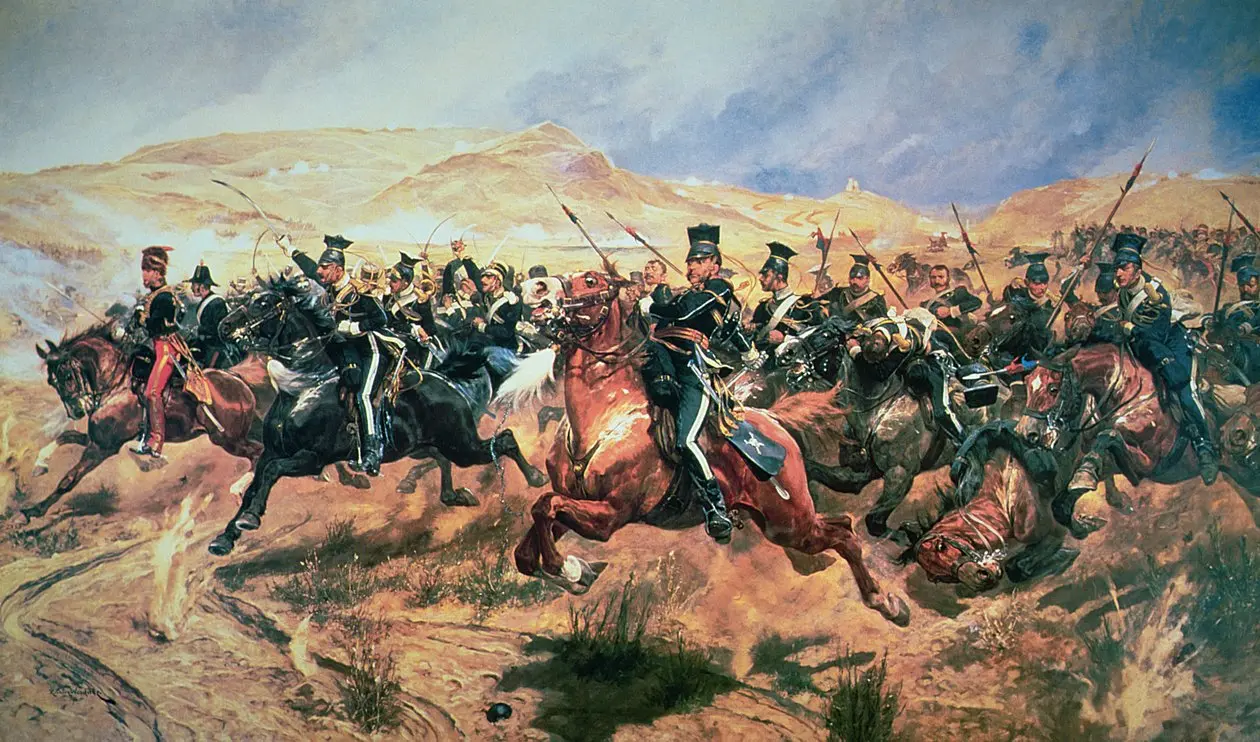
They were the Light Brigade, the pride of Britain's cavalry: hussars and lancers in plumed caps, led by James Brudenell, the 7th Earl of Cardigan, a peacock of a man who bought his command and despised his own superior officer. Below them lay a mile-long valley near the port of Balaclava. At its far end waited a Russian artillery battery. On the hills to the left and right waited more Russian guns and riflemen. Straight ahead waited death — and the order was to ride straight ahead.
The morning had begun with a Russian attack on Balaclava, the little harbor town through which the British army got all its supplies. The Russians had overrun Turkish-held redoubts on the Causeway Heights and were dragging captured British guns away. From his vantage point on the heights, the British commander-in-chief, Lord Raglan, could see what his cavalry commander, Lord Lucan, could not: the retreating Russians and the guns they were hauling off. Raglan scribbled an order — "advance rapidly to the front... and try to prevent the enemy carrying away the guns" — and handed it to a dashing young aide, Captain Louis Nolan.
Nolan galloped down to Lucan and delivered the order with a few impatient words and a sweeping gesture. Lucan, sitting in the valley with no view of the heights, could see only one set of guns: the Russian battery at the far end of the valley, bristling with artillery. "Attack, sir?" he asked. "Attack what? What guns, sir?" Nolan reportedly waved his hand vaguely and said, "There, my lord, is your enemy! There are your guns!"
Lucan turned to Cardigan and ordered the Light Brigade forward. Cardigan, who could see exactly what lay ahead, pointed out the battery, the guns on both flanks, the riflemen. Lucan's answer sealed their fate: "I know it. But Lord Raglan will have it. We have no choice but to obey."
What followed lasted about twenty minutes and became the most famous cavalry charge in history. The brigade rode down the valley at a trot, then a gallop, while Russian artillery on three sides tore through the ranks. Nolan, riding ahead of the line, was killed in the first minute — his body rode on through the ranks, a horrifying omen. Somehow the survivors reached the Russian battery at the valley's end and scattered the gunners with their sabers. Then they found Russian cavalry waiting behind the guns, and had to fight their way back through the same gauntlet, past guns that had been re-manned behind them.
French cavalry — the Chasseurs d'Afrique — charged the Russian guns on one flank to cover the retreat. When the remnants of the brigade finally stumbled back to British lines, the losses were staggering: about 110 men killed and some 160 wounded out of roughly 670 who rode out, and 475 horses dead or destroyed. It had achieved nothing militarily. The guns the charge was supposed to save were never retaken.
But Britain fell in love with the men who rode it. The Times correspondent William Howard Russell, who watched the whole disaster from the heights, sent home a dispatch that made the nation weep. Six weeks later, Poet Laureate Alfred, Lord Tennyson turned Russell's account into verse — "The Charge of the Light Brigade" — with its immortal refrain about the six hundred: "Theirs not to reason why, / Theirs but to do and die." A French general watching the charge is said to have murmured, "C'est magnifique, mais ce n'est pas la guerre: c'est de la folie." It is magnificent, but it is not war: it is madness.
The charge became a permanent lesson in two things at once: the extraordinary courage of ordinary soldiers, and the catastrophe that follows when orders are vague and pride stands in for communication. Armies still study Balaclava. So do managers, pilots, and surgeons — anyone whose work depends on a message being understood exactly as it was meant.
Image: "Charge of the Light Brigade, Balaclava, 25 October 1854," painted by Richard Caton Woodville Jr. in 1894, public domain (via Wikimedia Commons).