
From A to Ant: The Day the Great Dictionary Began
On February 1, 1884, the first installment of the Oxford English Dictionary rolled off the press — 352 pages covering every word from "a" to "ant."
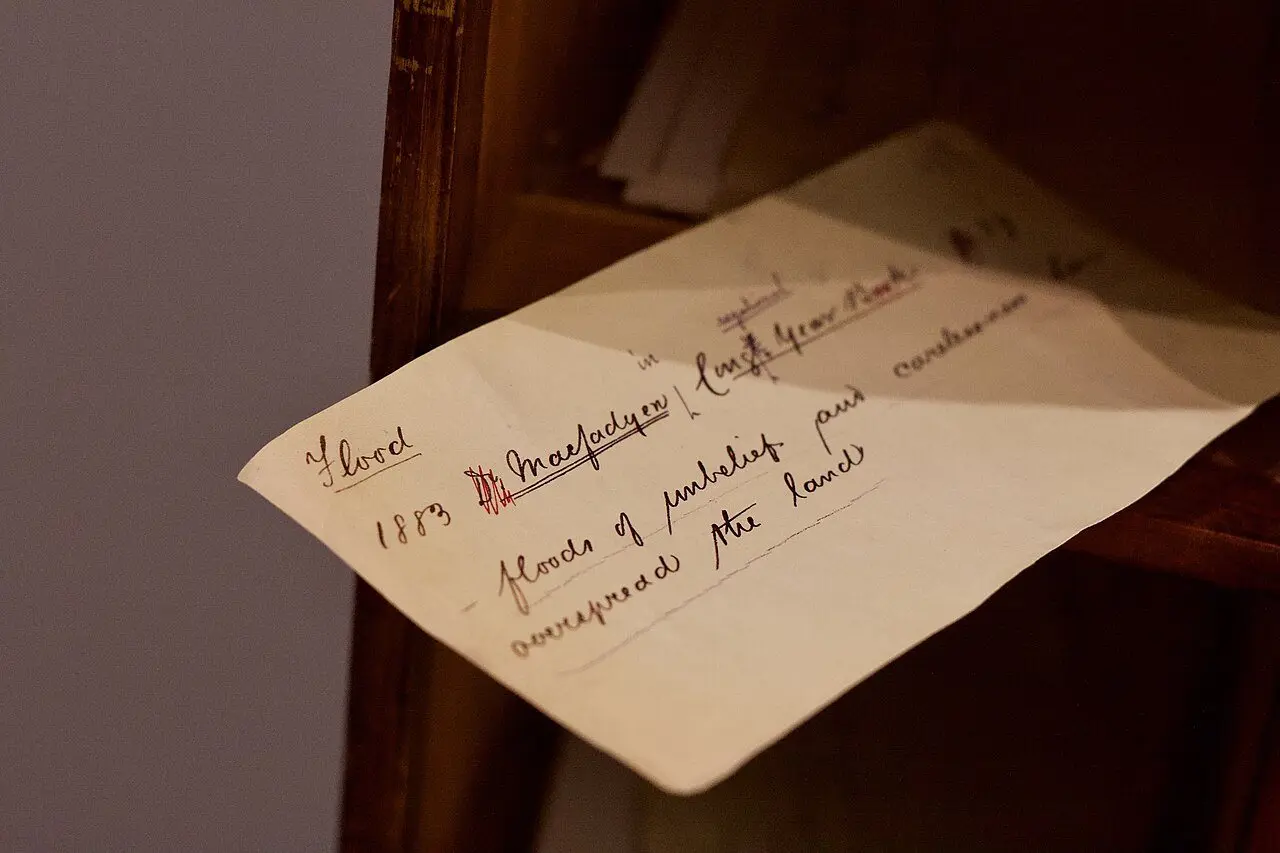
Imagine writing a dictionary of every word in the English language — every meaning, every spelling, every quotation showing how each word has been used since the days of the Anglo-Saxons. Now imagine doing it before computers, with nothing but paper, ink, and an army of volunteers.
That was the task James Murray took on, and on February 1, 1884, the world got its first glimpse of the result: the first installment of what would become the Oxford English Dictionary, a 352-page volume that covered the entire language all the way from "a" to — wait for it — "ant."
The idea had been brewing for decades. In 1857, members of London's Philological Society decided that every dictionary on the market was, to put it politely, inadequate. They wanted something worthy of the English language: a dictionary built on historical principles, tracing each word through centuries of literature. It took another twenty-two years of planning before the Oxford University Press agreed to publish the monster. In 1879 the Press appointed Murray, a Scottish schoolmaster with an extraordinary gift for languages — he would eventually become competent in some twenty-five of them — as editor.
Murray's plan was wildly ambitious: four volumes, about 6,400 pages, done in ten years. He built a corrugated-iron shed in his garden at Mill Hill, nicknamed the Scriptorium, and filled it with pigeonholes for paper slips. His grand scheme depended on ordinary readers. He appealed through newspapers and bookshops, asking volunteers to report "as many quotations as you can for ordinary words," plus words that were "rare, obsolete, old-fashioned, new, peculiar or used in a peculiar way." The response was extraordinary: a thousand slips a day arrived by post, and by 1880 Murray's team was sorting two and a half million of them — each one a word, a quotation, and a source, filed by hand.
Among the most prolific volunteers was William Chester Minor, an American surgeon confined to an asylum at Broadmoor, who sent in thousands of meticulously researched slips. The dictionary was, in effect, the first great crowdsourced project in history — decades before anyone coined the word.
By February 1884, five years into the work, Murray had only reached "ant." Rather than wait, the Press published what was done: the first fascicle — "fascicle" being a fancy word for installment — of A New English Dictionary on Historical Principles. It sold 4,000 copies at twelve shillings and sixpence apiece.
What was supposed to take ten years took forty-four. Murray resisted hiring help until the Press forced the issue; editors came and went. The 125th and final fascicle appeared in April 1928, completing ten volumes with more than 400,000 entries. Murray never saw the end — he died in 1915, thirteen years before his life's work was finished. It would not even be formally called the Oxford English Dictionary until 1933.
But here is why it matters. Before the OED, dictionaries were opinionated little books where one person's taste decided what counted. Murray's dictionary made English a democracy: every word, from the noblest poetry to slang overheard in a tavern, earned its place through evidence — real quotations from real books. Every time you look up a word today, you are standing on the shoulders of James Murray and his millions of paper slips.
And it all started on February 1, 1884 — with a book that couldn't get past "ant."
Photo: Daphne Preston-Kendal, CC BY-SA 4.0 (via Wikimedia Commons).