Custer's Last Stand: The Battle of the Little Bighorn
On June 25, 1876, Lakota, Northern Cheyenne, and Arapaho warriors annihilated Custer's 7th Cavalry on the Little Bighorn River — the greatest Native American victory of the Plains Indian Wars.
On the very weekend Americans were lighting fireworks for the nation's 100th birthday, shocking news was traveling east from the Montana Territory: an entire command of U.S. cavalry had been wiped out.
The roots of the disaster went back to the discovery of gold in the Black Hills in 1874. Prospectors poured into lands the 1868 Treaty of Fort Laramie had reserved for the Lakota, and the U.S. government made little effort to stop them. When the Lakota and Northern Cheyenne refused to return to their reservations, the Army launched a three-column campaign in the summer of 1876 to force them back.
Lieutenant Colonel George Armstrong Custer, commanding the 7th Cavalry, was ordered to scout ahead. On the morning of June 25, his scouts found an enormous village of thousands of people stretched along the Little Bighorn River. Rather than wait for the other columns, Custer split his regiment into detachments and attacked, fearing the village would scatter and escape.
It was a catastrophic misjudgment. Major Marcus Reno's detachment attacked first and was driven back in chaos. Then warriors led by Crazy Horse and inspired by Sitting Bull — who had rallied the camp and seen to the safety of the women and children — counterattacked in overwhelming numbers. Custer's five companies were surrounded on the ridges above the river. Within about an hour, Custer and every man with him were dead.
The toll was staggering: about 268 soldiers, scouts, and civilians were killed and dozens more wounded — the worst U.S. Army defeat of the Plains Indian Wars. Native losses, harder to count, are estimated by historians at anywhere from a few dozen to around a hundred killed. To the Lakota, the fight is known as the Battle of the Greasy Grass.
Custer had divided his regiment, and the other detachments fought their own desperate battle a few miles away. Major Reno's charge collapsed into a chaotic retreat across the river, and his men — joined by Captain Frederick Benteen's companies — dug in on the bluffs, where they were besieged through June 26. They survived only because General Terry's column arrived the next morning. Custer's battalion, fighting alone on the ridges, had no such rescue.
The village Custer attacked was one of the largest Native gatherings ever assembled on the Plains: an estimated 7,000 to 10,000 people, with perhaps 1,500 to 2,000 warriors. Word of the catastrophe reached the East just as Americans were celebrating the centennial of independence — the irony was not lost on anyone. A nation toasting 100 years of freedom was simultaneously waging war to take the freedom of the continent's first peoples.
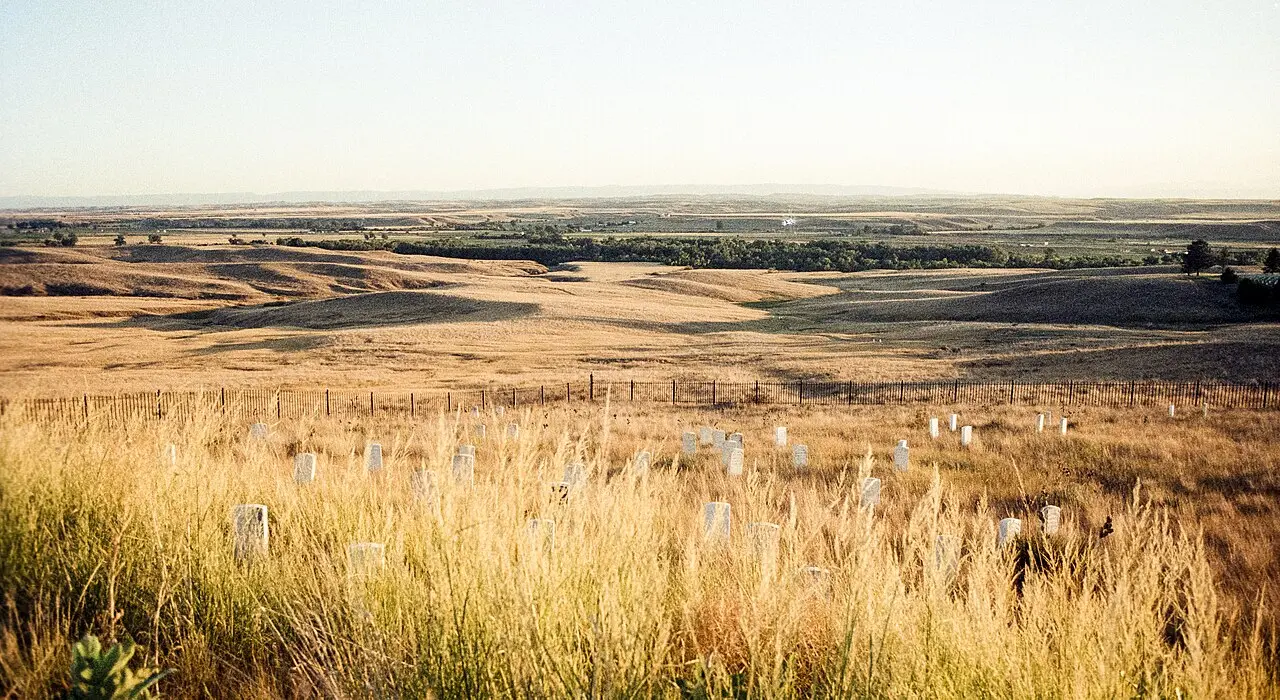
The victory was the greatest the Plains tribes ever won — and it doomed them. Outrage across the country brought a flood of troops west, and within five years nearly all of the Lakota Sioux and Northern Cheyenne were confined to reservations. Today the Little Bighorn Battlefield National Monument in Montana honors the dead on both sides, its white markers scattered across the grass where the fighting raged.
Photo: Acroterion, CC BY 4.0 (via Wikimedia Commons).