Culloden: The Hour That Ended the Jacobite Dream
On April 16, 1746, the Jacobite army of Bonnie Prince Charlie was crushed at Culloden Moor in under an hour — the last pitched battle ever fought on British soil.
The mist was still on the moor when the cannon opened fire.
On the morning of April 16, 1746, some 5,000 Jacobite soldiers stood on Culloden Moor, six miles east of Inverness in the Scottish Highlands, facing a British government army nearly twice their size. They were cold, hungry, and exhausted — the night before, they had marched out in the dark hoping to surprise the government camp while its soldiers celebrated their commander's 25th birthday, only to turn back, stumbling and starving, before dawn. Now they had to stand and fight.
Their leader was Charles Edward Stuart — "Bonnie Prince Charlie," the Young Pretender — grandson of the deposed Catholic king James II. Nine months earlier he had landed in Scotland determined to reclaim the British throne for the House of Stuart. He had taken Edinburgh, smashed a government army at Prestonpans, and marched his men as far south as Derby, within striking distance of London. Then the invasion stalled, the English recruits he expected never came, and his army retreated north into the Highlands, supplies running out and winter closing in.
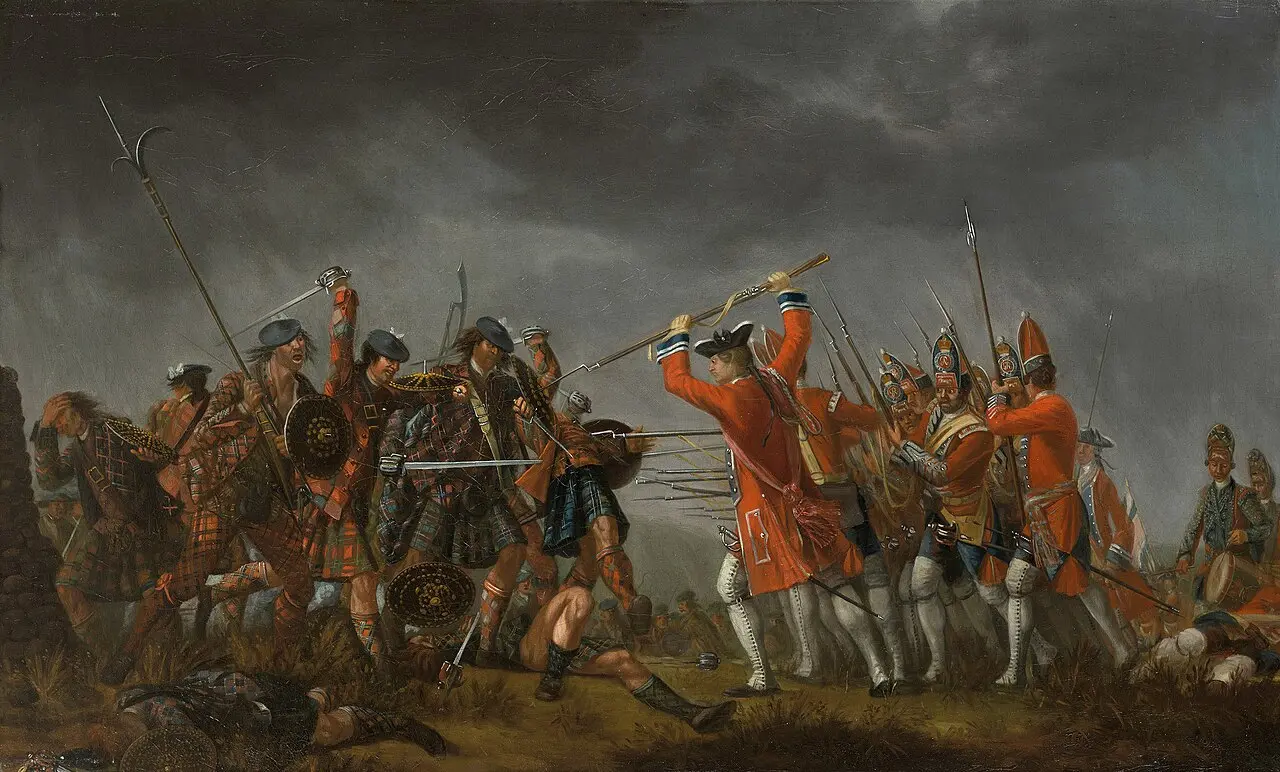
Across the moor stood the Duke of Cumberland, the 25-year-old younger son of King George II — the birthday boy. His redcoats were rested, well-fed, and superbly drilled. Cumberland had trained his infantry specifically to defeat the Highland charge, the terrifying headlong rush with broadsword and targe that had won the Jacobites their earlier victories. His order was cold and precise: instead of bayoneting the Highlander directly in front, each soldier was to thrust at the exposed side of the man to his right.
The Jacobites waited through a punishing artillery barrage — round shot skipping across the boggy ground like stones across water, tearing through the clan ranks. Then Charles gave the order his men had been begging for, and the Highland line surged forward.
Some of them reached the government lines. For a few desperate minutes there was brutal hand-to-hand fighting. But Cumberland's new bayonet drill worked exactly as designed, and the redcoat volleys never stopped. In less than an hour — most accounts say about forty minutes — the Jacobite army broke and fled.
The butcher's bill was lopsided beyond belief: roughly 1,500 to 2,000 Jacobites killed or wounded, with 376 taken prisoner, against about 50 government dead and some 260 wounded. And the killing did not stop when the battle ended. Government troops hunted the fugitives across the moor and through the glens in the weeks that followed, and Cumberland's ruthlessness earned him a name that still echoes in Scotland: "the Butcher."
Charles himself got away — sheltered, famously, by Flora MacDonald, who smuggled him to the Isle of Skye disguised as her maid — and after five months as a fugitive he escaped to France, never to return. The rising was over.
Culloden was the last pitched battle ever fought on British soil, and it ended Jacobitism as a political force forever. In its wake, the British government moved to crush Highland culture itself: the clan system was dismantled, and the old Gaelic world faded into memory and song. Yet the defeat became a legend — of doomed courage, lost causes, and a prince who sailed away over the sea to Skye — and the misty moor outside Inverness remains one of the most visited battlefields in Britain.
Photo: David Morier, public domain (via Wikimedia Commons).