
Apollo 16: The Moon Mission That Almost Wasn't
On April 16, 1972, Apollo 16 blasted off for the Moon — and a mid-flight malfunction nearly turned it back before it landed.
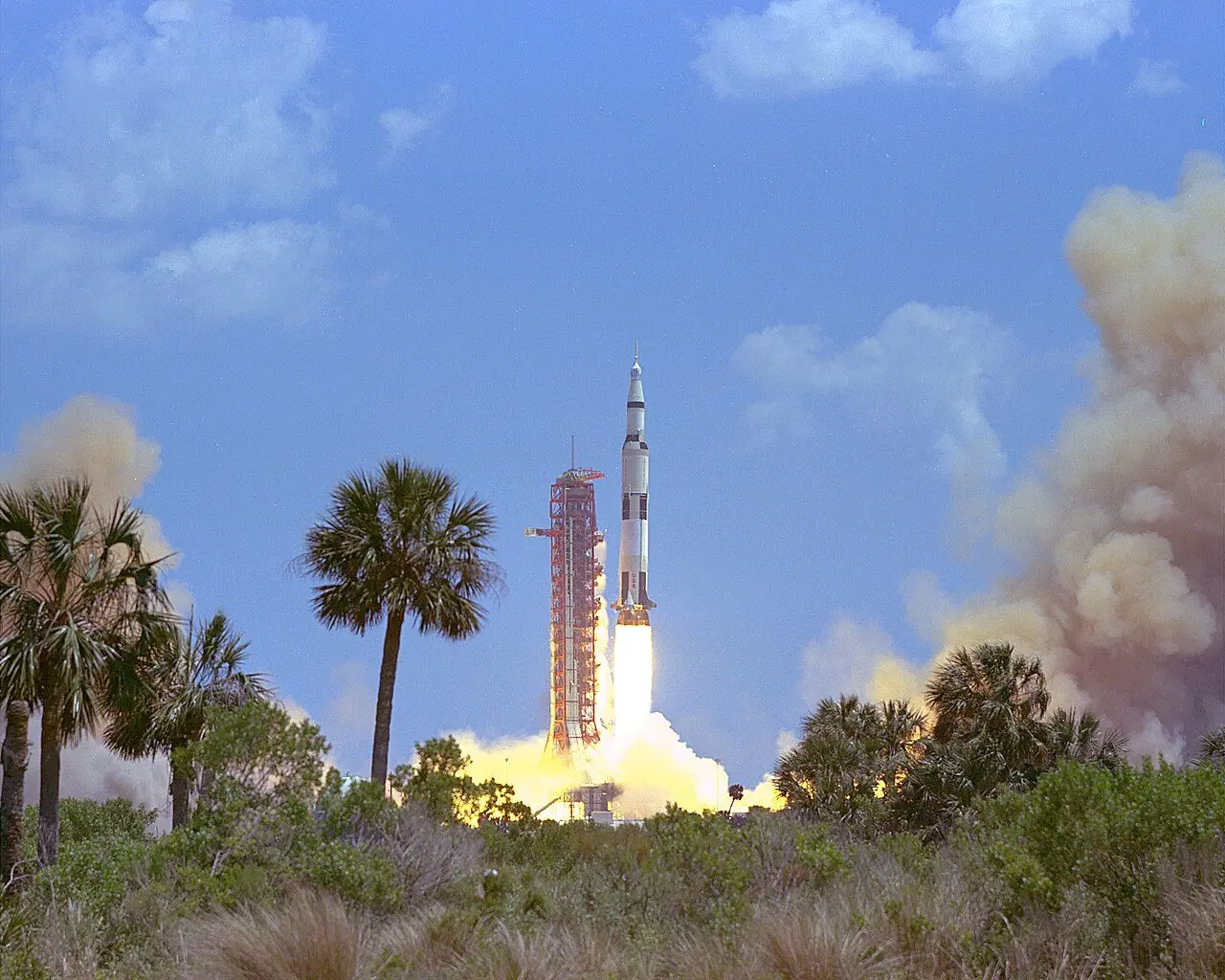
At 12:54 on a sunny Florida afternoon, three men sat strapped into a capsule atop a 363-foot tower of explosives, and the countdown reached zero. The Saturn V carrying Apollo 16 cleared the tower at Launch Complex 39A, and the fifth American mission to land on the Moon was on its way.
It had been a long road to the pad. Apollo 16 was supposed to fly on March 17, but NASA pushed the launch back nearly a month after engineers found problems with a spacesuit fitting, a lunar module battery, and the mechanism that would jettison the command module's docking ring. When the day finally came, April 16, 1972, everything went right. The countdown ran clean, the weather was fair, and thousands of spectators lined the beaches near the Kennedy Space Center to watch. In the capsule were Commander John W. Young, Command Module Pilot Thomas K. "Ken" Mattingly, and Lunar Module Pilot Charles M. Duke.
Their destination was the Descartes Highlands, a rugged, ancient region of the Moon chosen precisely because it was old. Three of the four previous landings had set down in or near the dark lunar maria, the vast plains. Scientists wanted rocks from the bright highlands, material dating to the Moon's earliest days, to test a bold hypothesis: that formations like Descartes and nearby Cayley were volcanic in origin.
The trip out was almost ruined before it began. After the crew separated their spacecraft from the spent third stage and docked with the lunar module — a maneuver Mattingly executed flawlessly — Duke noticed something alarming. Mattingly's job was to fire the service module's big engine to circularize their orbit, but when he powered up the engine's steering system, the whole spacecraft shuddered, "as if heading down a rough railroad track." The backup steering system was oscillating wildly. In Mission Control, engineers faced a brutal question: if the main engine couldn't be trusted to steer, there would be no landing — only an embarrassing early trip home.
For hours, Young and Duke waited in the lander while the ground ran the numbers. Finally, the verdict: the oscillation wouldn't seriously affect steering. The landing was on.
Late on April 20, the lunar module Orion touched down in the Descartes Highlands, about 276 meters from its target. Over the next three days, Young and Duke made three moonwalks totaling 20 hours and 14 minutes — driving their lunar rover across the highlands, deploying experiments, and gathering rocks. Not everything went smoothly: at one point Young tripped over the cable for the heat-flow experiment and snapped it, killing the instrument. But the science haul was enormous, and the rocks they brought home told a clear story: the Descartes and Cayley formations were not volcanic at all. A leading theory about the Moon's history was dead — and that, to a geologist, is a triumph.
On April 27, the crew splashed down safely in the Pacific, closing out an 11-day mission. Apollo 16 was the tenth crewed flight of the Apollo program and the next-to-last time humans would walk on the Moon. It is remembered as the mission that almost turned back — and proved that in spaceflight, careful engineering on the ground can save a mission in the sky.
Photo: NASA, public domain (via Wikimedia Commons).