Astronaut Bruce McCandless Becomes the First Human Satellite
On February 7, 1984, astronaut Bruce McCandless II made the first untethered spacewalk, flying free from the space shuttle Challenger.
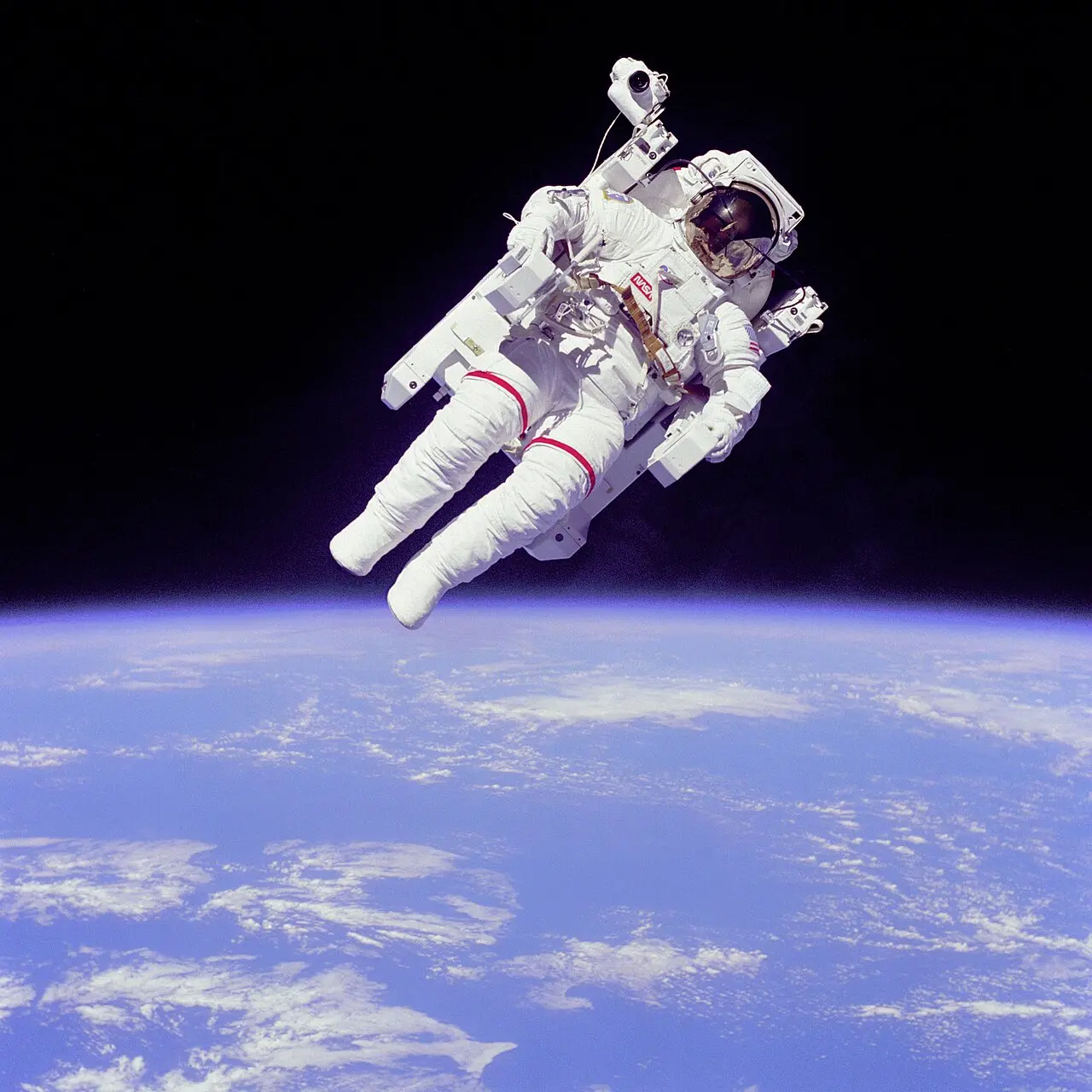
Two hundred and fifty miles above the Earth, a man in a white spacesuit let go of his spaceship — and kept going. No tether. No umbilical cord. No safety line of any kind. Just a backpack, his nerve, and the blue planet turning slowly beneath him.
The man was NASA astronaut Bruce McCandless II, and the morning was February 7, 1984. Four days earlier he had ridden the space shuttle Challenger into orbit on mission STS-41-B. Now, at 8:25 a.m. Eastern time, he pulsed the thrusters of the Manned Maneuvering Unit — a nitrogen-gas-powered backpack he had helped design — and drifted out of Challenger's payload bay.
The MMU was serious machinery: twenty-four thrusters fed by compressed nitrogen, steered by fingertip hand controllers at the ends of two arms. McCandless, selected as an astronaut in 1966, had served as the voice of Mission Control during Neil Armstrong and Buzz Aldrin's moonwalk on Apollo 11, and he had spent years helping develop the maneuvering unit. Now he eased himself away from the orbiter until he was some 320 feet — about 98 meters — from the nearest human-made object, circling the planet at 17,500 miles per hour yet perfectly still beside his ship.
For eighty-two minutes he was a satellite made of flesh and blood: the first human being ever to fly untethered in space. His crewmate Robert "Hoot" Gibson, Challenger's pilot, photographed him with a Hasselblad camera, and one of those frames — a lone astronaut floating against the black of space above a curve of blue Earth — became one of the most famous photographs of the space age.
"It may have been one small step for Neil," McCandless radioed, nodding to Armstrong, "but it's a heck of a big leap for me," as NASA's anniversary account of the flight quotes him. He later said he had been "grossly over-trained" and felt completely comfortable out there — though it got so cold his teeth chattered.
The flight proved that astronauts could maneuver freely outside a spacecraft, a capability NASA had wanted since a 1966 test of a similar rocket pack was canceled. Fellow astronaut Robert Stewart took his own untethered turn the same day. But the MMU's career was short: after the loss of Challenger in 1986, NASA judged the free-flying backpack too risky, and the untethered spacewalk became a wonder of a single era.
McCandless received the National Air and Space Museum Trophy in 1985, and the very MMU he flew now hangs in the Smithsonian's Udvar-Hazy Center in Virginia — a reminder of the morning a man stepped off his spaceship and trusted physics, engineering, and his own steady hands to bring him home.
Photo: NASA, public domain (via Wikimedia Commons)