A New Resident on Mars: InSight Lands, 2018
On November 26, 2018, NASA's InSight lander touched down on Mars to take the planet's pulse — listening for marsquakes and probing its hidden interior.
On May 5, 2018, an Atlas V rocket lifted off from Vandenberg Air Force Base in California carrying a passenger bound for another world: NASA's InSight lander, short for Interior Exploration using Seismic Investigations, Geodesy and Heat Transport. After a nearly seven-month, 300-million-mile cruise through space, the spacecraft arrived at Mars on November 26, 2018, aimed at a flat, smooth plain near the planet's equator called Elysium Planitia.
Landing on Mars is famously unforgiving, and InSight had to do it alone — the radio signal took more than eight minutes to reach Earth, so by the time mission control heard anything, the landing was already over. At NASA's Jet Propulsion Laboratory in Pasadena, engineers could only watch the telemetry arrive. Then, at 11:52 a.m. Pacific time, the confirmation came through: touchdown. It was the eighth time NASA had successfully landed a spacecraft on Mars. The landing signal had been relayed by two tiny hitchhikers, MarCO-A and MarCO-B — the first CubeSats ever sent into deep space, flying past Mars just to listen in.
Minutes later, InSight sent home its first photograph: a dusty, alien horizon, with one of the lander's own feet in the frame. "It's nice and dirty; I like that," said the mission's principal investigator, Bruce Banerdt, studying the dust already coating the camera lens. Within hours InSight unfurled its two round solar panels and settled in for a planned two-year stay. "We have an incredibly safe and boring-looking landing plain," said project manager Tom Hoffman. "That's exactly what we were going for."
InSight was not a rover — it was built to stay put and listen. Its French-built seismometer, SEIS, was designed to feel marsquakes rippling through the planet's interior; another experiment tracked the planet's wobble to measure the size of its core; and a German-built "mole" was supposed to hammer itself deep underground to take the planet's temperature. The mole struggled — the Martian soil at the site proved unexpectedly hard — but the seismometer succeeded beyond hopes, giving scientists their first real look inside another rocky world and revealing how planets like Earth and Mars are put together.
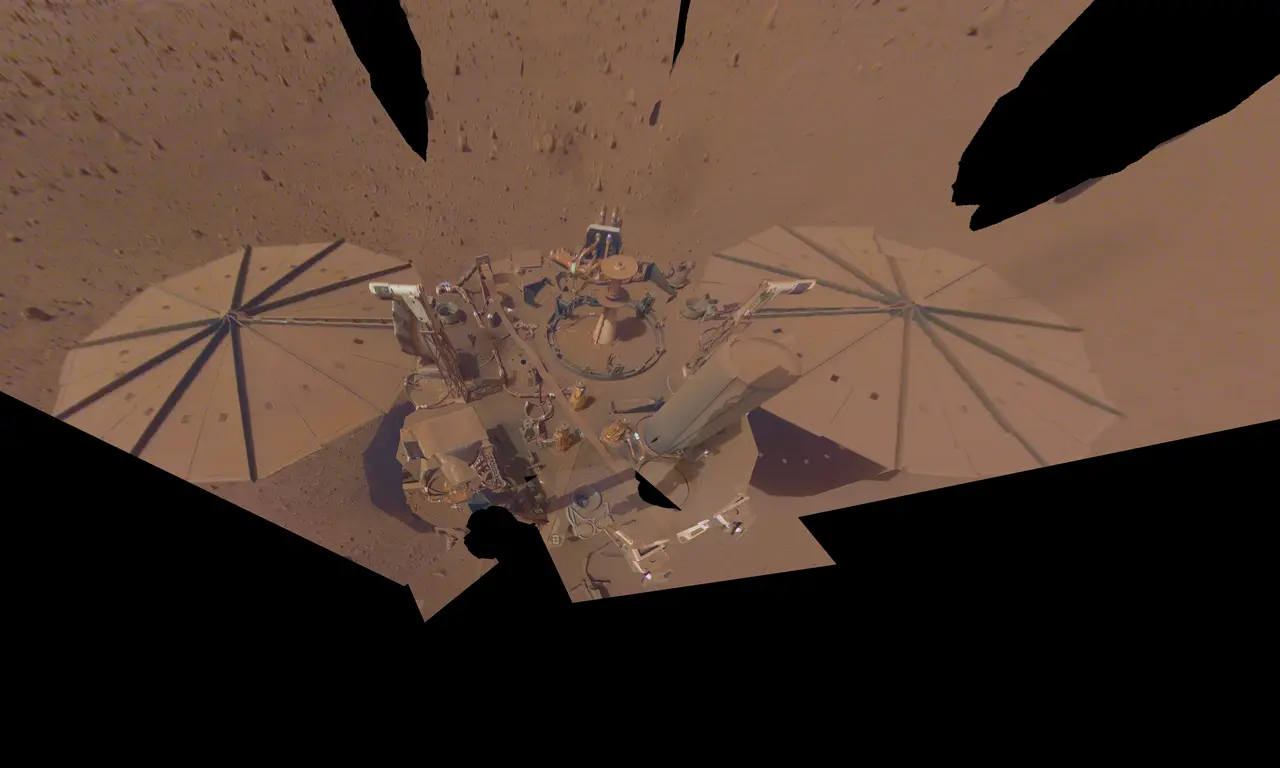
The mission was extended again and again, lasting four years instead of two, until dust slowly choked the solar panels and the lander fell silent in December 2022. For four years, a stationary robot the size of a small car sat on a plain of ancient lava, taking the pulse of an entire planet.
Photo: NASA/JPL-Caltech, public domain (via Wikimedia Commons).