A League to End All Wars
On January 10, 1920, the Treaty of Versailles took effect and with it the League of Nations — humanity's first attempt at a world organization dedicated to keeping the peace.
The ink on the Treaty of Versailles had barely dried when the world tried something it had never tried before. On January 10, 1920, the treaty formally took effect — and with it came Part I of the treaty, the Covenant of the League of Nations. For the first time in history, the nations of the world had a standing organization whose stated purpose was to prevent war.
The idea had been the centerpiece of American President Woodrow Wilson's vision for the peace. The last of his Fourteen Points called for a general association of nations to guarantee political independence and territorial integrity to all states, great and small. Forty-two nations signed on as founding members. Six days later, on January 16, the League's council held its first meeting, and the new organization set up its headquarters in Geneva, Switzerland — first in the Palais Wilson, later in the purpose-built Palace of Nations.
Its ambitions were enormous: disarmament, collective security, the settlement of disputes through negotiation rather than force, and the improvement of global welfare. In its early years it scored real victories, defusing border disputes and taking on humanitarian work from refugee resettlement to the fight against opium and slavery. Its first Secretary-General, Britain's Sir Eric Drummond, built an international civil service from scratch — a genuine world bureaucracy.
But the League was born with a hole at its heart: the country whose president had conceived it never joined. The United States Senate refused to ratify the Treaty of Versailles, and the League went forward without American power behind it. In the 1930s its authority crumbled — Japan's invasion of Manchuria in 1931 and Italy's attack on Abyssinia in 1935 both defied the League's orders to withdraw, and the League could do nothing to stop them. When Germany marched toward a second world war, the League was not even consulted. After December 1939 it barely met again.
On April 18, 1946, the League formally dissolved and handed its assets, its buildings and its hard-won lessons to a successor: the United Nations. The League failed at its central mission — it did not prevent the Second World War. But it proved that nations could sit at one table, argue in the open, and build institutions larger than any one country's army. The UN's charter, its agencies and its very existence are the League's second draft.
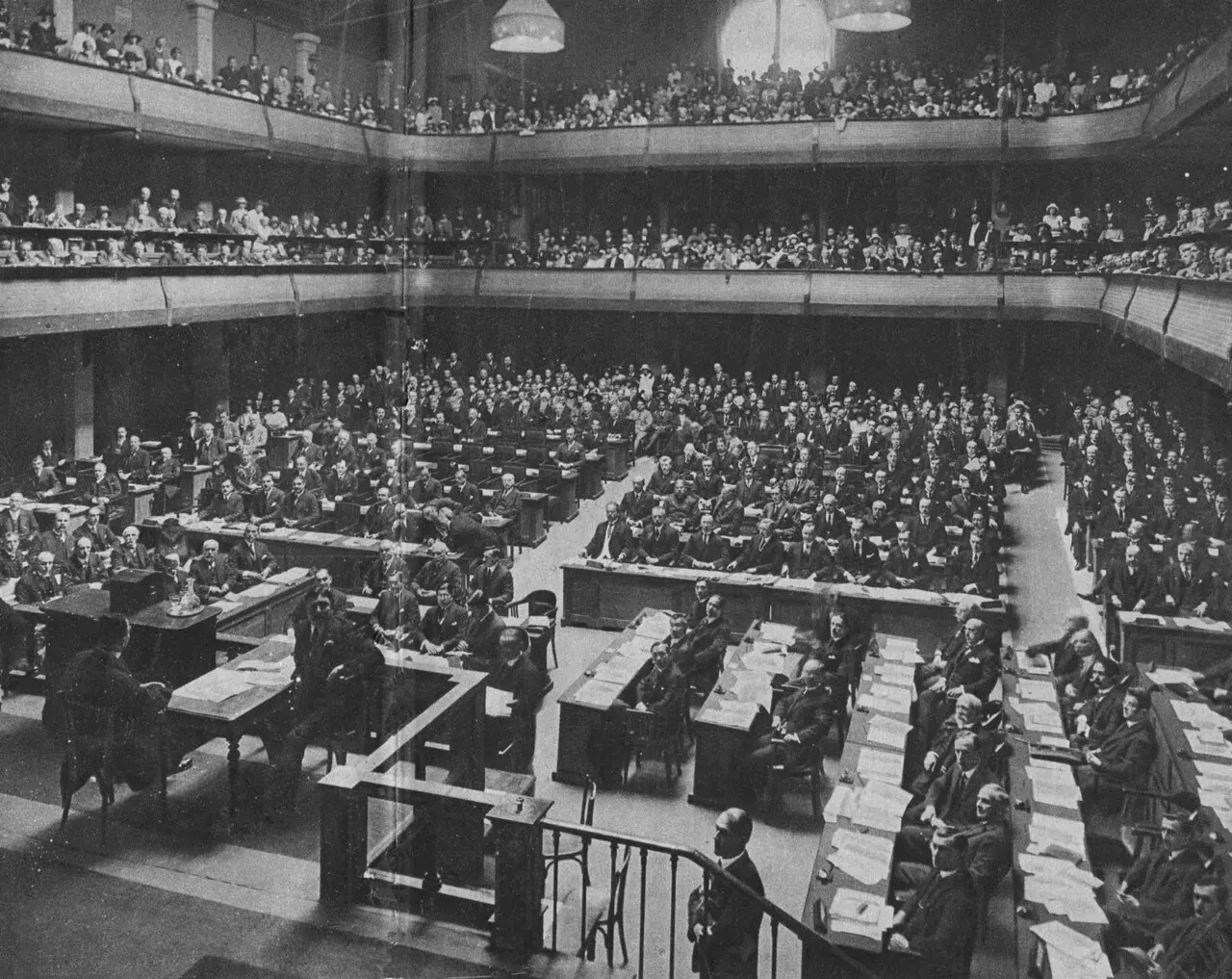
Photo: delegates gathered for a 1923 session of the League of Nations assembly in Geneva — anonymous press photograph, public domain (via Wikimedia Commons).