The Day London Went Underground
On January 10, 1863, the Metropolitan Railway opened between Paddington and Farringdon — the world's first passenger underground railway, and the ancestor of every subway on Earth.
On the morning of January 10, 1863, Londoners did something no one in human history had ever done: they walked down into a hole in the ground, climbed aboard a train, and rode beneath the streets of their own city.
The new Metropolitan Railway ran just 3.75 miles, from Bishop's Road at Paddington to Farringdon Street near the City. The trip took about 18 minutes. But nothing about it was ordinary. The carriages were wooden, divided into first, second and third class, and lit by flickering gas lamps. The locomotives burned coal and breathed steam — inside a tunnel. On the first day alone, some 38,000 passengers crowded aboard, and the company had to borrow extra trains from other railways just to keep up.
The idea had been kicking around since the 1830s, championed by Charles Pearson, a solicitor to the City of London who watched horse-drawn carts, cabs and omnibuses choke the streets and dreamed of putting the traffic underground. Parliament granted permission in 1854 at an estimated cost of £1 million, but raising the money during the Crimean War proved nearly impossible, and construction did not begin until March 1860. Critics predicted disaster: the tunnels would collapse under the weight of the streets above, buildings would shake apart, and passengers would be poisoned by engine fumes.
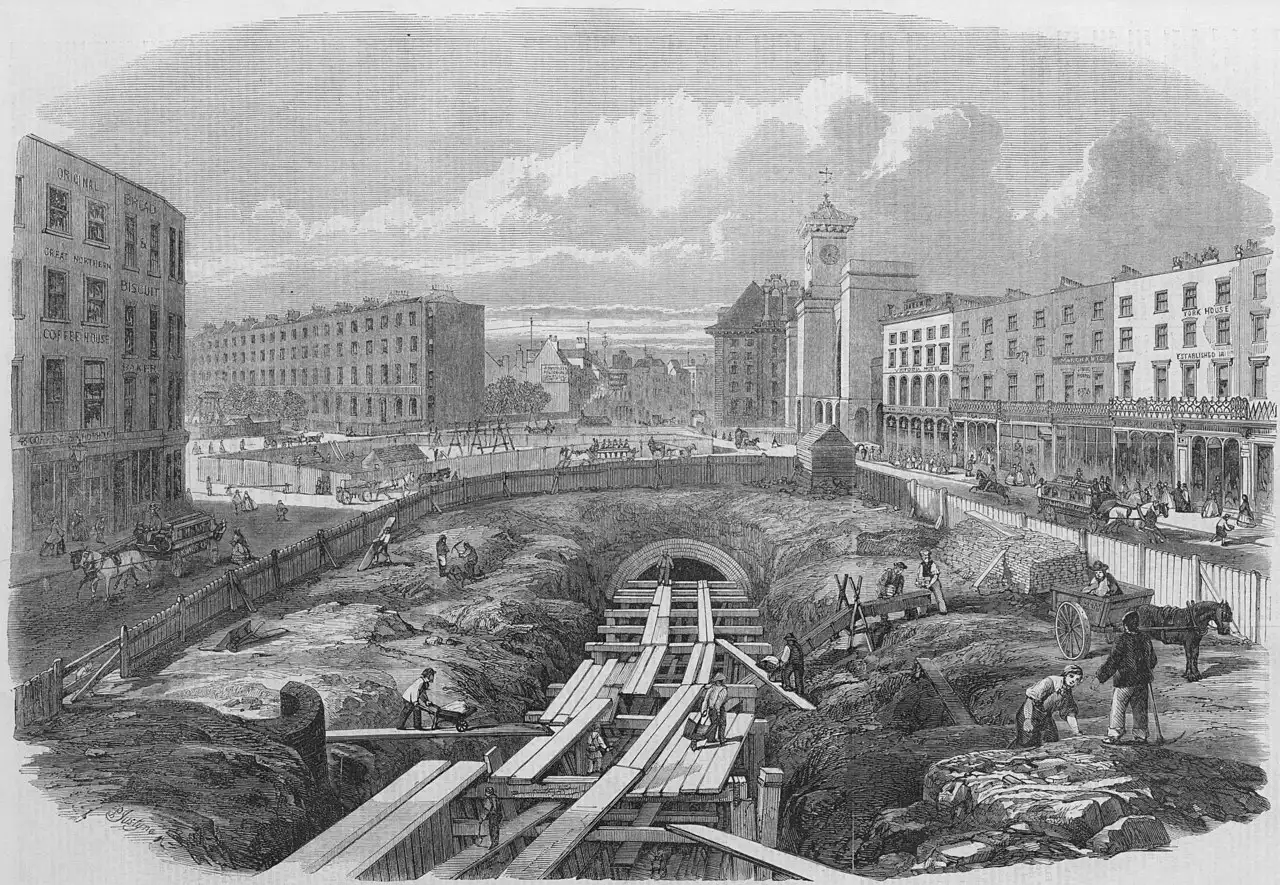
The builders, led by engineer John Fowler, answered with brute force and simplicity. Using a method called cut-and-cover, workmen dug a trench about ten metres wide and six metres deep along existing main roads, built brick walls and a brick arch inside it, then laid two metres of soil on top and rebuilt the road. London was effectively sliced open and stitched back together. Special condensing steam locomotives and regular ventilation shafts kept the smoke breathable, though tunnel air stayed notoriously smoky for decades.
It worked. In its first twelve months the railway carried 9.5 million passengers; in its second year, 12 million. A special trial trip in May 1862 had already carried William Gladstone, the Chancellor of the Exchequer, through the half-finished line. When Paris began planning its own underground in 1871, it named it the Métropolitain in imitation of the Met — and the modern word metro is the shortened echo of that tribute.
Those original tunnels are still in use today, carrying trains on London's Circle, Hammersmith & City and Metropolitan lines. Every subway system in the world — from New York to Tokyo to the newest metro rising in some booming city right now — descends from the little steam railway that opened beneath London on that cold January morning.
Photo: an 1860s engraving by artist Percy William Justyne showing the cut-and-cover construction of the Metropolitan Railway — public domain (via Wikimedia Commons).