
A Genius Is Born in Ulm, March 14, 1879
Albert Einstein was born in Ulm, Germany, on March 14, 1879 — a slow-speaking boy who would rewrite physics with a patent-office desk and four extraordinary papers.
Nothing about Albert Einstein's beginning suggested the ending. He was born on March 14, 1879, in Ulm, in the Kingdom of Württemberg, to Hermann Einstein, a salesman and engineer, and Pauline Koch. The family moved to Munich the following year. As a small boy he was so slow to talk that his parents worried something was wrong. At five, sick in bed, he was given a compass — and the invisible force turning the needle gave him, in his words, a sense that 'something deeply hidden had to be behind things.'
School did not always suit him. He clashed with the rigid teaching of his day and, after training as a teacher in Zurich, could not find an academic post. From 1902 to 1909 he worked as a patent examiner in Bern, Switzerland — a quiet desk job that left his mind free to wander. That wandering changed physics forever.
In 1905, his 'miracle year,' the 26-year-old published four papers in the journal Annalen der Physik. The first explained the photoelectric effect, proposing that light arrives in packets of energy — the idea that would win him the 1921 Nobel Prize in Physics and seed quantum theory. The second explained the jitter of particles in water, convincing skeptics that atoms are real. The third introduced special relativity, with its startling claim that the speed of light is the same for everyone. The fourth gave the world E = mc², showing that mass and energy are two forms of the same thing. A decade later, his general theory of relativity reimagined gravity as the curvature of space and time itself.
He had renounced his German citizenship as a teenager, was stateless from 1896 to 1901, and became a Swiss citizen in 1901. In 1933, with Hitler in power, Einstein left Germany for good, settled at Princeton, and became an American citizen in 1940. The chemical element einsteinium is named in his honor. A 1939 letter he signed warned President Roosevelt that atomic bombs were possible — a warning that helped launch the Manhattan Project, though Einstein later campaigned for peace and disarmament. He died on April 18, 1955, and in 1999 Time named him Person of the Century.
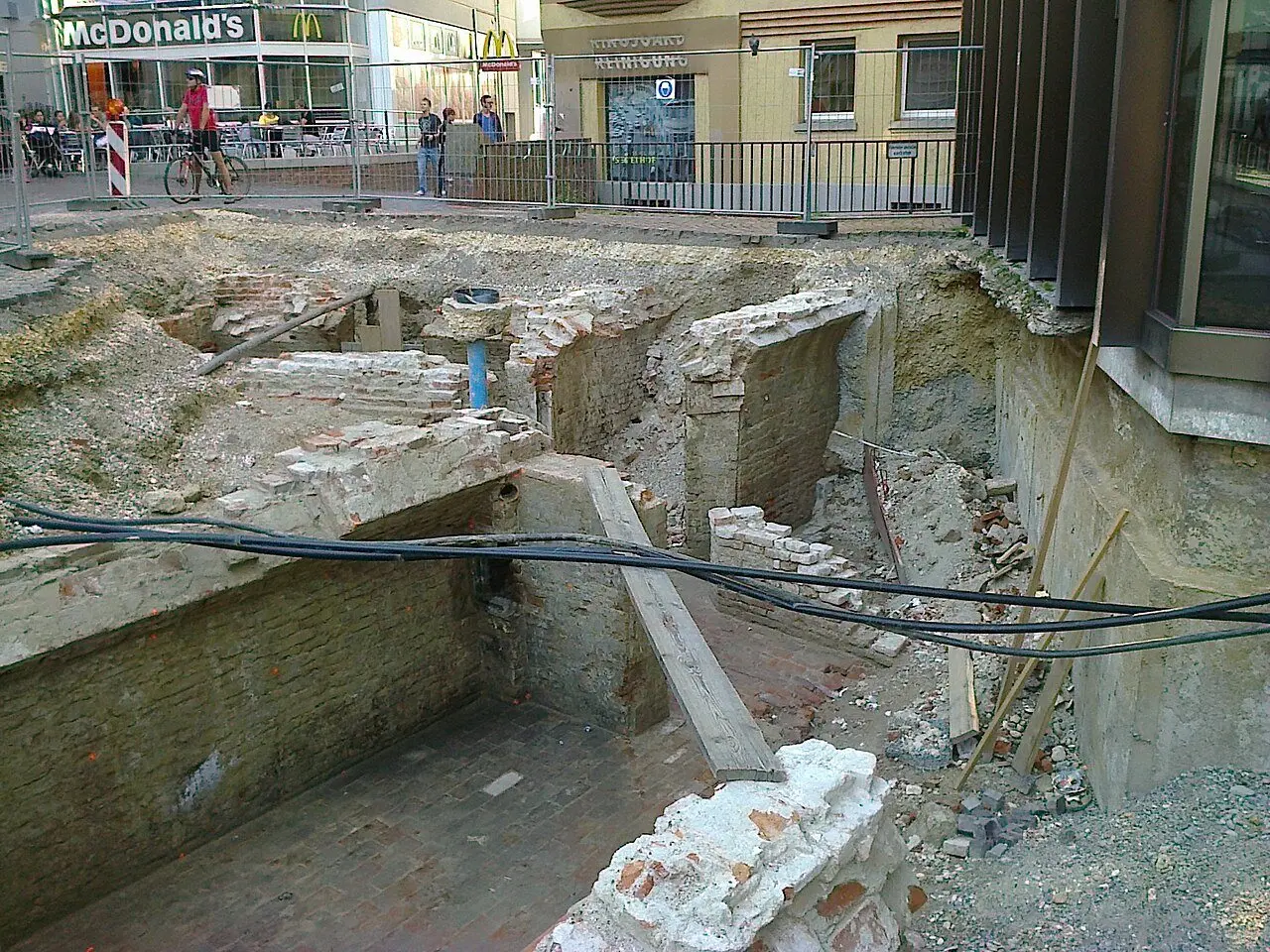
The house in Ulm where it all began was destroyed in a World War II air raid; archaeologists excavated its foundations in 2012. Genius, it turns out, does not announce itself — it grows, quietly, from a curious child and a compass.
Photo: Mirokado, CC BY-SA 3.0 (via Wikimedia Commons).