175 Days Around the World
On September 28, 1924, three battered U.S. Army biplanes landed in Seattle, completing the first flight around the world in history.
They had no radios. No parachutes. No life rafts. Their cockpits were open to the sky, and the longest legs of the journey crossed open ocean where no airplane had ever flown. On April 6, 1924, four Douglas World Cruisers lifted off from Sand Point Field in Seattle and set out to do what many called impossible: fly all the way around the Earth.
The mission belonged to the U.S. Army Air Service. Eight men — a pilot and a mechanic in each plane — flew aircraft named for four regions of the country: Seattle, Chicago, Boston, and New Orleans. The planes were modified Douglas bombers fitted with landing gear that could be swapped between wheels and floats. Weight was so tight that each crew was allowed only 300 pounds of supplies — which is why the parachutes, radios, and rafts stayed home.
To give the crews a chance, the Army spent more than a year pre-positioning fuel, spare parts, and support ships along the route, and won diplomatic clearance from every country on the path. It still nearly ended in the first month. On April 30, flying through dense Alaskan fog, the Seattle crashed into a mountainside. Pilot Major Frederick Martin and mechanic Alva Harvey survived the wreck and walked for ten days to reach civilization. Lieutenant Lowell Smith took command of the expedition.
What followed was a catalogue of endurance. The three remaining planes became the first aircraft ever to cross the Pacific, reaching Japan and pressing on through Korea, China, Southeast Asia, and India. They endured typhoons, desert heat, and constant mechanical trouble — engines were changed five times and wings fitted twice. On July 14 they landed in Paris on Bastille Day to a hero's welcome.
The Atlantic nearly finished them. On August 3 the Boston was forced down off the Faroe Islands and sank while under tow by the USS Richmond; the crew was rescued. A replacement plane, the Boston II, joined the formation at Pictou, Nova Scotia. On August 31 the three aircraft completed the Atlantic crossing at Icy Tickle, Labrador — and turned for home.
After a triumphant reception in Washington, D.C., and a victory tour across America, the Chicago, the New Orleans, and the Boston II touched down at Sand Point on September 28, 1924, before a cheering crowd of some 40,000 people. The journey had taken 175 days and covered more than 26,000 miles — some accounts put it at 27,553 — with 371 hours in the air, stops in 28 countries, and not a single life lost.
The flight proved the airplane could circle the globe. Douglas Aircraft adopted "First Around the World" as its company motto, and the achievement made the firm a giant of aviation. The Chicago now hangs in the Smithsonian's National Air and Space Museum, and the New Orleans is on display at the Museum of Flying in Santa Monica. More than a stunt, the 1924 flight turned aviation into a system — of planning, logistics, and global cooperation — and made the world a little smaller for everyone.
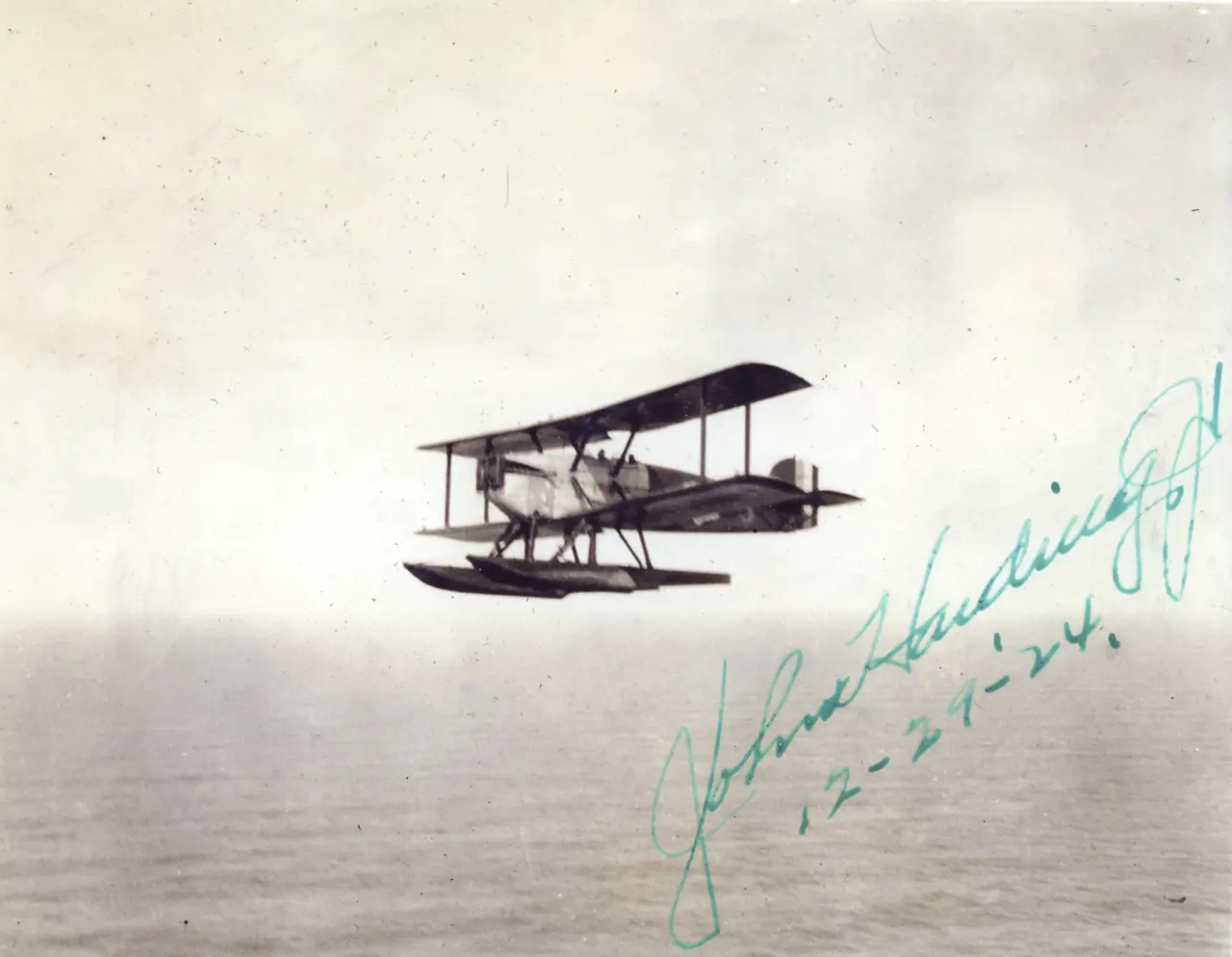
Photo: a 1924 photograph of a Douglas World Cruiser on floats in flight, signed by crew member Lt. John Harding Jr., public domain (via Wikimedia Commons).